Spanish Enneo completes 36.58 kWp rooftop PV project in Garrucha community
en.Wedoany.com Reported - Spanish engineering firm Enneo Ingeniería, based in Granada, has completed a rooftop photovoltaic retrofit for a homeowners' community in Garrucha, Almería province, and has obtained subsidies under Royal Decree 853 (RD 853). The company, which specializes in construction and sustainable energy solutions, abandoned its initial conventional design with a centralized inverter in favor of a distributed architecture based on microinverters, in order to bypass administrative hurdles in collective self-consumption projects.
Alejandro Vázquez, CEO of Enneo, told pv magazine that the traditional collective self-consumption model requires applying for a grid access point and connection, signing a distribution agreement among all homeowners, retrofitting the centralized meter box to accommodate generation meters, and completing regional administrative procedures. This process takes twelve months, causing prolonged delays in commissioning after installation and generating tension among neighbors. To avoid similar issues, the team converted the rooftop into an independent micro-generation network, with each unit corresponding to one household.
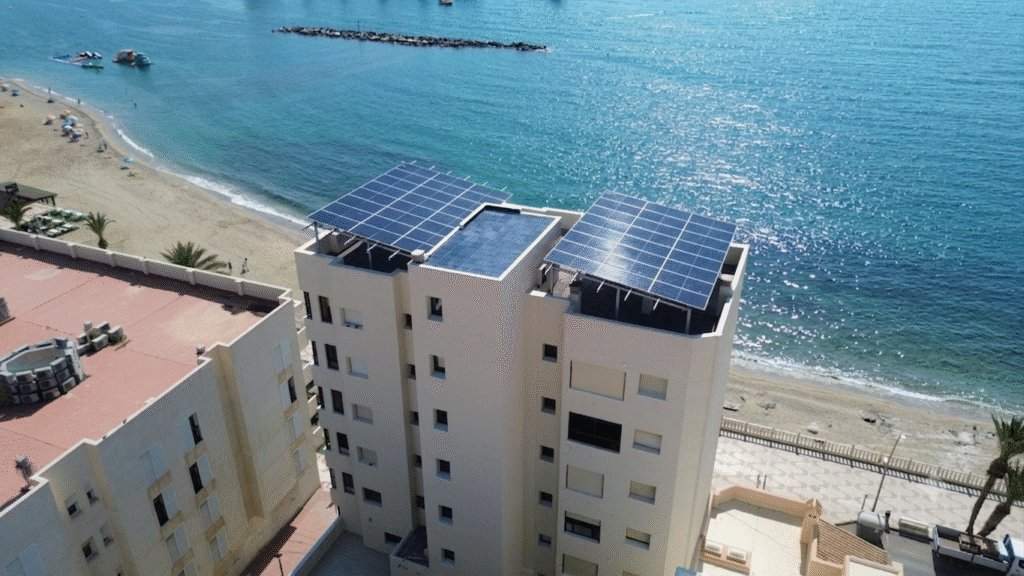
The PV system comprises 62 modules from Chinese manufacturer Tongwei, each rated at 590 W, for a total capacity of 36.58 kWp. Of these, 48 are installed on a hot-dip galvanized steel pergola, providing both power generation and terrace shading; the remaining 14 are arranged on east-west oriented aluminum mounting structures to utilize remaining space and flatten the generation curve. Vázquez stated that this combination optimizes the available area and minimizes shading losses caused by parapets, chimneys, and rooftop enclosures.
For power electronics, the system uses 27 single-phase microinverters from Chinese manufacturer Hoymiles, each rated at 1000 W, with two modules connected per inverter, corresponding to 27 households. Two additional Hoymiles three-phase microinverters, each rated at 2000 W with four modules connected, serve the common areas. According to the company, this configuration enables independent maximum power point tracking for each pair of modules, avoiding generation losses from uneven shading and ensuring balanced output among all users.
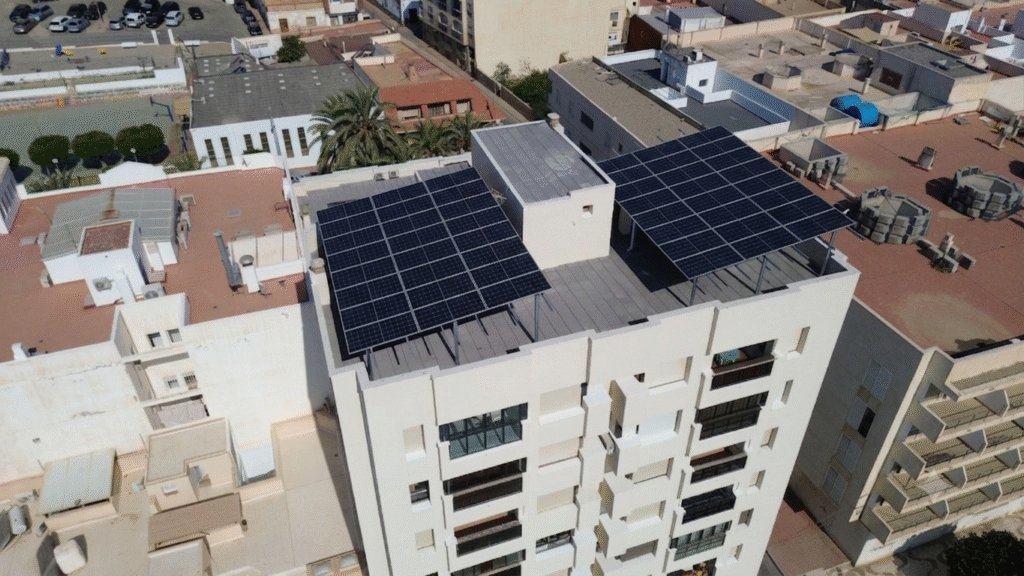
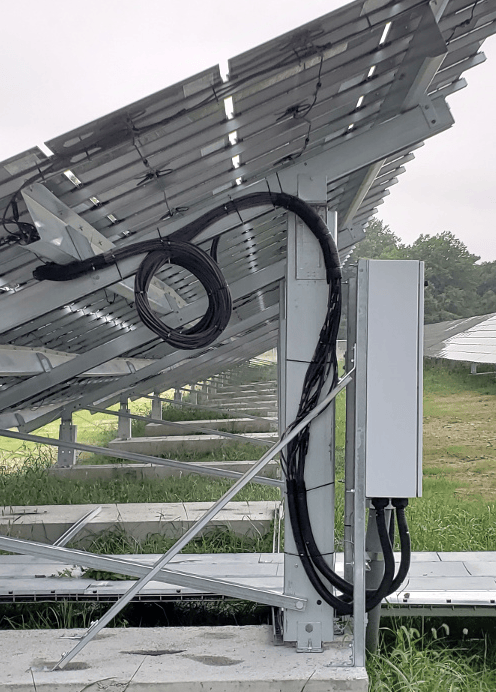
On the electrical integration side, an IP65 waterproof distribution box is installed on the rooftop, with each microinverter equipped with independent thermal-magnetic and differential protection. Cables run downward in 3×2.5 mm² sheathed wiring, partially concealed behind the SATE (external thermal insulation composite system) facade installed during the building renovation, avoiding exposed cable trays that would compromise aesthetics. The original terminal blocks in the centralized meter box were replaced with Wago dual-output terminals, allowing connection of household circuits and microinverter circuits without adding generation metering modules; an additional operating box with an isolating switch was installed in the meter room for maintenance purposes.
Vázquez emphasized that the microinverter solution also addresses the issue of fair distribution of generation. In collective installations with mixed orientations and variable shading, the more affected sections would harm the interests of corresponding users; by physically assigning modules to each meter, discrepancies are eliminated, enabling proportional and transparent generation. Economically, this solution eliminates the costs of centralized meter box retrofitting and metering point procedures, with estimated savings exceeding €4,500, and the system generates power immediately upon completion, avoiding the opportunity cost of a one-year delay caused by legalization of collective self-consumption.
The engineering firm noted that the system's modular design facilitates future integration of new users. Households that did not initially participate can later add modules and microinverters without affecting existing generation—a flexibility that is particularly important for highly seasonal communities or those with owners who are absent year-round. Vázquez concluded that the Calle Velarde project demonstrates that microinverters can simultaneously address the administrative, technical, and social challenges of collective self-consumption in residential buildings; the optimized structure, distributed electronics, and clean integration with the meter box provide a replicable model for subsidized energy retrofit projects and for communities seeking hassle-free photovoltaic solutions.
Related Products




TYC Series High-Efficiency Permanent Magnet Synchronous Motor
Xiangdian Smart Energy Technology Co., Ltd.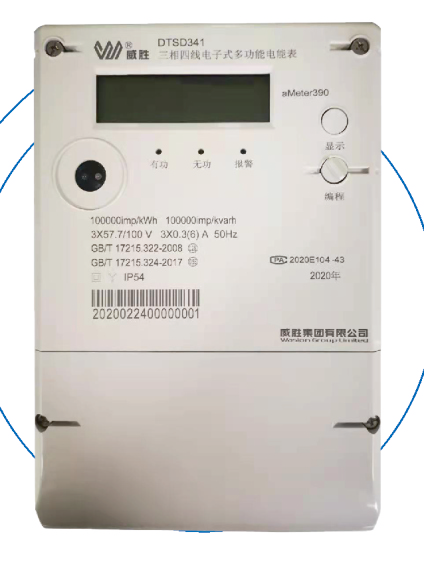
Overseas IEC Gateway Energy Meter - DTSD341/DSSD331-aMeter390
Wasion Group Limited Co., Ltd.

Off-Grid Fuel Cell Supercharging Station (180kW Configuration)
Shanghai REFIRE Group Limited