Egypt's Agricultural Research Center Develops Photovoltaic Refrigeration Device Preserving 720 kg of Fish Annually
en.Wedoany.com Reported - Researchers at Egypt's Agricultural Research Center (ARC) have developed a photovoltaic-powered thermoelectric refrigeration prototype for preserving fresh fish at low temperatures aboard fishing boats. Based on a scenario of a typical artisanal fisherman catching an average of 3 kg of fish per day and working 240 days per year, the device can preserve approximately 720 kg of fish annually.
The research team stated that maintaining fish quality and keeping it in optimal condition through low-temperature environments is a critical step for fishermen, known in the industry as premium fish handling. Current preservation on fishing boats relies primarily on ice, which extends shelf life by slowing bacterial growth. However, ice is constrained by weight, storage space, cost, and operating conditions, and suffers from drawbacks such as slow cooling, uneven temperature distribution, and short preservation duration. While adding salt to ice can extend preservation, it may alter the natural flavor of the fish. Industrial refrigeration systems can achieve precise temperature control, but they come with high purchase and operating costs, significant energy consumption, and poor environmental performance.
This solar cooling unit (SCU) consists of an insulated plywood cold storage chamber and three perforated aluminum shelves to accommodate more fish and maintain air circulation. Four DC fans are installed at the rear of the cold storage chamber to promote even circulation of cold air. A custom aluminum finned-tube heat exchanger absorbs heat from the chamber, which is then removed by circulating water. Cooling is accomplished by three Peltier TEC1-12706 thermoelectric modules mounted on a water tank, with the cold side lowering the water temperature and the hot side relying on forced air cooling via an aluminum radiator. The cooled water is then continuously pumped into the heat exchanger to extract heat from the storage chamber.
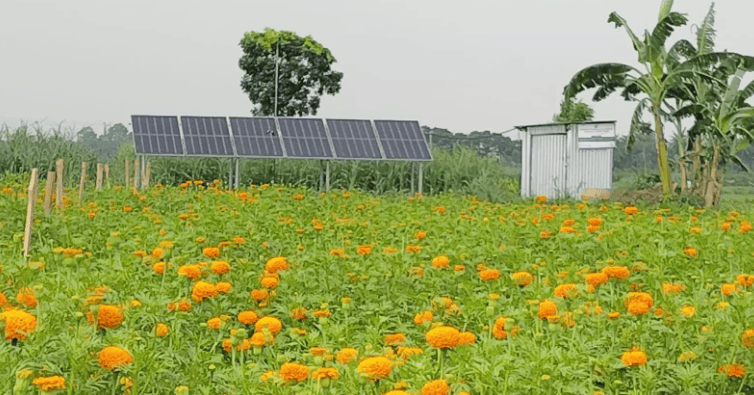
The system is powered by a 300 W photovoltaic panel, an MPPT (Maximum Power Point Tracking) charge controller, and a 12 V 100 Ah battery, enabling off-grid operation. The photovoltaic panel is tilted 31° facing south to maximize solar energy collection. An automatic control system regulates water circulation through a thermostat and temperature sensors, maintaining the cold storage chamber temperature at 5 °C. The water pump activates when the internal temperature exceeds the set value and automatically stops once the temperature returns to normal.
The energy efficiency evaluation covers total energy consumption, specific energy consumption per kilogram of fish, cooling efficiency, and overall coefficient of performance (COP), with the COP accounting for the electricity consumption of the Peltier modules, fans, and water pump. Experimental results were statistically validated through 10,000 Monte Carlo simulations, incorporating environmental variability and instrument measurement uncertainty to estimate the probability of the system achieving the target cooling conditions. Based on the assumed fishing scenario of 3 kg per day and 240 working days per year, the SCU can preserve approximately 720 kg of fish annually. With a manufacturing cost of approximately $182 and annual maintenance costs of $27.3, the estimated payback period is approximately 0.15 years.
The research team concluded that thermoelectric modules hold application potential for improving direct refrigeration methods, but the future deployment of this technology still depends on new thermoelectric materials with higher conversion efficiency and the development of more efficient systems. The next step is to validate the SCU under various operating conditions, covering variable heat loads, different fish species, and winter and summer seasonal conditions, as well as to conduct performance, energy efficiency, and economic feasibility comparisons with existing fish refrigeration technologies.