Young farmers in Telangana, India, try agricultural drones, priced between 250,000 and 600,000 rupees each
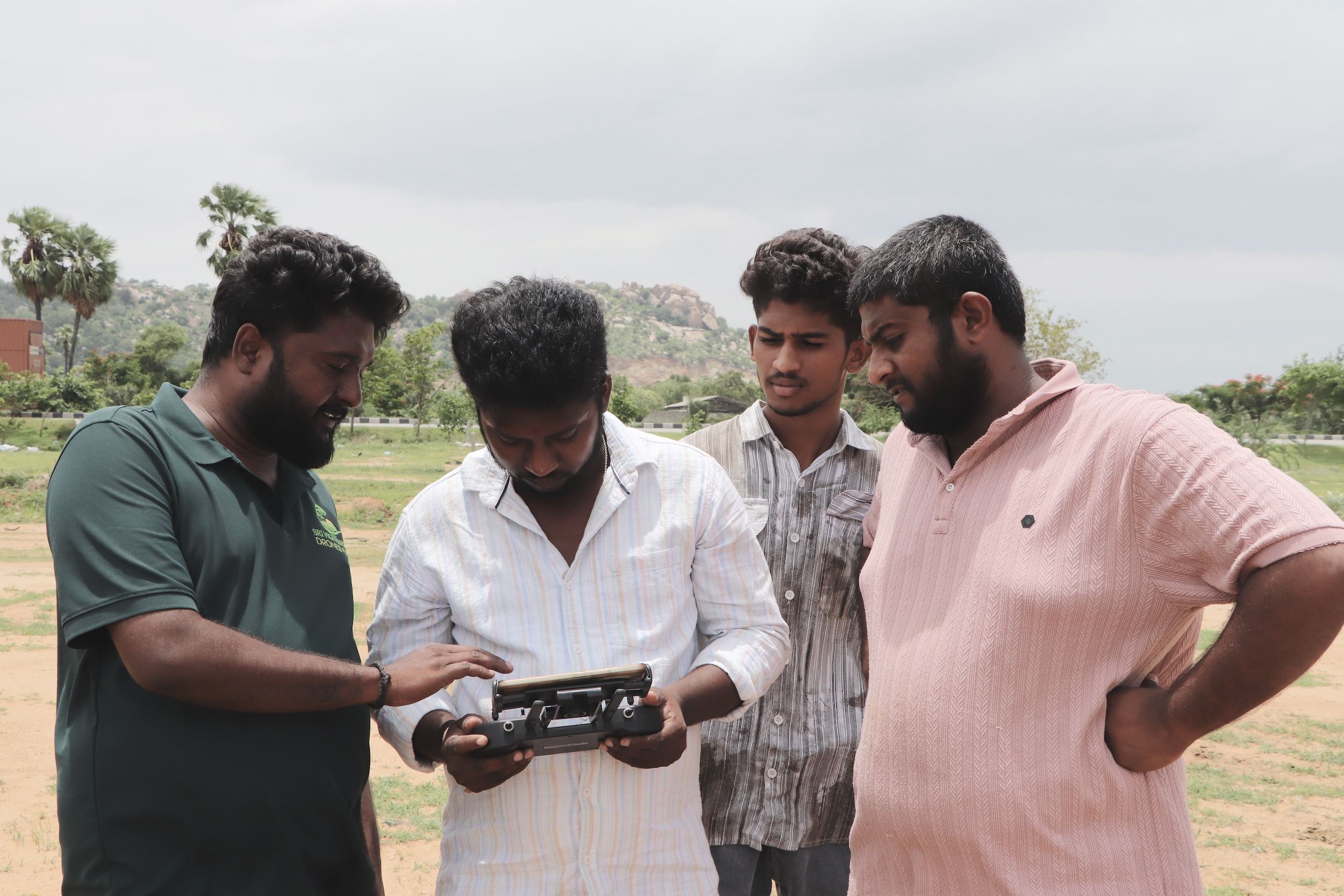
en.Wedoany.com Reported - In a field in Nalgonda district, Telangana, India, a group of college students are taking turns test-flying an agricultural drone used for pesticide spraying. The activity was organized by a drone vendor. These students, from families that have farmed for generations, plan to pool funds to purchase drones and offer pesticide spraying services to local farmers, charging 400 to 500 Indian rupees (about $4 to $5) per acre. According to the vendor on site, depending on size and functional configuration, a basic 10- to 16-liter spraying drone costs between 250,000 and 600,000 Indian rupees (about $2,600 to $6,300).
Shiva Reddy, 21, whose family owns 21 acres of farmland in Nalgonda, calculated for Dialogue Earth that if he purchased a drone for spraying services, he could earn up to 1 million Indian rupees annually. For Reddy and his friends, drones represent both a business opportunity and a response to rising agricultural labor costs. Facing ecological pressures from climate change and erratic weather, local young farmers say they are willing to try drones, while also remaining open to digital advisory services (subscription apps providing real-time, site-specific farming advice and alerts) and precision agriculture (using data to manage crop variability).
India is increasingly adopting such technologies to improve agricultural efficiency and reduce environmental impact. Some agricultural researchers note that using agricultural drones to spray agrochemicals can reduce waste while saving time and money, lower the risk of human exposure to hazardous substances, and integrate seamlessly into data analysis and monitoring platforms.
The Digital Agriculture Mission, established by the Indian government in 2024, has launched several digital platforms to help farmers track agriculture-related data. Among them, Agri Stack is a unified database containing farmer, land, and crop records, designed to streamline farmers' access to subsidies, credit, and advice. The Krishi Decision Support System analyzes soil health, satellite imagery, and weather data to generate yield estimates and drought and flood assessments. The government is also piloting a mobile application in dozens of states to make it easier for farmers to apply for subsidized fertilizers.
According to researchers and industry figures consulted by Dialogue Earth, India's broader goal is to make proven agricultural technologies exportable, and the prerequisite for achieving this is that domestic farmers adopt these technologies first. "If you want to export a technology, you first have to train, test, and then deploy it," said Rajashekar Reddy, director of Delta Things, an agritech company headquartered in Hyderabad that manufactures equipment for soil analysis, pest control, and weather stations.
As technology becomes increasingly integrated into the agricultural ecosystem, older farmers often face greater adaptation pressure. Muthyala Sathaiya, 65, walked into a farmer membership collective office in Nalgonda holding a handwritten receipt from a fertilizer dealer. He had come to collect several bags of fertilizer that the dealer had ordered online on his behalf a few days earlier. Unfamiliar with the online booking process, he spent four days asking educated young people in the village to help him obtain a one-time password before he could complete registration on the fertilizer sales app. His 35-year-old neighbor, Vanam Jagan, accompanied him in case of any digital glitches. Dialogue Earth observed that young farmers often provide support to older farmers learning to use these technologies.
As of 2016, the average age of Indian farmers was 50, and many have experienced decades of evolution and upheaval in the country's agricultural policies. In the 1960s, the Green Revolution pushed India toward large-scale commercial monoculture, primarily wheat and rice. Subsequently, farm mechanization, the spread of new irrigation technologies, and increased use of agrochemicals expanded agricultural markets by the 2000s. Chemical overuse has strained natural resources such as land, water, and biodiversity, and in recent decades has also led to pest resistance and a decline in beneficial insect populations.
India remains a major emitter of methane from rice cultivation and nitrous oxide, the latter a gas produced when soil bacteria break down nitrogen-based fertilizers such as urea. The country's agricultural sector has no mandatory emission reduction policies. Extreme and unpredictable weather events are increasingly directly affecting crop production and farmer incomes. This year, researchers at Australia's Monash University found that a 20% reduction in rainfall would lead to an average 8% decline in yields across all crops nationwide in India, with rice and cotton seeing significant drops of 11%; a 1-degree Celsius temperature rise would cause the largest yield declines in pearl millet and maize, at 19% and 16%, respectively. In Telangana, delayed monsoons have postponed this year's sowing season, and El Niño has kept reservoir levels low, affecting the planting of kharif (monsoon) crops.
Agritech is attempting to respond to these issues. The National Mission for Sustainable Agriculture promotes climate-resilient farming through soil health cards, providing farmers with soil nutrient testing reports every two years and advocating micro-irrigation to improve water-use efficiency. Kushang Mishra, a doctoral researcher at the University of Auckland studying agricultural digitalization in India, noted that precision agriculture has increased significantly worldwide. This model uses real-time data and predictive algorithms to manage crops, and the Indian government, research institutions, and civil society organizations have been promoting its adoption.
A press release issued by the Indian government earlier this year introduced an AI-based precision agriculture system developed by a Tamil Nadu startup. At a government-supported coconut farm in the state, sensors were used via a mobile platform to monitor soil moisture, irrigation, and fertilizer use in real time, doubling yields, and the system has been adopted by more than 3,500 farmers.
"With precision agriculture, labor intervention is reduced, input costs decrease, irrigation and fertilization become timely, and only the required amounts are applied," said Jella Satyanarayana, project lead at the Agricultural Robotics Laboratory at Professor Jayashankar Telangana Agricultural University in Hyderabad. "This reduces waste and increases productivity." Farmers interviewed by Mishra during his research said they saved water, fertilizer, and pesticides after adopting data-driven farming. However, he cautioned that precision agriculture does not necessarily equate to sustainable agriculture and may ultimately not reduce agrochemical use. "These technologies do not provide a solution for chemical-based agriculture, which has 'somewhat' polluted our soil [and] produced so many environmental impacts; rather, they may legitimize these chemical-based farming practices," he said.
Jagan has used multiple measures on his 8-acre farm, including drones, mechanized machinery, and soil testing, but he said the results have been disappointing. He claimed that the soil has degraded due to years of using chemical plant growth stimulants recommended by agricultural input dealers. He noted that despite advances in agricultural technology, farmers in nearby villages still rely on agricultural laborers during years of adverse weather. Mishra observed that farmers remain focused on immediate concerns, such as abnormal weather, rising input and labor costs, and access to better prices. "Things like farm data are not on their priority list."
Soil quality, weather, and crop data themselves have commercial value. Mishra worries that if large corporations selling pesticides or fertilizers obtain this data, they might engage in "targeted advertising"; banks and insurance companies could also use it to assess chemical composition profiles or soil moisture in specific regions to conduct targeted business. India's Digital Personal Data Protection Act requires companies to comply by May 2027, but how the law will apply to agricultural data—much of which falls in the gray zone between personal and non-personal information—remains uncertain. "We need to see how the policy evolves," said Reddy of Delta Things.
While data governance issues remain unresolved, India has begun expanding the reach of its digital agricultural ecosystem beyond its borders. The recent India-Vietnam Joint Statement on Enhanced Comprehensive Strategic Partnership is one example, highlighting digital technology cooperation and two-way investment in smart agriculture, water resource management, and technology transfer. The statement did not specify particular technologies or companies, but researchers and entrepreneurs interviewed noted that India's strength lies in developing data-driven agricultural solutions.
Experts say the country's diverse soils, cropping systems, and climatic conditions offer companies a vast testing ground, where predictive algorithms can be continuously refined across multiple crop cycles, weather patterns, and irrigation practices, generating datasets and use cases that are difficult to replicate elsewhere. "We don't need to compete with China in manufacturing," said Reddy of Delta Things. "What we can export is the use of those sensors, that is, the use cases." He added that the company has exported agricultural sensors to Hungary and Malaysia, where local customers hope to determine which nutrients to add to soil by analyzing crop nutrient uptake trends. However, he cautioned that Indian technology needs to be adapted to local soils, governance systems, infrastructure, and farming practices to succeed elsewhere.
Technology diffusion still faces practical barriers. Satyanarayana believes that high upfront costs limit adoption rates, and many digital agricultural tools are primarily designed for larger farms and are not specifically optimized for India's predominantly small-scale and fragmented landholdings. "Large [farms] are already using robots, drones, and agricultural sensors," he said. "Small and marginal farmers are not, because of the high cost and because the technology has not been fine-tuned for farms of their scale." This is where young farmers' adaptability can play a role. Back at the drone testing site in Nalgonda, Shiva Reddy said during a break that he remains cautious about predictive algorithms. "They can't be that easy to predict," he said, noting that farmers in the village do not currently use these algorithms, but he is willing to try them in the future.
Related Products

714CD Series C-Band Weather Radar
Chengdu Zhongdian Jinjiang Information Industry Co., Ltd.
Industrial and Commercial Point-Type Gas Detector
Jinan Benan Technology Development Co., Ltd.
4HS-8 High-efficiency Peanut Inverted-laying Harvester
Hebei Yongfa Hongtian Agricultural Machinery Manufacturing Co., Ltd.