Germany: AZO-based HJT cells without MgF2 degrade 16.38% under damp heat
en.Wedoany.com Reported - Research from Forschungszentrum Jülich GmbH in Germany shows that heterojunction (HJT) solar cells using aluminum-doped zinc oxide (AZO) instead of indium tin oxide (ITO) as the transparent conductive oxide (TCO) layer are more prone to performance degradation under damp-heat conditions. After adding a magnesium fluoride (MgF₂) capping layer on the AZO surface, the research team limited efficiency degradation to within approximately 7% after 1000 hours of damp-heat aging.
The researchers explained that AZO grows in a polycrystalline structure, allowing water molecules to rapidly penetrate along grain boundaries, which degrades the material's electrical properties and impairs its conductivity and optical transparency. To clarify this process, the team investigated the optoelectronic performance and surface morphology changes of AZO-based HJT cells under damp-heat conditions, using ITO-based cells as a control.
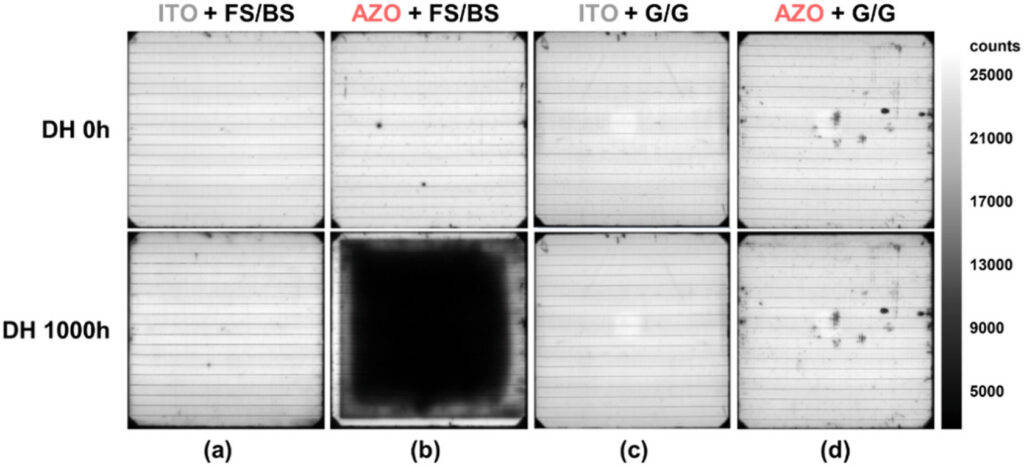
In the experiments, the researchers deposited 70-nanometer-thick ITO or AZO layers on the front and rear surfaces of bifacial HJT cells, and also deposited standalone ITO and AZO thin films on glass substrates to independently observe changes in the transparent conductive oxide material itself. The cells were then integrated into 210 mm × 210 mm single-cell mini modules using two encapsulation schemes: one was a glass/glass structure with 3.2 mm glass plates on both sides; the other was a lightweight frontsheet/backsheet structure with an ethylene-tetrafluoroethylene (ETFE) frontsheet and an aluminum-containing polyolefin backsheet.
Both module designs were manufactured with SHJ cells based on either ITO or AZO, with two samples prepared for each configuration. All samples underwent 1000 hours of accelerated damp-heat aging at 85 degrees Celsius and 85% relative humidity in accordance with the IEC 61215 standard, with electrical performance and electroluminescence (EL) images recorded every 200 hours, along with external quantum efficiency and reflectance measurements.
The results showed that after 1000 hours of damp-heat exposure, the efficiency of AZO-based HJT cells without additional capping decreased by a relative 16.38%, with a relative reduction in fill factor of 9.84%, closely linked to an increase in series resistance (Rs). During the same period, ITO-based cells exhibited an efficiency loss of only a relative 2.80%, demonstrating significantly greater stability.
Electroluminescence (EL) imaging revealed pronounced defects in AZO-based lightweight modules, primarily attributed to moisture ingress and corrosion of the AZO layer; no comparable defects were observed in AZO glass/glass modules or ITO-based devices. This indicates that glass/glass encapsulation provides stronger moisture protection, while ITO itself offers better resistance to humidity.
Chemical analysis found an increase in hydroxyl-related species in AZO after damp-heat exposure, supporting the conclusion of moisture-induced chemical modification. Scanning electron microscopy (SEM) images further showed corrosion grooves on the aged AZO surface, whereas ITO maintained a uniform and dense structure.
To address this moisture-resistance shortcoming, the researchers deposited a 110-nanometer-thick magnesium fluoride (MgF₂) capping layer on the front surface of the AZO-based cells. With this capping layer, the efficiency degradation after 1000 hours was maintained within approximately 7%, and electroluminescence defects were substantially reduced compared to uncapped AZO cells. The research team noted that MgF₂ can delay moisture ingress and corrosion but cannot form a complete moisture barrier, and the stability of AZO-based cells still falls short of the ITO reference group.
The findings were published in the journal Solar Energy Materials and Solar Cells under the title "Unveiling the damp-heat-induced degradation mechanism of AZO-incorporated silicon heterojunction solar cells and modules." The paper states that the study reveals the degradation mechanism of AZO-based silicon heterojunction solar cells and modules under damp-heat conditions and proposes practical strategies to enhance their durability and performance.
Related Products

TAI Slew-drive Single-axis Independent 1P Tracking Bracket System
ANTAI TECHNOLOGY CO., LTD.
PCS-901 Series Ultra (Extra) High-voltage Transmission Line Complete Protection Device
Nanjing NR Electric Co., Ltd.
Standard Nozzle Flowmeter
Jinggong Automatic Control Instrument Complete Technology Development Company

Modular Multifunctional Water Supply and Drainage Vehicle (18T)
Changsha Dewater Machinery Technology Co., Ltd.