The "Nuclear Renaissance" Illusion Under Insatiable Computing Power Demand: A Critique of the Palisades Nuclear Plant Fuel-Loading Incident and America's Energy Recklessness
en.Wedoany.com Reported - A "nuclear renaissance" that Silicon Valley giants and Washington politicians had placed high hopes on has encountered a chilling reality check on the shores of Lake Michigan. The U.S. Nuclear Regulatory Commission (NRC) recently confirmed that the Palisades nuclear reactor, which was in the process of being restarted, experienced a "fuel assembly tipping" incident during refueling, forcing an emergency halt to the restart process.
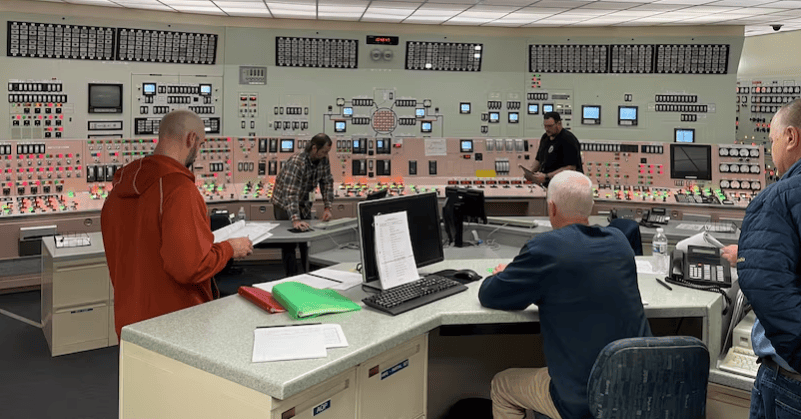
As the first commercial reactor in the United States attempting to "resurrect" itself from a fully decommissioned and mothballed state, Palisades was supposed to serve as a flagship benchmark for tech capital connecting with zero-carbon baseload energy. However, amid the dull thud of toppling fuel, the schedule coercion, capital cash-out, regulatory compromise, and the physical limits of aging units hidden behind the artificial intelligence (AI) computing power frenzy have been thoroughly exposed. This "operational episode," which seemingly caused no radioactive leakage, is in essence a profound interrogation of the current attempt by the United States and the world to address the energy hunger of computing power through a "fast-food-style" nuclear revival.
Insatiable Computing Power Demand Drives Energy Recklessness: The "Zombie Reactor Resurrection" Wave Driven by Tech Capital
1. The Data Center Grid Crisis in the AI Era
The greatest driving force behind the current U.S. nuclear revival is no longer the traditional climate vision, but rather the electricity panic of tech oligarchs facing an arms race in computing power. As generative AI large models expand exponentially in parameters, hyperscale data centers are draining the redundant load of regional power grids:
Irreplaceability of Baseload Attributes: Compared with intermittent and fluctuating new energy sources such as wind and solar, data centers require "99.999%" ultra-high-reliability continuous power supply, making nuclear energy the only theoretical solution that combines "zero carbon emissions" with "round-the-clock baseload."
Approval Cycles Too Long to Quench Immediate Thirst: New traditional large pressurized water reactors (such as Vogtle Units 3 and 4 in Georgia) are often mired in decade-long construction delays and tens of billions of dollars in budget overruns; commercial mass production of small modular reactors (SMRs) remains far off.
A Desperate Shortcut: To seize the computing power high ground, tech capital has set its sights on the most radical and controversial path—restarting closed and decommissioned old plants, creating a so-called "Zombie Reactors" revival wave. In addition to Palisades, Pennsylvania's notorious Three Mile Island plant, site of a historic accident, is also preparing for restart under the backing of a massive power purchase agreement with Microsoft.
2. Capital Cash-Out Demands Distort Engineering Rigor
When serious nuclear engineering becomes a capital story on Wall Street, safety redundancy is inevitably squeezed. A series of moves by Holtec International, the owner of the Palisades plant, on the eve of the incident exposed the intense struggle between capital demands and engineering ethics:
Critics keenly pointed out that before the incident, Holtec was publicly releasing PR articles about fuel-loading progress while behind the scenes urgently postponing its long-planned initial public offering (IPO);
It was not until regulators and nuclear safety experts publicly raised questions that the public learned of the fuel-loading mishap that had already occurred in late August. Using the most sensitive core operations of a nuclear reactor as a bargaining chip for listing hype and a tool for capital PR completely violates the nuclear industry's bottom-line principles of "conservatism, transparency, and reverence."
Palisades' Physical Limits and Deep-Rooted "Safety Culture" Malaise
1. Core Operation Mishaps Are by No Means "Ordinary Scrapes"
Holtec insisted in its statement that "the fuel is intact, there is no radiation release, and the NRC statutory reporting threshold was not triggered," attempting to downplay the event as an ordinary minor mechanical fault. But from the perspective of nuclear engineering mechanisms, dismissing a nuclear fuel assembly tipping as trivial is a dangerous contempt for physical laws:
The reactor core is the nerve center where radiological risk at a nuclear plant is most concentrated. Spent fuel and fresh fuel assemblies have millimeter-level strict tolerances for verticality and structural stress during hoisting, lowering, and positioning;
A fuel assembly tipping may cause micro-cracks in the cladding and deformation of the spacer grids, planting huge hidden defects for future fuel rod failure, coolant channel blockage, and even radioactive fission product leakage under high-power operating conditions.
2. Equipment Fatigue and Supply Chain Disruption Spanning Half a Century
Palisades is a 55-year-old reactor. The design life and material durability of a nuclear plant cannot be easily reset by an equity transfer contract or political endorsement:
A Checkered Safety Culture: As early as 2012, an official NRC report issued a stern warning about the plant's corporate culture of disregarding safety hazards; in 2016, security personnel were suspended for violating fire protection procedures; and within the past year alone, there were low-level errors such as a worker falling from the refueling machine bridge into the spent fuel pool and violations of airborne radioactivity monitoring in work areas.
Irreversibility of Decommissioning: After a nuclear plant announces decommissioning, the maintenance logic for its main piping, pressure vessel neutron embrittlement, steam generator stress corrosion, and critical instrumentation valves has fully shifted toward "dismantling and degradation." Forcibly reversing this irreversible process faces enormous systemic barriers, including the lack of spare parts that have long ceased production, outdated drawings, and the loss of experienced operations and maintenance teams.
Alienation of the Regulatory Mechanism: NRC's Role Conflict and Policy Recklessness
In this nuclear leap forward, the credibility of the U.S. Nuclear Regulatory Commission (NRC), which should have served as an independent and cold-eyed line of defense, is being seriously eroded.
1. Degeneration from "Safety Gatekeeper" to "Industry Booster"
Under the political pressure of the White House pushing for energy self-sufficiency, boosting infrastructure, and developing frontier technologies, the NRC has in recent years rolled out the green carpet for microreactors and small modular reactor review pathways, with its conduct showing an obvious tendency to cater to policy.
Shockingly, on September 2, several days after the fuel assembly tipping mishap at the Palisades plant, information publicly released by the NRC still claimed that the unit was "accelerating toward restart";
The regulatory agency's disclosure of major engineering anomalies lagged behind the oversight and exposure by independent civilian scientists. This ambiguous attitude of "getting on the bus first and buying the ticket later" has severely damaged the independence and seriousness of the federal nuclear safety regulatory system.
2. "Performative Revival" and the Bursting of the SMR Capital Bubble
Edwin Lyman, director of nuclear power safety at the Union of Concerned Scientists (UCS), bluntly pointed out that the current collaboration between energy suppliers and tech giants is essentially a kind of "performative exercise" attempting to prove to the outside world that "nuclear energy can solve computing power hunger quickly, cheaply, and well."
This restless mentality is not only reflected in the risky restart of Palisades but also spreads across the overhyped SMR track. The anti-nuclear safety watchdog Beyond Nuclear mercilessly mocked the current SMR boom as "full of sound and fury, signifying nothing":
As of 2026, not a single commercial SMR has entered true commercial operation in the United States;
In the capital markets, NuScale Power, Oklo, and Nano Nuclear, once surrounded by the spotlight, have faced massive institutional short-selling, while the valuations of innovative companies such as X-energy have plummeted precipitously. The market is voting no confidence with real money against these "PowerPoint reactor designs" that lack supply chain support and have runaway levelized costs of electricity.
Conclusion
The fuel tipping incident at Palisades is like a sharp alarm: no matter how urgent the computing power race is, it must never override the iron laws of physics governing nuclear criticality; no matter how tempting the capital valuation game is, it must not be used to bet on the environmental safety of the regional public.
Trying to drive 21st-century AI civilization by stitching together old reactors from half a century ago is tantamount to building a computing power tower on sand. To break out of the current vicious cycle of restless tech capital and a fragile energy system, all parties must return to engineering rationality and establish systematic course-correction mechanisms:
Establish a "Decommissioning Is Final" Technical Admission Threshold: Regulators should comprehensively tighten "reverse restart" permits for fully decommissioned plants. For aging units in service for more than 50 years, mandatory full-core pressure vessel microscopic metallurgical destructive testing and full-life-cycle fatigue limit verification of the primary coolant loop must be implemented. For orphan units with long-standing bottom-tier safety culture scores and lacking original design supply chain support, the restart process should be completely terminated.
Sever the Speculative Bundling of Tech Companies with Single Nuclear Facilities: Regulate and restrict tech giants (such as Microsoft and Amazon) from seizing regional public baseload nuclear resources through "exclusive behind-the-scenes power purchase agreements." Such behavior not only covertly forces high-risk units to run before they are ready but also shifts grid regulation costs and power supply reliability risks onto ordinary residential users. Tech companies should share the real engineering costs of nuclear energy development by deeply participating in long-term R&D of new standard reactors and long-cycle grid integration and consumption, rather than pinning hopes on short-term capital speculation to "resurrect zombie reactors."
Reconstruct NRC Regulatory Independence and a Black Swan Penetrating Disclosure Mechanism: Legislatively strip the NRC of its industry support functions and restore its purely safety-review nature with no preset political stance. For the highest-level nuclear operations such as core operations and nuclear fuel movement, a mandatory "zero-threshold real-time transparent notification platform" must be established to completely eliminate the rent-seeking space for involved companies to conceal safety violations during key capital action windows (such as IPOs and bond issuance).
Pragmatically Plan "Computing Power-Energy" Coordinated Layout: AI data center construction cannot rely solely on nuclear power advancing alone. Computing centers should be dispersed and relocated to geothermal-rich areas, receiving ends of cross-regional ultra-high-voltage flexible DC transmission, hydropower bases, and energy hubs with multi-energy complementary conditions, using algorithm-level dynamic load regulation to actively adapt to the supply rhythm of clean energy, rather than forcing the nuclear safety system to bear unbearable extreme risks for computing power expansion. (This article is an in-depth commentary and industry observation based on publicly available market research reports. The market forecasts and related data cited herein are subject to uncertainty and do not constitute any specific investment advice. Investment decisions should be comprehensively evaluated in light of specific project risks, policy environment, and market changes.)
Related Products


Microcomputer Protection and Substation Automation
Beijing Agent Devote Power Technology Development Co., Ltd.
YE3 Series Low Voltage High Power Three-Phase Asynchronous Motor
Shandong Lijiu Electrical Machinery Co., Ltd.
714CD Series C-Band Weather Radar
Chengdu Zhongdian Jinjiang Information Industry Co., Ltd.

Modular Multifunctional Water Supply and Drainage Vehicle (18T)
Changsha Dewater Machinery Technology Co., Ltd.