Breakthrough in China's "One-Line Method" Hybrid Rice: Cloning Rates Exceed 90% in 18 Combinations
en.Wedoany.com Reported - Significant phased breakthroughs have been achieved in the research on seed production technology for "one-line method" hybrid rice. On October 11, an on-site observation and review meeting on apomixis in hybrid rice ("one-line method" hybrid rice) was held at the Hunan Biological Breeding Base. According to the meeting, with the continued advancement of multi-variety and multi-ecological-zone validation and supporting technology research for "one-line method" hybrid rice, artificial apomixis is expected to provide a new technological pathway for the continuous propagation of elite hybrid rice combinations, reduce the cost and risk of hybrid rice seed production, and provide important support for ensuring food security and promoting innovation in the seed industry.
From the three-line method to the two-line method, Chinese hybrid rice varieties have been continuously iterated and upgraded, making major contributions to safeguarding national food security. However, traditional hybrid rice seed production suffers from relatively cumbersome procedures, high input, and high risks, which to some extent restricts the wider promotion of elite hybrid rice combinations. How to fix the heterosis of rice so that elite hybrid varieties can be continuously propagated through seeds has been a major scientific goal long pursued by hybrid rice breeders.
In 1987, Yuan Longping, Academician of the Chinese Academy of Engineering, proposed a grand strategic vision for the development of hybrid rice from the "three-line method" to the "two-line method," and ultimately to the "one-line method." The core of the "one-line method" is to fix heterosis so that elite hybrids can be continuously propagated through their own seeds, achieving "one hybridization, usable for generations." Artificial apomixis is a technique that redesigns the plant reproductive process to enable hybrids to produce clonal seeds with a genetic composition essentially identical to their own, providing a new technological pathway for achieving this strategic goal. Once stable industrial application is realized, this method is expected to fundamentally simplify the hybrid rice seed production system, reduce seed production costs and risks, and drive the transition of hybrid rice toward fixation and continuous propagation of elite heterozygous genotypes.
Accordingly, the Yazhou Bay Laboratory took the lead, coordinating with advantageous teams from the Institute of Crop Sciences of the Chinese Academy of Agricultural Sciences, the China National Rice Research Institute, the Hunan Academy of Agricultural Sciences, the Anhui Academy of Agricultural Sciences, Yuan Longping High-Tech Agriculture Co., Ltd., and Anhui Quanyin Hi-Tech Seed Industry Co., Ltd., to launch joint research targeting key issues such as rice cloning efficiency, seed-setting ability, applicability across genetic backgrounds, and field stability. The team linked reproductive regulation research, material creation, multi-generation propagation, and field evaluation, achieving a series of advances from efficient cloning to multi-variety, multi-ecological-zone application validation in this disruptive original innovation research on "one-line method" hybrid rice seed production technology.
Qian Qian, Academician of the Chinese Academy of Sciences, introduced that the team introduced the dandelion parthenogenesis gene ToPAR into rice for the first time, combining it with meiosis modification technology, and achieved a cloning rate of 100% and a seed-setting rate of 93.54% in the same line for some rice materials, balancing efficient cloning with normal seed-setting ability in rice. On this basis, the team developed the L3 material using Jiafengyou 3 as the background and completed five consecutive generations of tracking validation, providing important evidence for the cross-generational transmission of the genetic composition of elite hybrid combinations.
To test the applicability of this technology, the team validated 20 representative hybrid rice combinations from China, South Asia, and Southeast Asia, covering three-line indica type, three-line indica-japonica type, and two-line indica type, all of which yielded corresponding apomictic materials, with cloning rates exceeding 90% in 18 combinations.
This year, the team further established regular-season field trials across multiple ecological zones nationwide in biological breeding zones in Beijing, Hefei, Changsha, Hangzhou, and Sanya. Under different ecological environments covering the northern rice region, the middle and lower reaches of the Yangtze River rice region, and the tropical rice region of South China, the team deployed apomictic materials to examine material performance under different latitudes, light and temperature conditions, and rice cultivation ecological environments, advancing technology evaluation from single materials to multiple genetic backgrounds and multiple ecological zones.
The results indicate that artificial apomixis is advancing from "a single material being able to achieve clonal propagation" toward "different elite combinations being transformable and different ecological zones being verifiable." In the future, it is expected that mature hybrid varieties verified through years of production can be directly converted into "one-line method" materials capable of continuous propagation, significantly shortening the cycle for technology to enter industry and improving the efficiency of upgrading mature hybrid varieties to the "one-line method."
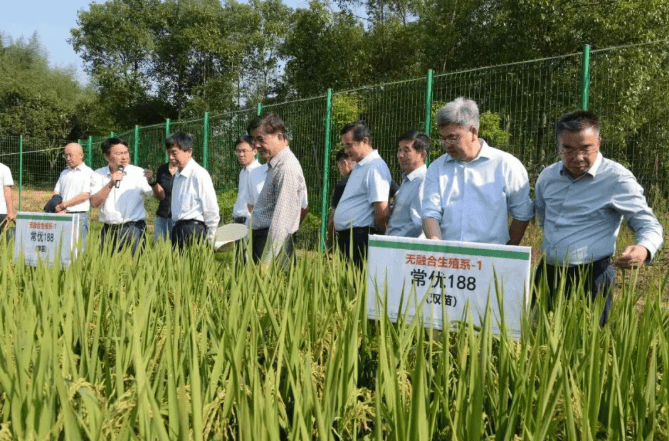
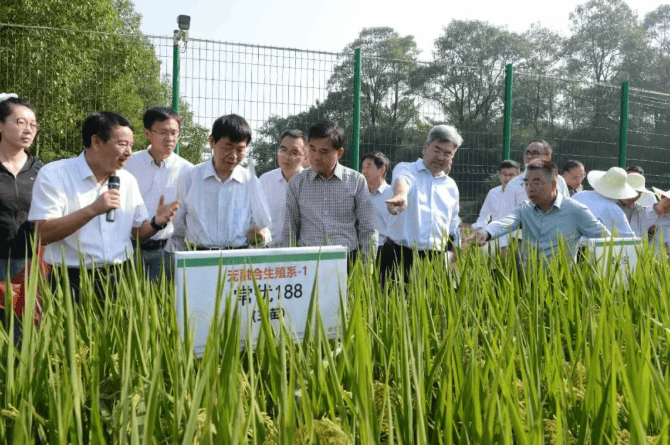
At the observation meeting site, the team demonstrated planting methods including single-plant, two-plant, and three-plant transplanting, combining molecular breeding with cultivation regulation to explore supporting measures for improving population stability. Under the demonstrated cultivation conditions, the relevant materials exhibited good population growth and agronomic traits.
Li Jiayang, Director of the Yazhou Bay Laboratory and Academician of the Chinese Academy of Sciences, stated that fixing heterosis is an important research direction in hybrid rice breeding, and current research progress has demonstrated its promising application potential. At the same time, however, there are still many practical challenges that need to be overcome before the phased results can be truly applied in large-scale production. Issues such as the impact of the environment on apomictic traits, the stability of performance across different genetic backgrounds, the reliability of long-term multi-generation propagation, and supporting cultivation technology systems still require sustained systematic research. He suggested that the next step should be to continuously deepen basic mechanism research, further solidify multi-ecological and multi-generation tracking validation, and strive to form a stable, reproducible, and production-applicable technology system.
Related Products



Industrial and Commercial Point-Type Gas Detector
Jinan Benan Technology Development Co., Ltd.
4HS-8 High-efficiency Peanut Inverted-laying Harvester
Hebei Yongfa Hongtian Agricultural Machinery Manufacturing Co., Ltd.


714CD Series C-Band Weather Radar
Chengdu Zhongdian Jinjiang Information Industry Co., Ltd.