NanoXplore and STMicroelectronics Jointly Launch European Space-Grade FPGA Chip
Wedoany.com Report on Feb 6th, NanoXplore and STMicroelectronics, a globally leading semiconductor company, recently jointly announced that their co-developed NG-ULTRA programmable system-on-chip (FPGA) has successfully passed space-grade industry standard certification. This certification signifies that the chip fully meets the stringent requirements of space missions in terms of radiation tolerance, extreme temperature adaptability, and long-term reliability. It means the chip has officially attained the technical qualification for stable operation in spacecraft such as satellites and deep-space probes, providing a high-performance, reconfigurable core hardware option for future space electronic systems.
The NG-ULTRA chip is designed to meet the growing demands for intelligence and autonomy in modern satellite missions. Its functionalities cover several critical strategic areas, with specific applications including:
Onboard Computing and Control Hub
Can serve as the core computing platform for satellites, supporting complex orbital control, mission scheduling, and fault-tolerant management.
Data Exchange and Routing Hub
Enables high-speed, reliable data interaction and unified scheduling among various satellite subsystems.
Real-time Image and Video Processing
Supports real-time image compression, encoding, and preprocessing in missions such as Earth observation and space situational awareness, significantly reducing the data transmission burden on downlink channels.
Software-Defined Radio (SDR) Applications
Allows for in-orbit dynamic updates to communication protocols and modulation schemes, greatly enhancing satellite communication flexibility and mission adaptability.
Onboard Autonomous Operation Capability
Through built-in intelligent detection, recognition, and monitoring mechanisms, supports satellites in completing anomaly diagnosis, system reconfiguration, and real-time mission optimization without human intervention.
This certification is a significant milestone in the technological maturity of the NG-ULTRA chip and also provides critical infrastructure for the global space industry's evolution towards high autonomy, reconfigurability, and intelligent collaboration. The chip's programmable nature allows satellites to adapt to new mission requirements via software updates even after launch, effectively extending satellite service life and improving overall performance. Against the backdrop of rapid developments in low Earth orbit constellations, deep-space exploration, and integrated civil-military satellite networks, the deployment of such high-performance space-grade chips will strongly propel the transformation of satellite systems from "fixed-function" to "dynamic and intelligent," injecting new technological momentum into global space infrastructure construction.
Related Products



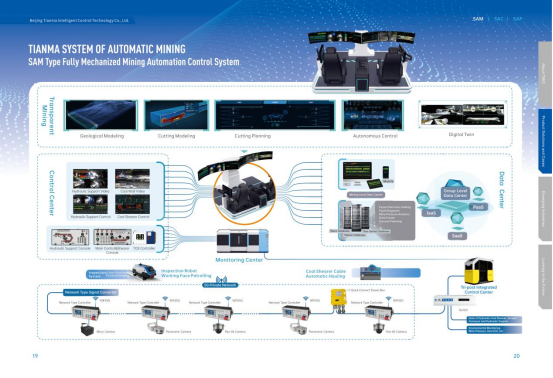
Comprehensive Mining Automation Control System
Beijing Tianma Intelligent Control Technology Co., Ltd.
20 Inch 1600*900 Full HD 60Hz TFT LED Monitor with VGA and DP Interfaces for Desktop Computers-Business Use
Guangzhou Zanying Optoelectronics Technology Co., Ltd.


G.652.D Wavelength-extended Non-dispersion Shifted Single-mode Optical Fiber
HONGAN GROUP CO., LTD.

Industrial and Commercial Point-Type Gas Detector
Jinan Benan Technology Development Co., Ltd.