
A joint research team from Loughborough University and Swansea University has achieved a breakthrough in space power technology with a lightweight cadmium telluride (CdTe) solar cell. By depositing ultra-thin CdTe films onto protective cover glass, the team has developed a new space power system that combines light weight, radiation resistance, and low cost. The technology has successfully completed its first in-orbit test on the AlSat-Nano CubeSat.
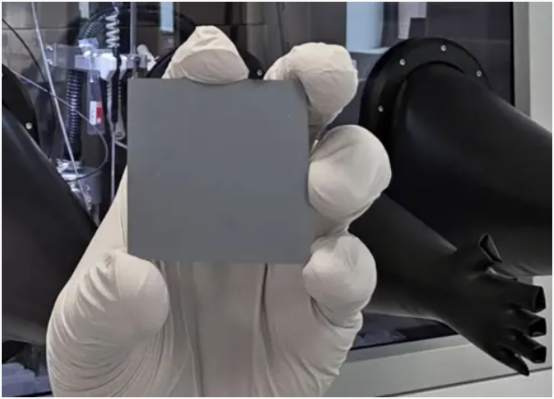
Traditional space missions rely primarily on silicon-based or multi-junction solar cells (MJSC). While MJSC leads in efficiency, its complex manufacturing process results in high costs that limit large-scale deployment. The new glass-based CdTe technology has achieved 23.1% conversion efficiency under terrestrial conditions, with a target of 20% for space applications—significantly improving cost-performance ratio compared to existing solutions. Professor Paul Meredith, Director of the Centre for Integrated Semiconductor Materials at Swansea University, stated that the technology delivers a triple breakthrough—higher specific power, longer lifetime, and lower cost—through optimized material structure and manufacturing processes, providing a critical energy solution for next-generation deep-space missions.
According to the European Space Agency, driven by the expansion of satellite constellations and the rise of in-space manufacturing, global demand for space solar power is projected to surge from 1MW per year currently to 10GW by 2035. The UK space industry, currently valued at £17.5 billion, has an urgent need for efficient, scalable power systems. Professor Michael Walls, Director of the Centre for Renewable Energy Systems Technology at Loughborough University, emphasized that thin-film CdTe technology integrates photovoltaic components with structural materials, reducing satellite payload weight by more than 30% and substantially lowering launch costs.
This breakthrough is supported by the UK's first dedicated space semiconductor foundry project, enabling technology transfer from terrestrial clean energy to space power systems. The team reports that its radiation hardness is more than 5 times higher than conventional silicon cells, supporting over 15 years of operation in low Earth orbit without power system replacement. The project is currently collaborating with the European Space Agency to optimize thin-film deposition processes, with plans to complete full-scale component space qualification before 2026.
This achievement marks a critical step toward lighter, longer-life space power systems. As the global space industry enters a period of commercial explosion, low-cost, high-reliability next-generation photovoltaic technologies will become a core element in securing leadership in space resource development.