
Astronomers using the Gemini North telescope in Hawaii have successfully captured images of the third interstellar object, 3I/ATLAS (formally designated comet C/2025 N1 (ATLAS)), as it passes through the Solar System. The object was first discovered on July 1, 2025, by the Asteroid Terrestrial-impact Last Alert System (ATLAS). This observation, led by a team from the University of Hawaii Institute for Astronomy headed by Karen Meech, provides critical data for studying the origin, orbit, and composition of interstellar objects.
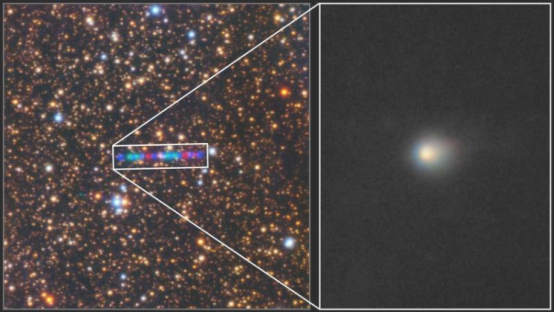
3I/ATLAS is the third confirmed interstellar object after 1I/Oumuamua in 2017 and 2I/Borisov in 2019. Using the high-sensitivity Gemini Multi-Object Spectrograph (GMOS-N) at the International Gemini Observatory, the comet's dense coma—the cloud of gas and dust surrounding its icy nucleus—was clearly imaged. Martin Still, Program Director for the U.S. National Science Foundation International Gemini Observatory, said: "The sensitivity and scheduling flexibility of the International Gemini Observatory have enabled crucial early characterization of this interstellar wanderer, and we look forward to gathering more data as it continues its interstellar journey."
Interstellar objects originate outside the Solar System, typically ejected into interstellar space by gravitational perturbations from planets or stars in their home systems. With an orbital eccentricity of 6.2—far exceeding Oumuamua's 1.2 and Borisov's 3.6—3I/ATLAS is confirmed to be from interstellar space and will not orbit the Sun. Currently inside Jupiter’s orbit and approximately 465 million kilometers from Earth, it will reach a closest approach of 270 million kilometers on December 19 without posing any threat. Its estimated diameter of up to 20 kilometers makes it significantly larger than Oumuamua (~200 meters) and Borisov (<1 kilometer), making it an even more promising target for study.
Scientists believe interstellar objects carry chemical signatures from the stellar systems where they formed, offering insights into the evolutionary history of distant planetary systems across the Milky Way. Although only three such objects have been confirmed so far, the astronomical community expects that the upcoming Legacy Survey of Space and Time (LSST) at the NSF–DOE Vera C. Rubin Observatory, which will repeatedly scan the southern sky, will discover many more over the next decade.