
California startup Reflect Orbital has decided to tackle the challenge of solar power's unavailability at night. Instead of developing advanced batteries, the company proposes a unique solution: launching a constellation of satellites equipped with giant mirrors into space to reflect sunlight back to Earth after sunset, illuminating solar power plants or other objects requiring nighttime lighting. This idea could bring revolutionary changes to the renewable energy sector, though numerous technical challenges must be overcome before implementation.
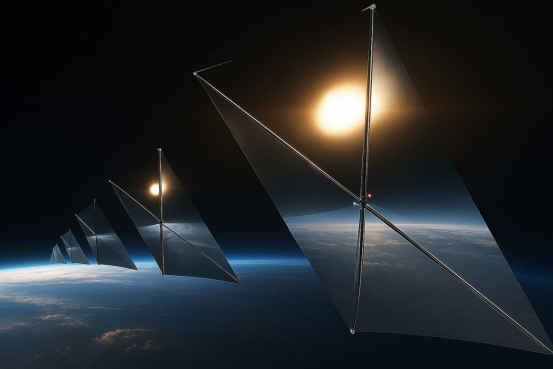
The system is based on satellites, each deploying a 10×10 meter reflector made from ultra-light and ultra-strong polyester film material, with each mirror weighing only 16kg—significantly reducing the cost of launching to a 600km low Earth orbit. However, the primary engineering challenge lies in extremely precise guidance: each mirror must continuously adjust its position using reaction wheels while tracking the Sun's movement and targets on Earth. Customers would also be able to specify the reflection point via the internet.
The "night sun" plan faces several severe challenges: first, aiming complexity—precisely directing sunlight onto small targets amid the Sun's movement and Earth's rotation requires a perfect control system capable of operating continuously for decades; second, atmospheric obstacles—clouds and light scattering in the atmosphere weaken the energy flux reaching the ground, reducing system efficiency; third, space debris—the company promises strict compliance with disposal rules, ensuring satellites deorbit within 25 years after mission end; fourth, light pollution—the company claims the mirror design ensures only people near the target area are affected by additional lighting, minimizing impacts on the nighttime environment and astronomical observations.
Reflect Orbital plans to create an initial network of 57 satellites. Currently, the project is in its early stages. Although preliminary tests using balloons and small mirrors have shown promising results, scaling to a mature orbital system will significantly increase complexity.