
Scientists are working to explore how to identify land on exoplanets in order to gain a deeper understanding of whether these distant worlds could harbor life. The latest research focuses on distinguishing true habitable planets from "water world" false positives, which may appear to have deep oceans but could actually be unsuitable for life. The study has been posted on the arXiv preprint server, aiming to provide scientists with more accurate methods for classifying exoplanets and their compositions, particularly in the search for signs of life.
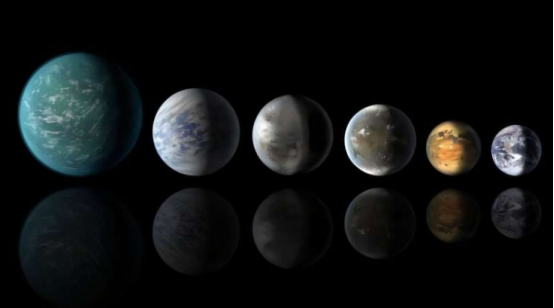
The research team used data from the U.S. Geological Survey spectral library to analyze various spectral features excluding desert sands and ice, assessing whether the proposed Habitable Worlds Observatory (HWO) could detect land on rocky exoplanets. The study indicates that HWO would require a telescope with an approximately 8-meter aperture to effectively detect land based on signal-to-noise ratio data in visible and ultraviolet wavelengths, while also verifying its capability to detect oxygen biosignatures. The conclusions emphasize: "Detecting land through reflected spectra can help HWO eliminate false positives caused by extremely deep oceans suppressing oxygen absorption."
As the next-generation space telescope, HWO is planned to succeed NASA's James Webb Space Telescope and become the most powerful space observation instrument. Its design goals include imaging objects in visible, infrared, and ultraviolet bands, with direct observations of at least 25 habitable exoplanets. Although HWO is not expected to launch until the 2040s, scientists and engineers are actively developing the necessary technologies to search for habitable worlds beyond Earth. Currently, there are numerous water world exoplanet candidates, such as those orbiting TRAPPIST-1 and Kepler-11, as well as Kepler-62e and Kepler-62f. Recently, the James Webb Space Telescope discovered a "steam world" named GJ 9827d, which has an atmosphere composed of steam but is too hot to sustain known forms of life.
With the number of confirmed exoplanets in the Milky Way approaching 6,000—including 219 Earth-like planets and 1,746 super-Earths—this research is particularly important. Although the James Webb Space Telescope can already analyze exoplanet atmospheres, HWO is expected to usher in a new era of exoplanet discovery and exploration through direct imaging of habitable planets.