
A research team from Rutgers University has published a study in Science Advances reporting a new type of quantum state—a quantum liquid crystal. The discovery stems from investigations into the interface between two exotic materials: Weyl semimetals and spin ice, potentially offering new avenues for advanced technologies such as quantum sensors.
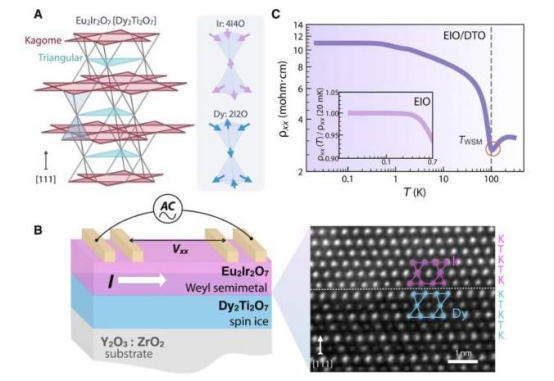
Led by Tsung-Chi Wu, a doctoral student in physics and astronomy at Rutgers University, the team observed the interaction between Weyl semimetals and spin ice under strong magnetic fields. Wu stated: "We observed a new quantum phase that emerges only when the two materials are in contact. This quantum liquid crystal state exhibits unique electronic behavior under strong magnetic fields."
Experiments revealed significant electronic anisotropy at the interface, where conductivity varies with direction. Over a 360-degree range, electrons showed the lowest conductivity in six specific directions, and as the magnetic field strengthened, electrons began flowing in opposite directions. This phenomenon indicates that the quantum state breaks conventional rotational symmetry and may possess topological properties.
Weyl semimetals are known for conducting current with zero energy loss, while spin ice features a magnetic structure analogous to the arrangement of hydrogen atoms in water ice. The research team constructed a heterostructure of these materials using the Quantum Phenomena Discovery Platform (Q-DiP) and tested it in the ultra-low-temperature environment at the National High Magnetic Field Laboratory (MagLab) in Florida.
Wu noted: "This discovery provides new methods for manipulating quantum materials, which in the future could be used to develop high-precision quantum sensors." The team plans to further explore combinations of different quantum materials to uncover additional unknown phenomena.