
Quantum teleportation is a fascinating process that involves transferring the quantum state of a particle to another distant location without physically moving or measuring the particle itself. This process could be at the core of realizing the so-called "quantum internet"—a version of the internet capable of securely and instantaneously transmitting quantum information between devices on the same network.
Quantum teleportation is not a novel idea and has been experimentally demonstrated multiple times in the past. However, most previous demonstrations relied on frequency conversion rather than operating natively in the telecommunications band.
Researchers at Nanjing University have recently demonstrated the teleportation of a telecom-wavelength photonic qubit (i.e., a quantum bit encoded in light at the same wavelength as that supporting current communications) to a telecom quantum memory. Their paper, published in Physical Review Letters, may open new possibilities for scalable quantum networks and even the quantum internet.
"Quantum teleportation has always been a fascinating protocol in quantum communication because it allows the transfer of quantum states without exposing any information," senior author Professor Xiaosong Ma told Phys.org. "To further extend the distance of state transmission, incorporating quantum memory into the quantum teleportation system is crucial."
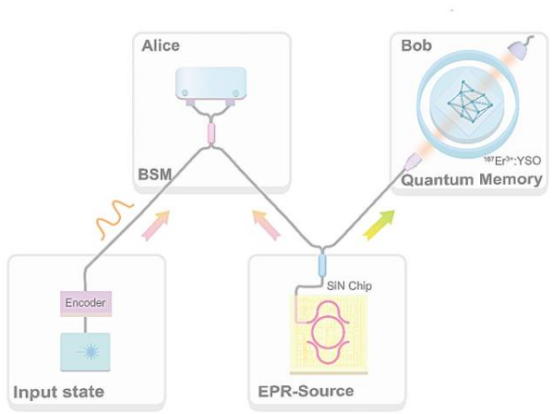
The primary goal of Ma and his colleagues' recent study was to successfully integrate a telecom solid-state quantum memory into a quantum teleportation system, thereby enabling the storage of transmitted quantum information. The main role of this memory is to propagate and store entangled particles (i.e., entanglement distribution) through quantum networks.
Quantum networks rely on quantum repeaters, devices that break down information transmission distances into shorter, more manageable segments known as basic links. When quantum memories are placed at the ends of these segments, they can store quantum information for a time sufficient to establish entanglement across the entire network segment, enabling longer-distance transmission.
"We used five systems to complete the experiment," Ma explained. "They include input state preparation, an EPR source for generating entangled photon pairs from an integrated photonic chip, Bell-state measurement, and a quantum memory based on an erbium ion ensemble. We also employed frequency distribution and fine-tuning modules based on FP cavity and PDH technology."
The latest research by Ma and his colleagues shows that quantum information can be transmitted through networks using devices and light wavelengths compatible with current communication systems. The team's demonstration of quantum teleportation is expected to advance the development of quantum networks and contribute to the future realization of a reliable quantum internet.
Professor Ma added: "Our study demonstrates, for the first time, quantum teleportation from a telecom photon to a solid-state quantum memory based on erbium ions. All components in our system are perfectly compatible with existing optical fiber networks. This telecom-compatible platform for generating, storing, and processing photonic quantum states provides a highly promising approach for large-scale quantum networks."
As part of their next research efforts, the team plans to focus on improving the performance of the erbium-ion solid-state memory used in the experiment. More specifically, they aim to extend its storage time and increase its efficiency in storing quantum information.