
By analyzing data from the MeerKAT International GHz Tiered Extragalactic Exploration (MIGHTEE-HI) survey, astronomers have discovered a new rotating galaxy filament. This newly identified filament is about 5.5 million light-years long and connects 14 galaxies. The discovery was published on the preprint server arXiv on August 18.
Galaxy filaments are among the largest known structures in the universe, containing galaxies with mixed stellar populations and structures. They feed gas into galaxies, aiding their growth and evolution.
Large filamentary structures have only recently been discovered through observations of neutral hydrogen atoms (HI). Studying cold HI gas in galaxy filaments helps better understand the relationship between low-density gas in the cosmic web and how galaxies within it utilize this material for growth.
Now, a team of astronomers led by Madalina N. Tudorache from the University of Cambridge in the UK reports the discovery of a chain of HI galaxies in the MIGHTEE-HI survey.
The researchers wrote in the paper: “In this work, we present 14 HI galaxies identified in the MIGHTEE-HI survey in the COSMOS field at z = 0.03, forming a filament-like structure.”
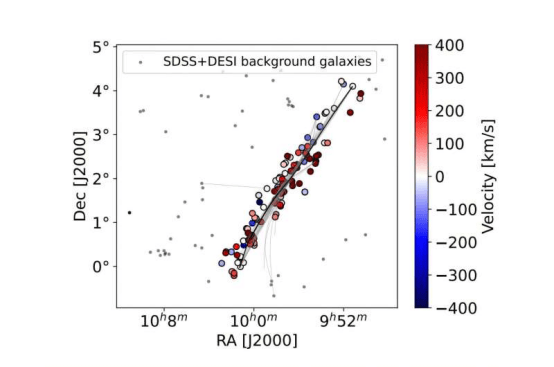
The recession velocities of these 14 galaxies all fall within a narrow range of 9230 to 9700km/s (with a velocity dispersion of about 140km/s), forming a linear structure on the sky at approximately 30 degrees north-west, with a length of about 5.5 million light-years and a width of about 117,000 light-years.
Additionally, the observations indicate that this galaxy filament is embedded within a larger cosmic web structure measuring at least 49 million light-years across. The thickness of this cosmic web filament appears to be between 2.6 million and 3.3 million light-years.
The observations show that the 14 reported HI galaxies are arranged much more tightly with the cosmic web filamentary structure. This suggests a close connection between the angular momentum of galaxies and large-scale filamentary structures.
Furthermore, analysis of the collected data revealed strong evidence that the galaxies are rotating around the spine of the filamentary structure. This discovery makes the newly detected galaxy filament one of the longest and largest rotating structures identified to date.
The results also provide the Tudorache team with greater insight into the evolutionary stage of galaxy filaments.
The astronomers concluded: “The abundance of HI galaxies within the filamentary structure and the low dynamical temperature of galaxies inside the filament indicate that the filamentary structure is in an early evolutionary stage, preserving the influence of cosmic matter flows on galaxies across cosmic time.”