
An international research team led by the University of Waterloo has developed a novel micro-robotic system that can accelerate the dissolution of uric acid kidney stones in the urinary tract. The research, published in the journal Advanced Healthcare Materials, provides a potential minimally invasive alternative for treating kidney stones.
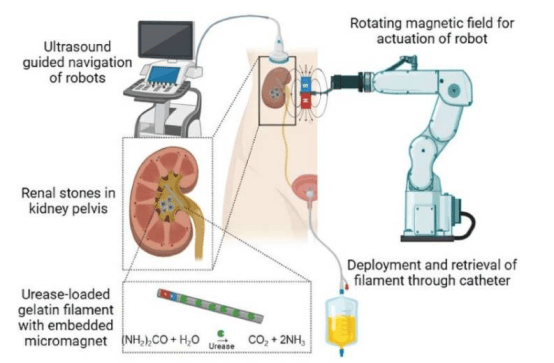
The team tested the technology on a life-sized 3D-printed model of the urinary system. The system uses soft, flexible magnetic robotic strips, approximately one centimeter in length, embedded with the enzyme urease. Physicians control these micro-robots via a robotic arm to precisely target the stones. The urease enzyme lowers the acidity of the urine, promoting the dissolution of the stones to a size small enough for natural passage within a few days.
Dr. Veronika Magdanz, a professor in the Department of Systems Design Engineering at the University of Waterloo, stated: “There are currently no highly effective treatments for this type of kidney stone. Patients typically rely on painkillers or long-term oral dissolution medications, and in emergencies, surgery is required.” Kidney stones affect approximately 12% of the global population, are prone to recurrence, and impose a significant burden on healthcare systems.
The research team believes this technology is particularly suitable for patients who cannot tolerate medications or face surgical risks. Dr. Magdanz added: “Our goal is to provide faster pain relief and stone clearance.” The next steps in the research will focus on large-animal experiments and optimization of the control system, including fine-tuning the magnetic forces of the robotic arm and integrating real-time ultrasound navigation.
The collaborative team includes researchers and clinicians from Spain and Germany.