
Supersolids — a paradoxical state of matter that is as rigid as a crystal yet can flow without friction — have recently exhibited new quantum properties in studies of dipolar quantum gases. A research team led by Francesca Ferlaino has deeply explored how the solid and superfluid properties of supersolids interact under rotation. The related findings were published in the journal Nature Physics.
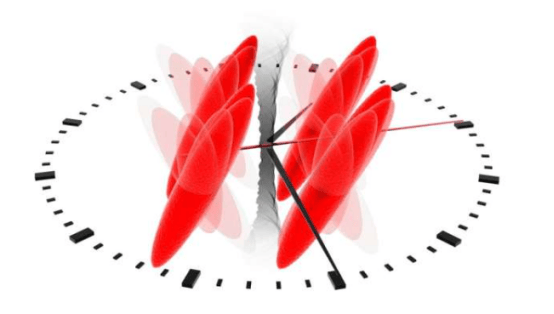
In the experiment, the research team used a magnetic field to precisely control the rotation of the supersolid quantum gas and observed that the supersolid quantum droplets arranged themselves in a periodic crystal-like pattern. Each droplet precessed in sync with the rotation of the external magnetic field, and when vortices entered the system, the precession and revolution began to synchronize. "The supersolid crystal does not rotate in a disordered manner," said Elena Poli, head of theoretical modeling. "Once quantum vortices form, the entire structure falls into rhythm with the external magnetic field." Andrea Litvinov, who conducted the experiments, also expressed excitement: "The moment we saw the data match the theory, the whole system suddenly seemed to 'fall into rhythm'."
Synchronization is a common phenomenon in nature, and the Innsbruck team has now proven that even exotic quantum matter can achieve synchronization. This discovery not only deepens our understanding of the unusual state of matter known as supersolids but also provides a new method for exploring quantum systems. By tracking synchronization, the research group successfully determined the critical frequency at which vortices appear — a fundamental yet difficult-to-measure property of rotating quantum fluids. The research team combined advanced simulation techniques with precise experiments, using "magnetic stirring" to rotate the supersolid and capture its evolution with high precision.
The significance of this research extends far beyond the laboratory. Similar vortex dynamics have also been observed in cosmic bodies such as neutron stars, and supersolids may become a new pathway for exploring phenomena on cosmic scales. "Supersolids are the perfect place to explore problems that other methods cannot reach," Poli emphasized. "Although they are generated in micrometer-scale laboratories, their behavior may correspond to phenomena on cosmic scales."