
A research team at Kaunas University of Technology (KTU) has successfully developed a new type of polymer material made from plant-based raw materials. The production process requires no solvents or catalysts. The research results were published in the journal Biomacromolecules, providing a more sustainable material option for fields such as clean technology, medical devices, and precision manufacturing.
The new material belongs to the vitrimer category — a class of network polymers with dynamic covalent bonds that can be reshaped and self-repaired at specific temperatures. Professor Jolita Ostrauskaitė from the Department of Polymer Chemistry and Technology at KTU said: "Advanced materials are not only fully functional but also friendly to humans and the environment. This work paves the way for technologies that enable a safer and more sustainable daily life." Unlike most vitrimers based on petroleum sources, this material is entirely prepared from plant oils and by-products of biodiesel production, and is cured using ultraviolet or visible light, eliminating the need for catalysts in traditional processes.
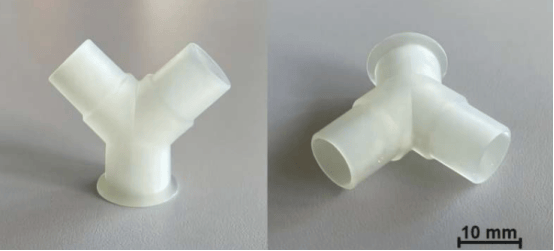
The research team pointed out that the vitrimer material exhibits several advanced properties, including thermally responsive shape memory capability, antibacterial performance, and processing adaptability suitable for optical 3D printing. KTU PhD student Viltė Šereikaitė, along with researchers Aukse Navaruckienė and Sigita Grauželienė, participated in the material development and testing. Using optical 3D printing technology, the team successfully manufactured high-precision Y-shaped medical connectors, verifying its potential in medical device manufacturing.
The material's antibacterial properties originate from specific fragments in its plant-based structure, which can effectively inhibit the growth of common microorganisms. Professor Ostrauskaitė explained: "The starting compounds used in the study come from by-products of plant oil and biodiesel production. Certain fragments interfere with bacteria and other microorganisms, disrupting their important functions." This characteristic makes it valuable in medical devices, electronic products, and hygiene-sensitive applications.
In addition to the medical field, the vitrimer material can also be used in the manufacture of products with high requirements for geometric precision, such as optical components and electronic parts. Its reshapable and repairable properties help reduce industrial waste and support the development of a circular economy model. The KTU team stated that integrating plant-based raw materials, radiation curing, self-healing, and antibacterial properties into a single material is innovative in both the scientific and industrial communities.