
Light particles exhibit a unique tendency toward collectivism. When faced with a choice between two states, they tend to select the state already adopted by the majority of their fellow particles. However, this collective behavior only manifests when a large number of photons are gathered in the same location. This discovery was made by a research group led by Professor Martin Weitz from the Institute of Applied Physics at the University of Bonn and has been published in Physical Review Letters. It holds significant importance for the development of devices such as ultra-strong laser sources.
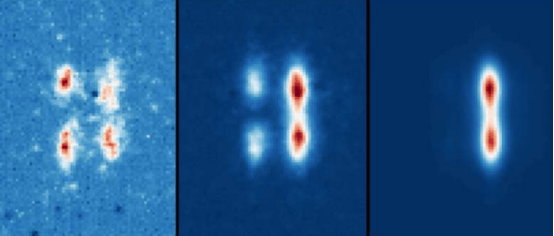
In physics, particles are divided into two major categories: fermions and bosons. Fermions, such as electrons orbiting atomic nuclei, have a strong sense of individuality and cannot occupy the same state in a confined space. Bosons, such as photons, tend to act collectively and share the same state. When a sufficient number of photons are cooled and confined in a small space, they merge into a giant "superphoton." Professor Weitz's research team discovered through experiments that when the number of photons is small, their choice between two slightly different energy levels (or colors) is quite random. However, as the number of photons increases, newly added photons begin to favor the energy level that already has more photons. This trend becomes particularly evident when the number of photons reaches dozens. Once hundreds of photons have accumulated in one energy level, the other energy level is almost no longer selected.
This discovery not only reveals the collective behavior characteristics of photons but also provides new ideas for designing more powerful lasers. In theory, by combining multiple radiation sources and utilizing the collective tendency of photons, the energy of the laser can be increased. Professor Weitz pointed out that this requires all radiation sources to be "in phase," meaning their waves must always be perfectly synchronized. Although precisely aligning the light waves emitted by multiple laser beams is challenging, the research results indicate that using the collective behavior of photons to achieve this goal is feasible.