
In the field of construction, the principle that "the foundation determines the solidity of a building" is deeply rooted, emphasizing the critical role of a stable foundation for the safety of building structures. Among these factors, the depth of the bearing layer — a key parameter influencing foundation design and placement — is directly related to the risk of soil liquefaction and the prevention of soil-related disasters. Accurately estimating the bearing layer depth is of great significance for designing robust foundations and reducing disaster risks.
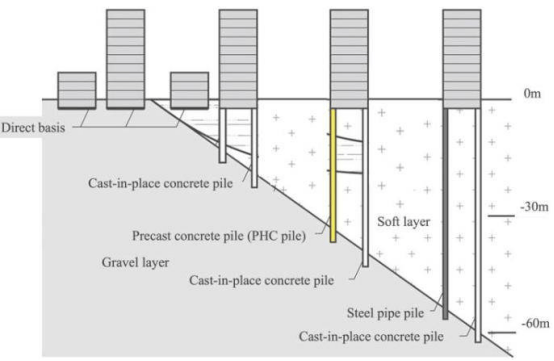
Traditional methods for assessing bearing layer depth, such as the Standard Penetration Test (SPT), are reliable but time-consuming, labor-intensive, and costly. To find a more cost-effective alternative, scientists at Japan's Shibaura Institute of Technology (SIT) have turned to machine learning (ML). A research team led by Professor Shinya Inazumi from the SIT College of Engineering used 942 geological survey records and SPT data from the Tokyo metropolitan area, applying three ML algorithms — Random Forest (RF), Artificial Neural Network (ANN), and Support Vector Machine (SVM) — to predict bearing layer depth.
The results showed that, in comparative evaluations, the RF model excelled in depth prediction accuracy (average absolute error of 0.86 meters in Case 2 and 1.26 meters in Case 1) and robustness against noisy data. Additionally, when stratigraphic classification data was included as an explanatory variable, the prediction accuracy of all models improved significantly. The study also found that increasing the density of spatial data helps enhance prediction accuracy, indicating that dense datasets are crucial for accurate prediction of bearing layer depth. Professor Inazumi stated: "Our research aims to provide urban planners and engineers with efficient tools. By optimizing site selection for resilient smart cities and infrastructure projects through machine learning models, we can achieve sustainable development, reduce costs, and enhance safety."
The team's research demonstrates that machine learning, especially the RF model, offers a viable alternative to traditional methods for regional disaster risk assessment. Compared with SPT, machine learning models are cost-effective and have the potential to revolutionize infrastructure planning in seismically active regions by reducing reliance on expensive localized testing while improving safety and efficiency.