
Europe has committed to achieving climate neutrality by 2050, but how can this goal be reached in a technologically feasible, economically responsible, and fair manner for all member states? A new study by researchers from Aarhus University and the Technical University of Denmark, published in Nature Communications, offers a solution.
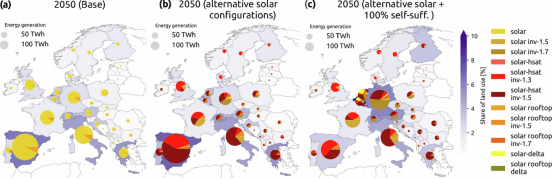
Using an advanced energy model covering the European continent, the researchers investigated how countries can achieve annual energy self-sufficiency (where energy production equals consumption). This is not isolationism, but rather a principle of energy fairness and resilience.
The results are positive. First author of the paper and postdoctoral researcher Parisa Rahdan stated that climate neutrality does not necessarily require sacrificing energy fairness. With intelligent technologies and collaborative efforts, a transition that benefits all countries can be achieved.
The study shows that Europe can achieve net-zero emissions — meaning greenhouse gas emissions do not exceed the amount absorbed through reforestation, carbon storage, or technological solutions. This is crucial for meeting the Paris Agreement's goal of limiting global warming. Compared with the most cost-effective scenario without self-sufficiency, achieving net-zero emissions increases the average cost by only 2.1%.
Countries currently dependent on energy imports, such as Belgium and the Netherlands, may see costs rise by up to 150%, while other countries could save money. Overall, this would lead to a more balanced distribution of solar and wind power facilities, enabling a fairer and more resilient transition.
In this scenario, solar energy — especially the configuration of new solar panels — is a key technology. The model shows that single-axis tracking systems that follow the sun from east to west throughout the day are cost-effective in Europe. Since solar panels rarely operate at full capacity, downsizing inverters is an economically effective strategy.
Parisa Rahdan noted that technologies once considered expensive are now cost-effective due to the sharp decline in solar panel prices, including inverter sizing and east-west tilted panel configurations. These solutions are particularly valuable for densely populated countries or those with limited land, as they can increase energy yield per unit area and support self-sufficiency.
The researchers emphasized that self-sufficiency does not mean isolation. Even if electricity production becomes more localized, countries will still trade synthetic fuels, methanol, and hydrogen produced in resource-rich regions. The European energy system is like a green puzzle, with each country contributing and benefiting from support from its neighbors, with all pieces fitting perfectly together.
Regarding the key question of whether the necessary large-scale expansion of solar and wind power is realistic, the researchers' analysis shows that the prerequisite is a substantial increase in development levels in many countries. Based on historical data, the required growth rates in some countries exceed historical records, but they are not unattainable.
Parisa Rahdan stated that ambition must be raised. Technological development and political momentum are moving in the right direction, and now is the time to act. The study sends a clear message to national policymakers and the European Union: make room for new solar technologies in energy models, promote global coordination, and let energy justice become a driving force — rather than an obstacle — for the transition.