
A research team from the Harvard-Smithsonian Center for Astrophysics has conducted a new exploration of the Large Magellanic Cloud's motion path over the past billions of years by analyzing the trajectories of hypervelocity stars. This study on hypervelocity stars utilized observational data from the European Space Agency's Gaia satellite, providing a new perspective for understanding galactic motion.
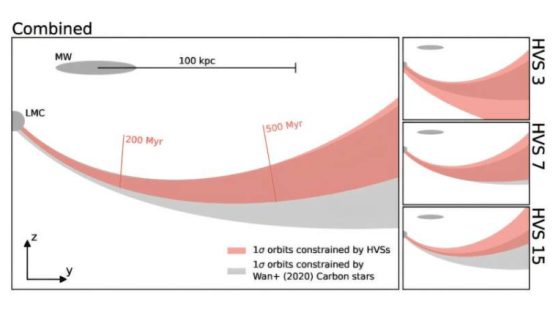
In a paper published on the arXiv preprint server, the research team focused on two newly discovered hypervelocity star candidates, HVS 7 and HVS 15. The motion trajectories of these hypervelocity stars indicate that they did not originate from the Milky Way, but most likely from the Large Magellanic Cloud. When a binary star system passes too close to a supermassive black hole, one of the stars may be ejected at speeds exceeding 1,000km/s, forming this type of hypervelocity star.
By constructing models that include dark matter and dynamical friction effects, the study narrowed the possible motion path of the Large Magellanic Cloud over the past millions of years by 50%. This hypervelocity star research also provides indirect evidence for the possible existence of a supermassive black hole at the center of the Large Magellanic Cloud and calculates the possible coordinates of its location.
The paper's authors noted that the current data based on only three hypervelocity stars still have limitations, and more observations are needed to refine the models. Further study of the motion trajectories of these hypervelocity stars will help more precisely understand the interaction mechanisms between the Large Magellanic Cloud and the Milky Way, as well as the influence of dark matter on galactic motion.