
In the MAST Upgrade nuclear fusion experiment facility operated by the UK Atomic Energy Authority (UKAEA), a research team has successfully validated the performance advantages of the Super-X divertor design. By extending the plasma path, this design significantly reduces the heat load on the divertor walls, providing a new solution for exhaust systems in future fusion power plants.
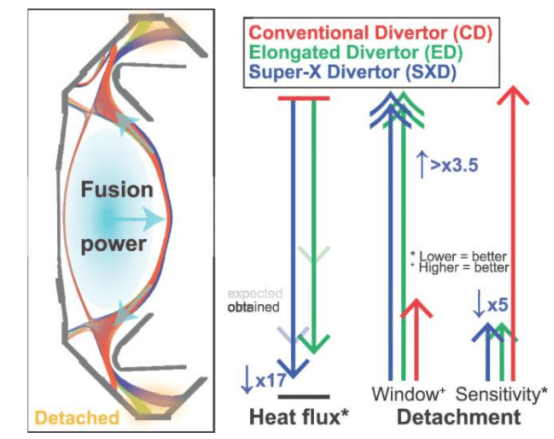
The research results on the Super-X divertor have been published in the journals Communications Physics and Nature Energy. Experimental data show that, compared with traditional designs, the Super-X configuration can reduce the heat load by an order of magnitude while maintaining effective control of plasma exhaust. The design originated from a concept proposed by the Institute for Fusion Studies at the University of Texas at Austin, characterized by longer divertor legs that provide more space for plasma cooling.
The researchers confirmed that the Super-X divertor maintains exhaust control capability without affecting the performance of the opposing divertor or the plasma core. The experimental results indicate that even relatively conservative modifications to the divertor geometry can bring significant improvements in thermal control. These findings are consistent with computer simulation predictions, suggesting that the understanding of divertor physics is deepening.
Kevin Verhaegh from Eindhoven University of Technology stated: "These results have positive implications for future fusion projects, including the UK's STEP, the United States' ARC, and Europe's DEMO program. We have demonstrated that by strategically modifying the divertor geometry, benefits close to those of extreme configurations can be obtained." Verhaegh previously worked at the UK Atomic Energy Authority and now co-leads the research with Bob Kool from the DIFFER institute.
Kool added: "The results clearly show that alternative divertor configurations offer clear advantages in maintaining operating conditions for fusion power plants. This represents an important advance in solving the exhaust problem and brings us one step closer to realizing the application of fusion energy."
James Harrison, Head of Science for the UKAEA MAST Upgrade project, pointed out: "Proving that plasma conditions in the divertor can be controlled independently is an important step in developing exhaust control systems for future fusion devices. These achievements are the result of international collaboration between the UK Atomic Energy Authority, Eindhoven University of Technology, DIFFER, and the EUROfusion team."
The research builds on multiple collaborations in the divertor field, including experiments conducted on the Swiss TCV fusion device. The progress in Super-X divertor technology provides new possibilities for the design of future fusion power plants, particularly in balancing engineering complexity with performance optimization.