
Researchers at the Research Center for Materials, Architectures and Integration of Nanomembranes (MAIN) at Chemnitz University of Technology in Germany have made key progress in the field of intelligent microrobots. They have developed a new generation of autonomous microrobots that can communicate, respond, and collaborate in water environments. These miniature devices, only one millimeter in size, integrate electronic components, sensors, actuators, and energy systems, and can exchange information via optical signals and move autonomously. The related results were published in the journal Science Robotics under the title "3D Modular Microrobots with Si-Chip-Controlled Intelligent Communication in Natural Aquatic Environments".
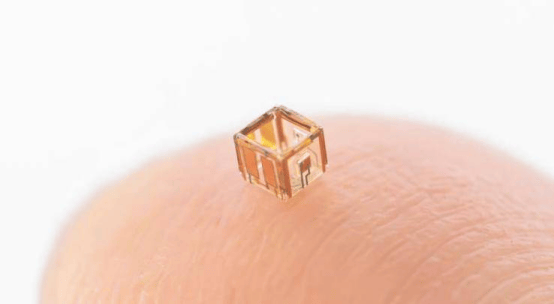
Unlike traditional microrobots that rely on external wireless control, these intelligent microrobots are powered by integrated photovoltaic cells, precisely controlled by microchips, and achieve optical communication through embedded miniature LEDs and photodiodes. MAIN Scientific Director Professor Oliver G. Schmidt pointed out: "This is the first independent platform capable of autonomously sensing, moving, and interacting with other robots in water." Its structure is based on origami technology, where intelligent multilayer materials are curled and folded into 3D cubes. The interior integrates solar energy collectors and computational logic, while the exterior supports interaction and movement functions. When immersed in water, the robots adjust buoyancy through bubble generators and emit optical signal pulses to coordinate group behavior.
The core innovation of the device lies in the "wireless communication loop", which enables decentralized control without external cameras or antennas. Each robot locally interprets optical information through encoded logic stored in its microchip and uses soft-key technology to connect customized silicon chips (Lablets) to the origami film. This design allows the robots to synchronize movement according to environmental stimuli, for example, triggering group coordination through optical signals. Dr. Vineeth Bandari, co-corresponding author of the paper, stated: "Optical communication provides a compact and scalable solution for distributed robotic systems."
Currently, these microrobots have demonstrated potential applications in water quality monitoring and minimally invasive medical diagnostics. Their biocompatibility and environmental responsiveness make them promising for performing detection tasks in confined biological environments. Dr. Yeji Lee, co-author of the paper, revealed that the team is exploring the addition of chemical and acoustic sensing modules to enhance the robots' adaptability in complex fluids. In the future, the researchers envision these microrobots evolving into dynamic digital biological communities, where each unit performs sensing, communication, or movement functions, collectively forming adaptive robotic organisms.