
Researchers at National Taiwan University have developed a novel graphene oxide-biochar-titanium dioxide nanocomposite material that combines adsorption properties with photocatalytic activity, providing a sustainable solution for removing antibiotics from livestock wastewater. The research results have been published in the Chemical Engineering Journal.
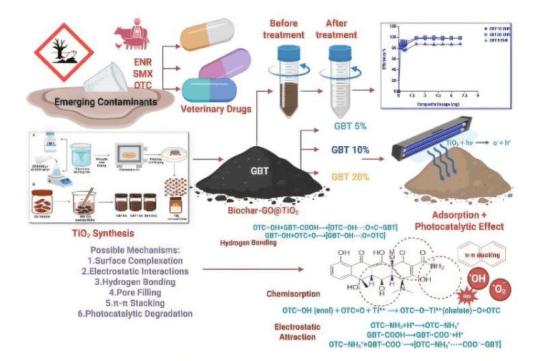
Antibiotics such as sulfamethoxazole, oxytetracycline, and enrofloxacin remaining in livestock wastewater pose potential risks to aquatic ecosystems and may promote the spread of antibiotic resistance. Traditional treatment methods suffer from insufficient efficiency or high costs, necessitating the development of new treatment materials.
The research team prepared a nanocomposite with synergistic functions by integrating graphene oxide, biochar, and titanium dioxide. Material characterization showed: scanning electron microscope images revealed a porous structure with uniformly distributed titanium dioxide nanoparticles; X-ray diffraction confirmed a stable crystal structure; FTIR and Raman spectroscopy detected abundant surface functional groups; BET specific surface area analysis indicated that the material has high porosity.
The nanocomposite can remove more than 95% of antibiotics under ultraviolet light irradiation and still maintains nearly 90% removal efficiency after multiple cycles of use. Ultraviolet-visible spectroscopy and photocurrent response tests showed that the material has broad-spectrum absorption, narrow bandgap, improved carrier separation efficiency, and efficient electron transfer capability, making its photocatalytic activity significantly higher than traditional titanium dioxide systems.
The innovation of this material lies in its synergistic mechanism: antibiotic molecules are first adsorbed and enriched by the biochar-graphene oxide matrix, and then degraded into harmless substances by photo-activated titanium dioxide. Corresponding author Professor Shang-Lien Lo stated: "This study demonstrates a pioneering approach to protecting water resources from pharmaceutical pollution."
This multifunctional nanocomposite provides a durable and scalable solution for wastewater treatment, contributing to the goals of clean water resource protection and sustainable water environment management.