
A research team from Kaunas University of Technology in Lithuania, in collaboration with an international team, has made significant progress in all-inorganic perovskite solar cell technology, achieving a power conversion efficiency exceeding 21% while substantially improving device stability. The research results have been published in the journal Nature Energy.
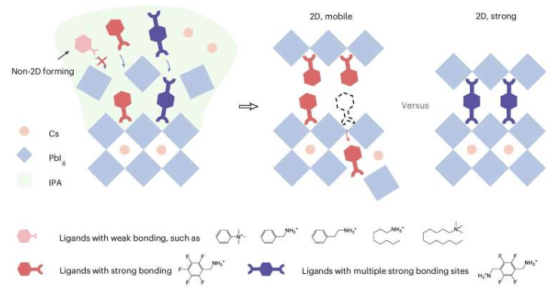
The researchers employed a surface passivation strategy to construct a stable two-dimensional capping layer on the surface of all-inorganic perovskites, effectively reducing material defect density and enhancing resistance to environmental factors such as humidity and temperature. Dr. Kasparas Rakštys, a researcher at Kaunas University of Technology, stated: "Perovskite solar cells are one of the fastest-developing thin-film photovoltaic technologies, offering advantages of low material cost and potential for flexible applications."
The commercialization of all-inorganic perovskite solar cells has long been limited by their long-term stability issues. Unlike traditional hybrid perovskites, forming a stable interface between two-dimensional passivation layers and all-inorganic perovskites has been challenging. The research team synthesized perfluorinated two-dimensional ammonium cations and utilized the strong electronegativity of fluorine atoms to achieve robust bonding between the two-dimensional layer and the three-dimensional perovskite. Dr. Rakštys noted: "This heterostructure remains stable under high-temperature conditions, providing a new approach for material design."
In stability tests, perovskite mini-modules using this technology maintained stable performance after continuous illumination at 85°C for 950 hours. While the effective area was expanded 300 times compared to standard laboratory cells, the efficiency remained close to 20%. This achievement marks an important step forward in the durability of all-inorganic perovskite solar cells and lays a foundation for subsequent industrial applications.
Dr. Rakštys added: "Although actual operating temperatures are typically lower than the test conditions, standardized evaluations indicate that the stability of such cells is approaching the requirements for commercial silicon-based solar cells."