
A joint research team from University College London and the University of Oxford has developed a novel transcranial ultrasound stimulation (TUS) system capable of precisely modulating neural activity in deep brain regions in a non-invasive manner. The research results were published in the journal Nature Communications, offering a new approach for the treatment of neurological disorders.
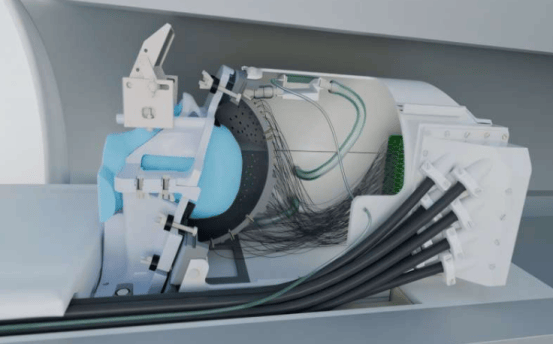
The system features a special helmet design integrated with 256 ultrasound elements, which focuses ultrasonic beams to target specific brain areas. Combined with a flexible plastic face mask fixation device, it improves stimulation precision by 30 times compared to traditional equipment and reduces the target area volume by approximately 1,000 times. Experiments involving seven volunteers confirmed that the system can precisely target the lateral geniculate nucleus (LGN) of the thalamus and induce sustained changes in visual cortex activity.
Senior author of the project, Professor Bradley Treeby from University College London, stated: "This advancement opens new opportunities for neuroscience research, enabling the study of causal relationships in deep brain circuits for the first time without surgery." The experiments showed that visual cortex activity remained reduced for at least 40 minutes after ultrasound stimulation, indicating the system's potential to induce long-lasting modulation of neural function.
First author Dr. Eleanor Martin noted: "The system is compatible with functional magnetic resonance imaging, allowing real-time monitoring of effects and providing possibilities for closed-loop neuromodulation and personalized treatment." The research team has established a spin-off company, NeuroHarmonics, dedicated to developing portable clinical devices.
This technology is expected to provide a non-invasive alternative to deep brain stimulation surgery for neurological disorders such as Parkinson’s disease and depression, enabling precise and non-invasive treatment. The researchers emphasized the need for further exploration of the mechanisms of ultrasound neuromodulation, but the current results mark an important advancement in the development of non-invasive brain stimulation technology.