
Scientists at La Trobe University have achieved a major breakthrough in materials research by successfully developing a new highly conductive material. This achievement is expected to bring disruptive changes to wearable technologies such as smartphones and medical devices. The related research was published in the journal ACS Applied Materials & Interfaces.
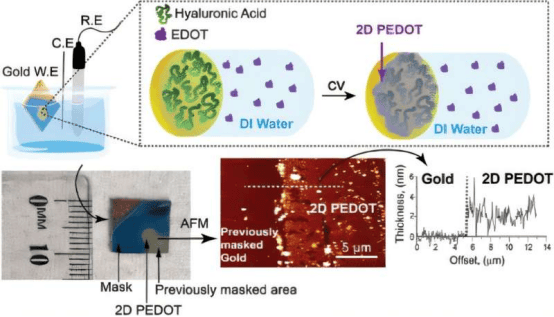
The new conductive material uses hyaluronic acid (widely used in skincare products) as a key raw material. By directly applying it to a gold-plated surface, a thinner and more durable film or polymer is formed, which can be applied to devices such as biosensors to achieve conductivity.
Lead researcher Associate Professor Wren Greene pointed out that this technology can significantly enhance the functionality of devices such as touchscreens and wearable biosensors, while reducing costs and improving usability. He noted that although conductive polymers developed nearly 50 years ago had potential, they faced manufacturing challenges such as poor film conductivity, opacity, and unstable properties. The newly developed "bound dopant templating" method has created a conductive polymer with excellent performance. It combines flexibility and durability, with conductivity comparable to metals, and is easy to replicate with good scalability.
Conductive polymers, as synthetic materials widely used in various smart devices, play an important role in smartphone touchscreens and medical devices that regulate patient drug dosage and delivery. This new study breaks traditional perceptions. Previously, it was believed that manufacturing conductive polymers required adding substances such as hyaluronic acid to a mixture of water and polymer to form particles. The new method directly coats hyaluronic acid onto gold, allowing scientists to precisely control the material's conductivity, shape, and appearance.
This new material is called 2D PEDOT. Although invisible to the naked eye, it possesses powerful performance far superior to similar materials and is highly likely to have a profound impact on the future development of smart sensor devices. Lead researcher and PhD candidate Luiza Aguiar do Nascimento excitedly stated that when directly connected to gold, not only was the polymer successfully formed, but these polymers were thinner, more conductive, and had an extremely high replication success rate.
Dr. Saimon Moraes Silva, Senior Researcher and Director of La Trobe University's Biomedical and Environmental Sensor Technology (BEST) Research Centre, said that this innovation has a huge impact on health and medical environment devices. Currently, it is difficult to consistently replicate the high-quality conductive polymers required for health and medical monitoring and drug delivery devices. This achievement creates new scalable, affordable, and repeatable properties for these materials.