

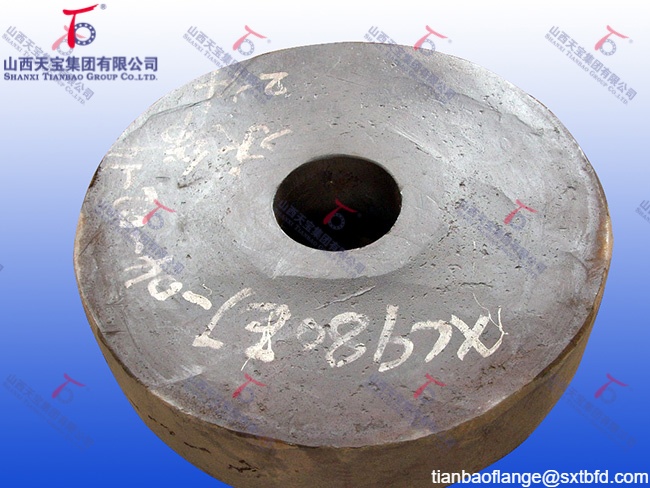

Product Introduction:
Gear blanks, as an essential component of gear transmission systems, have a wide range of applications and significant value.
Product Overview:
Gear blanks are a crucial part of gear transmission systems. Their basic structure is similar to that of finished gears, and although they are not finely processed, they already have the initial forms of features such as gear teeth, tooth grooves, end faces, tip circles, root circles, and pitch circles.
The blanks themselves do not directly participate in operation but provide a solid foundation for the finished gears. Forging ensures that the internal metal structure is dense and uniform, with reasonable fiber flow lines, imparting excellent mechanical properties. This ensures that the gears, once machined, can stably and efficiently transmit motion and power.
In terms of materials, commonly used steels include carbon steels like 45 steel for medium-load gears, alloy steels like 40Cr and 42CrMo with high hardenability and strength, and carburizing steels like 20CrMnTi with high surface hardness and wear resistance. Additionally, the materials must possess good forgeability, hardenability, and high purity.
Open-die forging is suitable for small-batch supply, with forging pressures ranging from tens to hundreds of tons. Closed-die forging is suitable for large-batch supply, with forging pressures typically ranging from hundreds to thousands of tons.
Sizes vary widely, from a few millimeters to several meters. Under specific standards, the outer diameter of blanks generally does not exceed 1200 mm.
Forged gear blanks typically do not involve strict sealing surfaces. However, considering subsequent requirements, related treatments may be applied. Common sealing forms include flat sealing, where the end face is machined flat and a sealing gasket is added, and fitted sealing, where the shaft hole or outer cylindrical surface is precision-machined to achieve a fit with other components.
