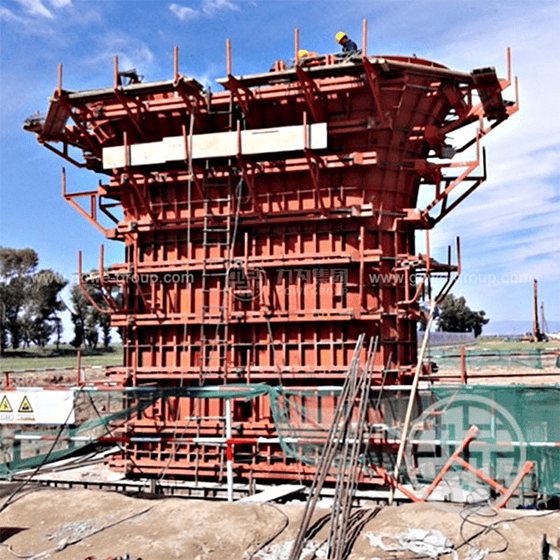


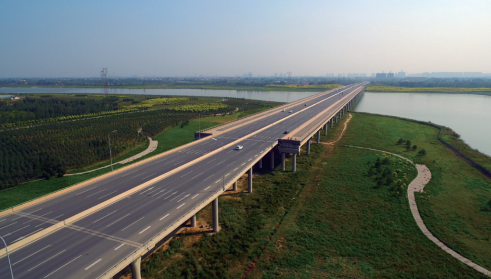
Bridge pier columns are the core load-bearing components of the bridge substructure, located above the bridge foundation (pile cap or pile group) and below the capping beam (or bearing). Their primary function is to withstand loads transmitted from the superstructure (such as vehicular traffic on the deck, self-weight of the girders, wind loads, etc.) and safely transfer them to the foundation, serving as a critical lifeline for ensuring the stability and safety of the overall bridge structure.
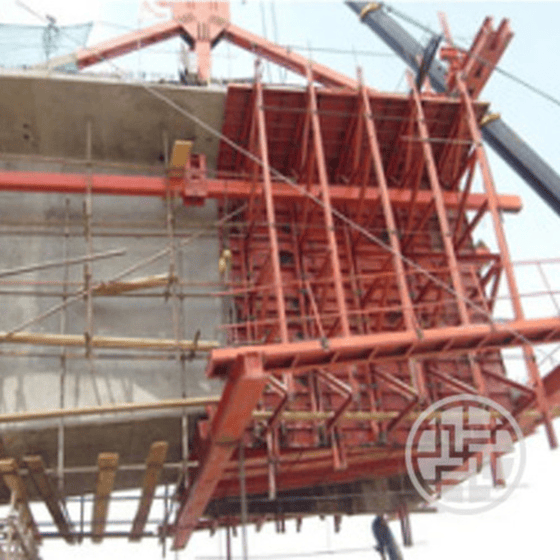
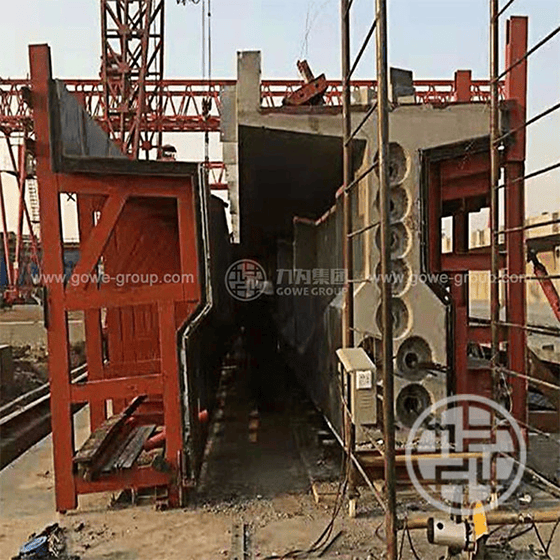
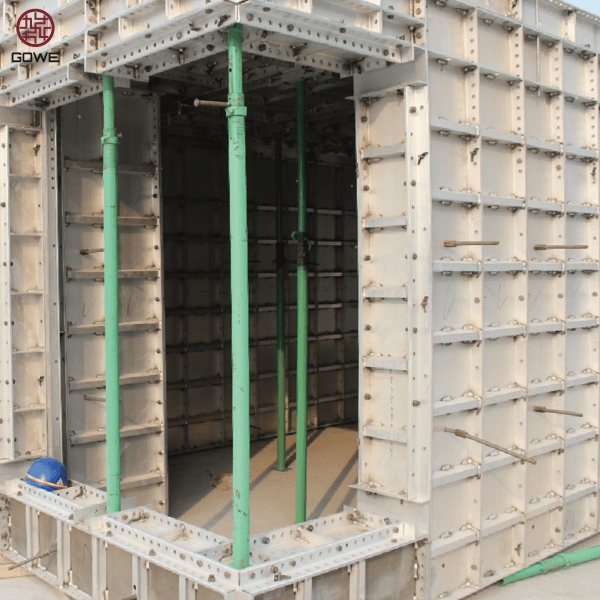
To meet the requirements for appearance, structural performance, and construction schedule in various scenarios such as highway bridges, high-speed railways, and urban interchange bridges, pier columns are typically constructed usinghigh-precision custom steel formwork for cast-in-place construction, ensuring the structural strength, surface flatness, and durability of the concrete members.
Pier Column Types and Structural Classification
According to bridge design specifications and structural system requirements, pier columns are mainly classified into the following common types:
-
Circular Solid/Hollow Pier Columns
Features: Low water resistance, uniform stress distribution, and convenient construction. Commonly used for river-crossing bridges or urban viaducts.
-
Rectangular/Square Pier Columns (including rounded-end types)
Features: High sectional stiffness and strong flexural capacity. Commonly used for mountain-area viaducts and continuous girder bridge substructures.
-
Thin-Walled Hollow High Pier Columns
Features: Light self-weight and high stiffness, suitable for long-span and canyon high-bridge construction, used in conjunction with self-climbing formwork or jump-form operations.
Core Product Technical Parameters
The following is the standard technical parameter table for bridge pier column construction and the associatedcustom steel formwork:
1. Pier Column Structural Design Parameters
| Parameter Item | Specification/Requirement | Remarks/Specification Notes |
| Concrete Strength Grade | C35 / C40 / C50 / C60 |
Designed according to bridge load rating |
| Reinforcement Cover Thickness | 35 mm – 50 mm |
For circular columns, arrange high-strength mortar spacers in a quincunx pattern, 4 per ring, with rings spaced at 2 m intervals |
| Cover Spacer Density | Circular columns: 4 per ring; Rectangular columns: ≥ 4 pcs/m² |
Increase density appropriately at critical load-bearing areas |
| Curing Requirements | Water spraying/film curing for no less than 7 days |
Ensure concrete strength development and durability |
2. Pier Column Custom Steel Formwork Parameters
| Parameter Item | Performance/Specification | Remarks |
| Panel Steel Plate Thickness |
≥ 5 mm |
Ensure sufficient lateral pressure resistance and rigidity to prevent formwork bursting/deformation |
| Circular Formwork Segment Height |
≥ 3.0 m / segment |
Reduce the number of joints and improve the surface flatness of the column |
| Rectangular Formwork Segment Height |
≥ 2.0 m / segment |
Facilitate transportation and on-site lifting and assembly |
| Formwork Joint Requirements | High sealing integrity, with waterstop strips applied at joints |
Strictly prevent common surface defects such as grout leakage, misalignment, and sand lines |
| Trial Assembly and Inspection | 100% trial assembly verification in factory/on-site |
Strictly inspect rigidity, flatness, and structural dimensions |
Core Product Advantages
- Precise Structure and High Compressive Rigidity: Manufactured with high-quality high-strength structural steel, with panel thickness of 5 mm or more, effectively withstanding lateral pressure during concrete pouring, ensuring zero dimensional deviation and no formwork bursting after casting.
- Excellent Surface Quality ("Mirror" Effect): The custom steel formwork features tight joints, combined with standard high-strength mortar spacer positioning, resulting in smooth, clean, and uniformly colored column surfaces after casting, free from pitting, honeycombing, and grout leakage.
- Standardized Segmental Assembly: Modular design with circular columns at 3 m or more per segment and rectangular columns at 2 m or more per segment, enabling rapid bolt-hole alignment and assembly with tower cranes or crawler cranes, significantly shortening the construction cycle per column.
- Quality Control and Full-Cycle Management: The formwork undergoes rigorous trial assembly and flatness verification before leaving the factory, offering high turnover rates and reliable safety.
V. Construction Process and Standard Procedures
1. Foundation Preparation and Rebar Tying: Clean the reserved bars on the pile cap/ground tie beam, and complete the welding and tying of the main reinforcement and stirrups of the pier column.
2. Installation of Cover Spacers: Arrange high-strength mortar spacers in a quincunx pattern as per specifications (4 per ring for circular columns, no less than 4 per square meter for rectangular columns).
3. Formwork Trial Assembly and Lifting/Assembly: After checking the flatness and sealing integrity of the custom steel formwork, apply release agent, lift and assemble segment by segment, tighten bolts, and secure with wind ropes.
4. Concrete Pouring and Vibrating: Pour in layers, control the drop height and vibrator insertion depth to prevent under-vibration or over-vibration.
5. Formwork Removal and Moisture Curing: Safely remove the formwork after reaching the specified stripping strength, and immediately apply film covering/water spraying for curing,with a curing period of no less than 7 days .

![IVECO Cash-in-Transit [DMT5048XYCL3-AM] - Chongqing Dima Industry Co., Ltd](https://img.wedoany.com/2026/0911/20260911030157582.png)