Symptoms and Identification Methods of Soybean Frogeye Leaf Spot
Frogeye leaf spot is a soybean disease caused by the fungus Cercospora sojina. It is named for the circular or angular lesions resembling a frog's eye that appear on the leaves. While seemingly minor, this disease can damage plant growth and spread infection. If not controlled promptly, it may spread to pods and seeds, leading to significant yield losses. Infected residues can overwinter in the field, increasing the risk for the following year. Data from 2024 shows that the disease caused approximately 3 million bushels of soybean losses. Correctly identifying soybean frogeye leaf spot helps distinguish it from other foliar diseases and enables effective control measures.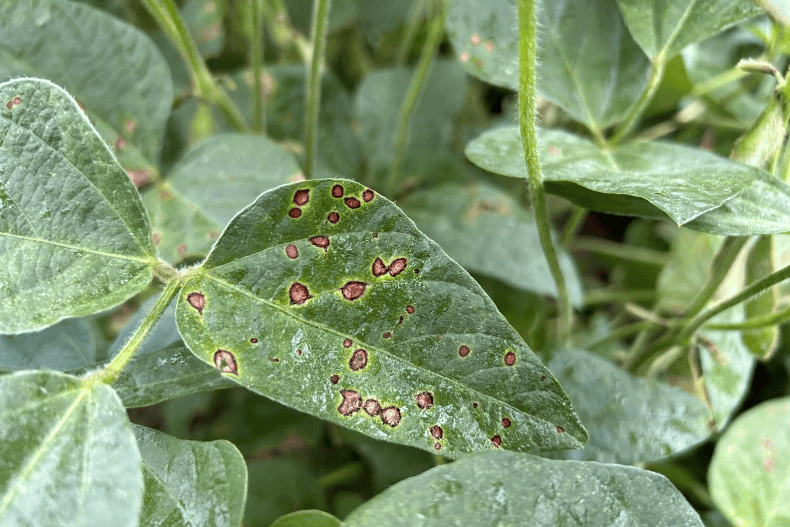
The infection cycle of frogeye leaf spot often begins on immature plants, such as seedlings or senescing flowers. Spread occurs via infected seeds, spores released from field residues, and short-distance dispersal by rain, irrigation, or wind. The fungus Cercospora sojina is polycyclic, capable of producing multiple spore generations during a growing season. Optimal conditions are temperatures between 70°F and 80°F combined with high humidity. Infected plants can serve as hosts, infecting neighboring plants. After tillage buries residues, the fungus may re-emerge two to three years later.
For fields with a history of soybean frogeye leaf spot, it is recommended to intensify scouting during the R1 to R6 growth stages, with priority around R1. Check at least a few plants per 10 acres. Symptoms appear as spots 1 to 5 mm in diameter scattered across the leaf surface; rarely, they may also appear on stems. As the disease progresses, the center of the spots becomes light gray with a red, brown, or purple border. Small black dots, which are fungal fruiting bodies, may appear in the center.
Environmental factors, such as hot and humid summers, favor the development of soybean frogeye leaf spot. Disease severity varies with field conditions; for example, areas that remain wet for extended periods are more conducive to fungal growth. For diagnosis, if spots have a purple border, they are likely frogeye leaf spot. More subtle symptoms include reddish lesions on stems and pods, which darken to brown and become sunken with age. The fungus can invade pod walls, damage seeds, and perpetuate the disease cycle. For effective management, consult seed retailers, extension offices, or professional company representatives for assistance.
Related Products



Industrial and Commercial Point-Type Gas Detector
Jinan Benan Technology Development Co., Ltd.
4HS-8 High-efficiency Peanut Inverted-laying Harvester
Hebei Yongfa Hongtian Agricultural Machinery Manufacturing Co., Ltd.
714CD Series C-Band Weather Radar
Chengdu Zhongdian Jinjiang Information Industry Co., Ltd.