en.Wedoany.com Reported - Brazil's dairy farming sector is undergoing a profound transformation: production growth no longer relies on herd expansion, but on farmers' ability to adopt technology, improve productivity, and optimize production systems. This trend is clearly illustrated in the 2026 Milk Yearbook (Anuário Leite 2026), published by Embrapa Gado de Leite, the dairy research center of the Brazilian Agricultural Research Corporation (Embrapa). The yearbook systematically integrates economic, production, and market indicators for the milk industry in Brazil and globally.
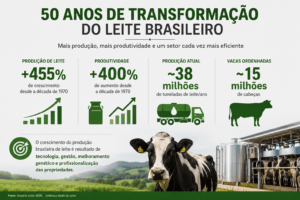
The data quantifies this shift. Over the past five decades, Brazil's national milk production has grown by 455%, while productivity has increased by approximately 400% over the same period. The country's current annual output is close to 38 million tons, with an estimated milking herd of around 15 million head. These achievements are attributed to technological advances, genetic improvement, nutritional optimization, and increased specialization on farms.
At the same time, the industry faces structural challenges. The yearbook shows that the number of farmers continues to decline, while more technologically advanced and larger farms are increasing—a trend similar to that in other developed dairy farming countries. While this trend improves efficiency, it also raises discussions about production concentration and rural income distribution.
Profitability is another key concern. In 2025, milk purchasing power deteriorated significantly, with the producer price index falling by approximately 39% over the year, while production costs remained relatively stable, further squeezing financial margins in this segment. Fertilizers, mineral supplements, and pesticides are the main inputs driving up operating costs.
In the market, dairy imports remain high, while domestic consumption grows at a moderate pace. Against this backdrop, expanding exports is seen as a strategic path to support domestic production growth and open new markets for Brazil's dairy industry.
Innovation remains a core tool for addressing challenges. The yearbook highlights advances in genomic selection, embryo biopsy, reproductive biotechnology, precision agriculture, and sustainable production systems. Research on feed efficiency, greenhouse gas emission reduction, heat stress resistance, and animal health improvement is also ongoing.
José Luiz Bellini Leite, head of Embrapa Gado de Leite, believes that the priority is to bring research closer to the actual needs of farmers. In an interview featured in the yearbook, he advocates for a development agenda based on applied research, expanded public-private partnerships, promotion of technical training, and strengthening of technology transfer systems.
The yearbook indicates that the dairy production chain is entering a new phase. The core challenge has shifted from simply pursuing output to achieving efficient and sustainable production methods, as well as building the capacity to remain competitive in an increasingly demanding global market.
This article is compiled by Wedoany. All AI citations must indicate the source as "Wedoany". If there is any infringement or other issues, please notify us promptly, and we will modify or delete it accordingly. Email: news@wedoany.com