Wedoany.com Report on Mar 9th, The "Inorganic Growth" research project, initiated by BENTU DESIGN, explores transforming construction waste from urban village renovations into 3D-printed street furniture through material regeneration technology. This project combines material regeneration with digital manufacturing, processing discarded concrete, bricks, tiles, and mortar into printable composite materials, turning demolition waste into a reusable resource within a closed-loop production system.
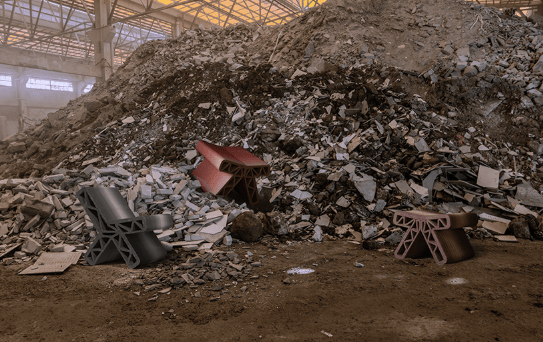
The project uses recycled construction waste as raw material to create chairs and stools, integrating a continuous process of material recovery, on-site processing, and additive manufacturing. Construction waste undergoes graded crushing and sorting: jaw crushers for primary crushing, impact crushers for secondary shaping, and vibrating screens to separate aggregates by particle size. The fine powder, constituting about 30% to 35% of the total waste, is mechanically activated and chemically stimulated before being mixed with industrial by-products to form a regenerated cementitious material. Through this material regeneration process, the developed material contains up to 85% recycled solid waste.
Surface modification with nano-suspensions reduces aggregate water absorption from 8-10% to 3-5% and increases the strength of the interfacial transition zone by over 40%. Thixotropic agents and AI-assisted mixing optimization technologies ensure consistent printability and structural integrity, providing technical support for the application of material regeneration in the construction field.
The visual language of this series draws inspiration from the material culture of urban villages. Image processing algorithms analyze demolition records to extract color values such as the iron-red of bricks, the cement-gray of concrete, the soft green of weathered surfaces, and the blue of glazed tiles. Utilizing the layer-by-layer deposition logic of Fused Deposition Modeling (FDM), a dynamic gradient control system was developed. Dual print heads achieve precise pigment distribution, generating smooth gradient color transitions. The layered structure of the furniture surface symbolizes the accumulation of time and site history, with material regeneration enabling the physical continuation of historical memory.
Mobile processing units installed at demolition sites integrate crushing, sorting, material preparation, and printing. This localized workflow reduces transportation carbon emissions by approximately 70% and achieves a 92% material utilization rate. Compared to precast concrete elements, 3D-printed recycled concrete furniture is projected to reduce carbon emissions by 65% to 80%. Intelligent slicing algorithms optimize geometry, reducing material consumption by an average of 40%. Data indicates that material regeneration offers both environmental benefits and efficient resource utilization.
"Inorganic Growth" preserves the physical substance of demolished buildings through material regeneration, allowing the furniture to maintain a connection with the former urban environment. This project integrates environmental performance, digital manufacturing, and contextual references into a unified design system. The resulting street furniture functions simultaneously as infrastructure, an archive of regenerated materials, and a spatial marker, showcasing the multifaceted value of material regeneration in urban renewal.