en.Wedoany.com Reported - A research team from MIT, in collaboration with several universities, recently introduced an artificial intelligence system named VisiPrint, aimed at providing 3D printing users with more precise aesthetic visual previews. By combining digital design screenshots and material images, this system automatically generates appearance renderings of printed objects, helping to reduce reprints and material waste caused by mismatched colors, textures, or shadows.
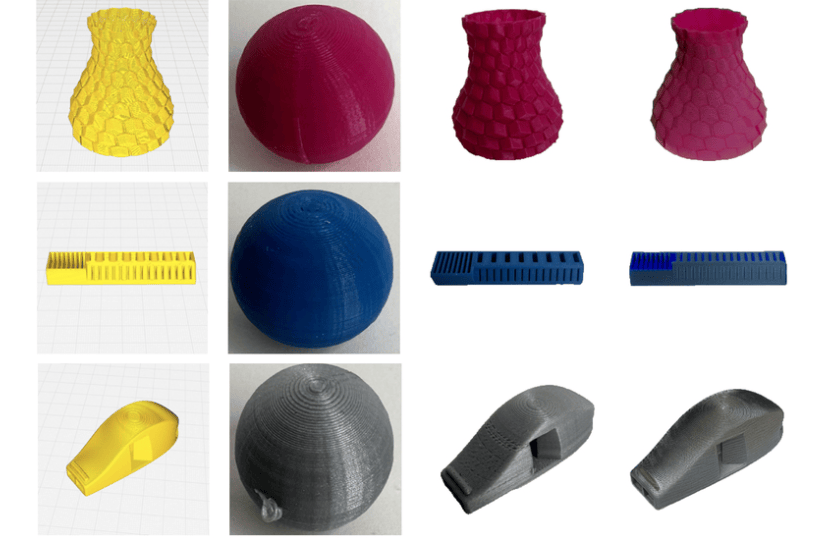
The VisiPrint system focuses on Fused Deposition Modeling (FDM), a common 3D printing technology, and utilizes two AI models working in synergy to overcome appearance variation challenges during the manufacturing process. Users only need to upload design screenshots from slicing software and images of material samples. The system can then extract key features, combine geometric structures and slicing patterns to generate realistic previews. Its special adjustment method ensures the accuracy of shapes and details through depth maps and edge maps.
"3D printing can be a very wasteful process. Some studies estimate that up to one-third of materials go directly to landfill, often from prototypes users ultimately discard. To make 3D printing more sustainable, we want to reduce the number of attempts needed to get the desired prototype. Users shouldn't have to try all printing materials before finalizing a design," said Maxine Perroni-Scharf, an MIT graduate student in electrical engineering and computer science and the lead author of the VisiPrint paper.
This tool has potential applications in fields such as dentistry and architecture, for example, helping clinicians match the appearance of dental crowns or assisting designers in evaluating model visual effects. User studies show that VisiPrint outperforms other methods in overall appearance and texture similarity, and the preview process takes only about one minute on average, representing a significant speed improvement.
"'What You See Is What You Get' was a major reason for the 'success' of desktop publishing in the 1980s because it allowed users to get what they wanted on the first try. It's also time to achieve WYSIWYG for 3D printing. VisiPrint is an important step in that direction," commented Patrick Baudisch, a professor of computer science at the Hasso Plattner Institute.
This research will be presented at the ACM CHI Conference on Human Factors in Computing Systems and was partially funded by the MIT Morningside Academy of Design Fellowship and the MathWorks Fellowship. In the future, the team plans to further optimize detail handling and expand functionality to promote the sustainable development of 3D printing technology.
This article is compiled by Wedoany. All AI citations must indicate the source as "Wedoany". If there is any infringement or other issues, please notify us promptly, and we will modify or delete it accordingly. Email: news@wedoany.com