Microsoft Copilot Plans to Integrate OpenClaw-like Agent Capabilities, Enterprise-Grade Security Control Becomes Core Differentiator
en.Wedoany.com Reported - April 14, 2026 - Microsoft confirmed to the technology media The Information that the company is developing a series of new features for its AI assistant Copilot, aiming to introduce autonomous agent capabilities similar to the open-source project OpenClaw for enterprise application scenarios. Microsoft Corporate Vice President Omar Shahine explicitly stated that the company is currently "exploring the potential of technologies like OpenClaw in enterprise application scenarios" and emphasized that the version for enterprise customers will offer stricter security control mechanisms than the open-source OpenClaw. This initiative is personally driven by Microsoft CEO Satya Nadella, who has prioritized the reorganization of the Copilot team and plans to launch specialized intelligent agents for specific functions such as marketing, financial analysis, and sales management.
According to The Information, the new features under development will enable Microsoft 365 Copilot to operate autonomously around the clock. This agent can continuously monitor a user's Outlook inbox and calendar data, automatically generate suggested task lists daily, and is capable of completing multi-step complex tasks over longer time spans. Unlike OpenClaw's model, which emphasizes running directly on the user's local device, Microsoft's enterprise version will be deployed on the Azure cloud infrastructure, with all operations completed in the cloud, thereby achieving centralized control over data flow and permission usage. This design aims to address enterprise customers' core concerns regarding data sovereignty and operational auditing.
Regarding existing product offerings, Microsoft has already launched multiple intelligent agent tools with autonomous execution capabilities. In March 2026, Microsoft released Copilot Cowork, a tool driven by its self-developed "Work IQ" technology, which can perform specific operations directly within Microsoft 365 applications, rather than merely returning search results or engaging in text conversations within an independent workspace. According to Microsoft's announcement, Copilot Cowork has integrated Anthropic's Claude model as an optional engine. It is noteworthy that OpenClaw also supports multiple models, with Claude being one of the preferred models among its open-source community users. In February 2026, Microsoft also launched a preview of Copilot Tasks, a tool focused on tasks such as email organization, itinerary planning, and meeting scheduling, positioned more towards high-end individual users, also running on a cloud-based deployment.
The open-source project OpenClaw was officially released in November 2025, positioning itself as a groundbreaking open-source intelligent agent coordination platform. This platform allows users to create AI agents that perform various operations on behalf of the user on local devices, with a particular emphasis on lowering the barrier to entry, enabling non-professional developers with basic programming skills to easily deploy and coordinate AI agent clusters. However, in recent months, OpenClaw has drawn widespread attention in the security field due to its potential for uncontrolled behavior, with several cases reported of agents accessing user inboxes and performing sensitive operations without sufficient authorization. The Information's report cites sources familiar with the matter stating that Microsoft's technical team is confident that through enterprise-grade architectural design, they can achieve a version that retains core autonomous capabilities while meeting higher security standards. Although OpenClaw supports the Windows platform, the Mac Mini has consistently been the preferred hardware for its developer community, a demand that once significantly boosted sales of related models.
According to further disclosures by The Information, Microsoft's product roadmap also includes launching highly customized OpenClaw-like agents for different business roles. For example, agents designed for marketing personnel are only granted access to marketing campaign-related data, sales agents are isolated within customer relationship management systems, and accounting agents' permissions are strictly limited to financial data, ensuring secure data and operational isolation between different business units. The Azure cloud platform and the Agent 365 platform will jointly provide the underlying computing power support and task scheduling framework for these specialized intelligent agents.
From a technical roadmap perspective, Microsoft has not fully committed to a single operational model. According to sources familiar with the matter, internal R&D teams are still evaluating whether to adopt a fully cloud-hosted architecture or to incorporate the local execution feature favored by OpenClaw supporters while retaining cloud-based control capabilities. This trade-off directly impacts the final product's response latency, offline availability, and the enterprise's reliance on end-device computing resources. Microsoft is expected to showcase some related feature prototypes for the first time at the Build developer conference in San Francisco on June 2, 2026. This move signifies a further clarification of Microsoft's strategic focus in the field of AI agents, namely, to drive the comprehensive evolution of Copilot from a passive Q&A assistant to an enterprise-grade autonomous intelligent agent that proactively executes tasks.
This article is compiled by Wedoany. All AI citations must indicate the source as "Wedoany". If there is any infringement or other issues, please notify us promptly, and we will modify or delete it accordingly. Email: news@wedoany.com
Related Products


Conveyor Belt Intelligent Monitoring System
LUO YANG WIRE ROPE INSPECTION TECHNOLOGY CO., LTD.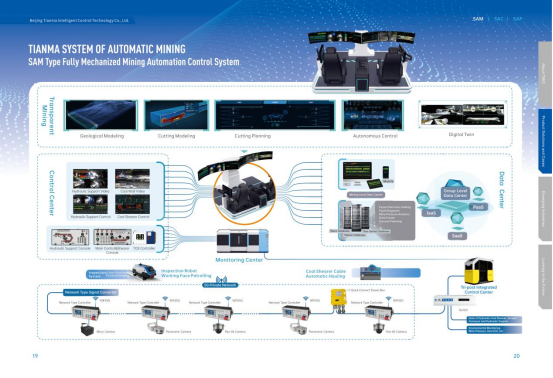
Comprehensive Mining Automation Control System
Beijing Tianma Intelligent Control Technology Co., Ltd.
TWP16 P-Band Tropospheric Wind Profile Radar
China Huayun Meteorological Technology Group Co., Ltd.

MUX Series Communication Interface Device for Security and Stability Control System
Nanjing NR Electric Co., Ltd.


Mine Explosion-proof and Intrinsically Safe Industrial Ethernet Ring Network (10 Gigabit/Gigabit)
Chongqing Mas Sci&Tech Co., Ltd.