IBM Releases Qiskit Fermions 0.1.0
en.Wedoany.com Reported - IBM Quantum has officially released Qiskit Fermions (v0.1.0), an open-source software library and transpiler extension for fermionic systems, capable of representing fermionic operators, building domain-specific fermionic circuits, and optimizing mappings to qubit architectures. Built on a high-performance Rust core with Python and C bindings, the library addresses the compilation gap between interacting particle physics problems—such as quantum chemistry and condensed matter simulations—and standard qubit processors.
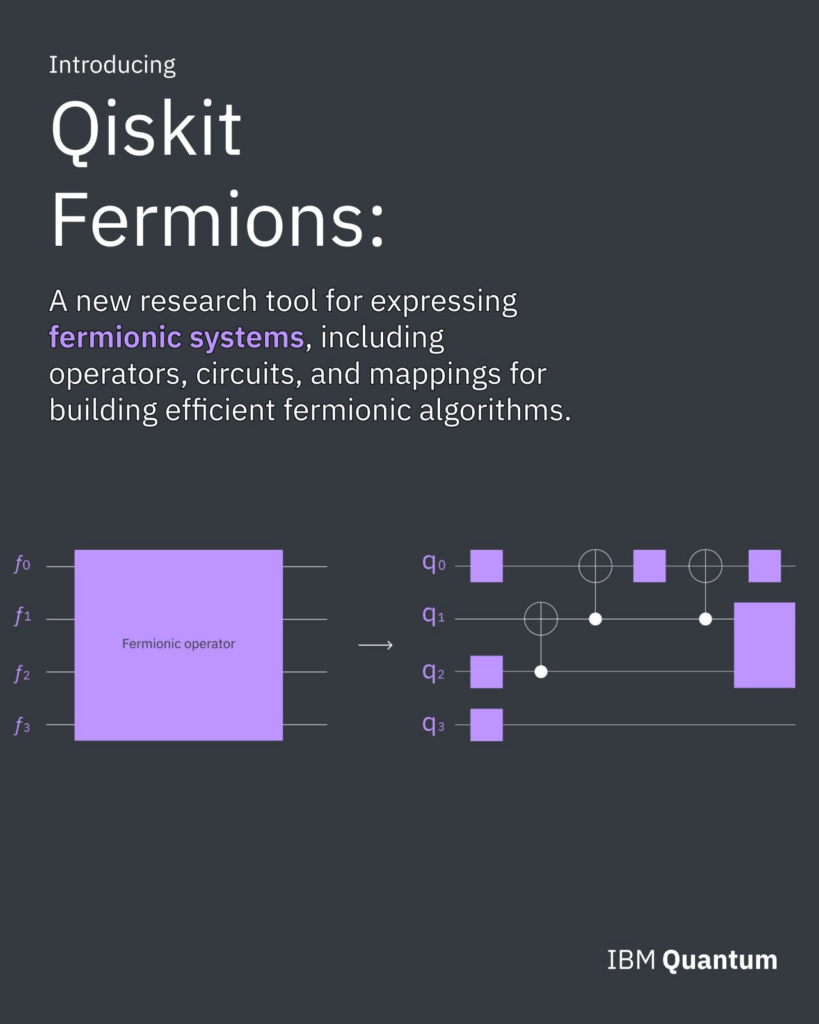
Qiskit Fermions adopts a layered design: the core framework is a high-performance Rust core, with a Python API and C bindings on top, released under the Apache 2.0 license. In terms of transpilation strategy, the library supports delayed fermion-to-qubit synthesis and introduces auxiliary-qubit-assisted flow-set encoding. For ecosystem integration, it interfaces directly with ffsim (Fock-space simulation), while also connecting to sampling-based quantum diagonalization (SQD) plugins as well as qDRIFT and SqDRIFT stochastic compilation techniques.
In the compilation workflow, traditional quantum chemistry pipelines typically first map fermionic Hamiltonians to qubits via transformations such as Jordan-Wigner, and then execute time-evolution algorithms. Qiskit Fermions reverses this order, retaining operations within a domain-specific "fermionic circuit" layer during the early compilation stages and deferring the conversion to qubit gates until the final transpilation step, thereby preserving physical symmetries and particle-number conservation rules throughout the deeper compilation pipeline.
In benchmark tests of 1D Fermi-Hubbard time evolution, with auxiliary-qubit-assisted local flow-set encoding, particle hopping terms are converted to single-qubit rotations, and the two-qubit gate depth remains constant at 12 across system sizes ranging from 4 to 100 sites; in comparison, traditional Jordan-Wigner Trotterization reaches a depth of 407 at 100 sites. The library's encoding channels are pluggable, allowing researchers to use built-in conversion channels or custom fermion-to-qubit mappings without altering high-level algorithm logic. Native ffsim integration enables circuits to be simulated in the compact fermionic Fock space rather than the 2^N-dimensional qubit Hilbert space, accelerating local validation.
Qiskit Fermions was developed by IBM researchers Max Rossmannek, Jennifer Glick, and Robert Davis, and is part of IBM's "utility mapping tools" initiative. This series of reusable domain modules aims to bridge complex physics problem definitions with fault-tolerant and error-mitigated execution, directly supporting SQD plugins for ground-state energy estimation as well as stochastic compilation techniques such as SqDRIFT.
Related Products


D12 Humanoid Robot
Automation Research Institute Co., Ltd. of China South Industries Group Corporation
Flat Portable Satellite Terminal 0.35m Aperture Manual Portable Terminal
China Starwin Science & Technology Co., Ltd.
Multi-function Marine Monitoring Low-altitude Detection Radar Sea-air Boundary Ocean Dynamic Environment Measurement
Chengdu Dixin Technology Co., Ltd.

Comprehensive Mining Automation Control System
Beijing Tianma Intelligent Control Technology Co., Ltd.
Industrial and Commercial Point-Type Gas Detector
Jinan Benan Technology Development Co., Ltd.
KJD127(A) Mining Explosion-Proof and Intrinsically Safe Computer
Taiyuan Xiangming Intelligent Control Technology Co., Ltd.

MUX Series Communication Interface Device for Security and Stability Control System
Nanjing NR Electric Co., Ltd.