China's XPENG Releases VLA 6.3.0, Robotics Division Raises $900 Million
en.Wedoany.com Reported - Over the past week, XPENG released its second-quarter results, the VLA 2.0 6.3.0 intelligent driving system, and funding progress for its humanoid robot IRON—three moves all centered on physical AI. The related outcomes have not yet been fully reflected in current financials, but they are opening a new phase of development for this rapidly expanding tech company.
According to the financial report, XPENG's second-quarter revenue reached $2.91 billion, up 8.0% year-over-year and 51.5% quarter-over-quarter. Overall gross margin stood at 20.7%, up from 17.3% in 2025; by comparison, Tesla's gross margin was 16.8%. However, automotive business margin fell to 12.1%, down from 14% in 2025, partly due to costs associated with new model launches. The gross margin improvement was driven mainly by the services business, with the majority of revenue coming from technology R&D services provided to Volkswagen Group. This revenue structure brings XPENG closer to a tech company in terms of profitability, rather than a pure automaker.
Technology investment also weighed on current-period profits, with XPENG reporting a total net loss of $200 million, mainly driven by a 35% year-over-year increase in R&D spending, as well as higher administrative and selling expenses from global expansion and new model launches. The L03 launch event held in Munich in July, for example, involved significant investment. As multiple models ramp up production and enter the delivery phase, these R&D and marketing investments will gradually be reflected in subsequent operations.
Last Thursday, XPENG released VLA 2.0 6.3.0, the first major version upgrade since the system's initial VLA 2.0 launch, which will be pushed via OTA in the coming weeks. Upgrading an intelligent driving system requires balancing safety, reliability, and response speed, all while operating under constraints of latency, compute power, and power consumption. If new software cannot run smoothly on existing hardware, the upgrade holds no practical value.
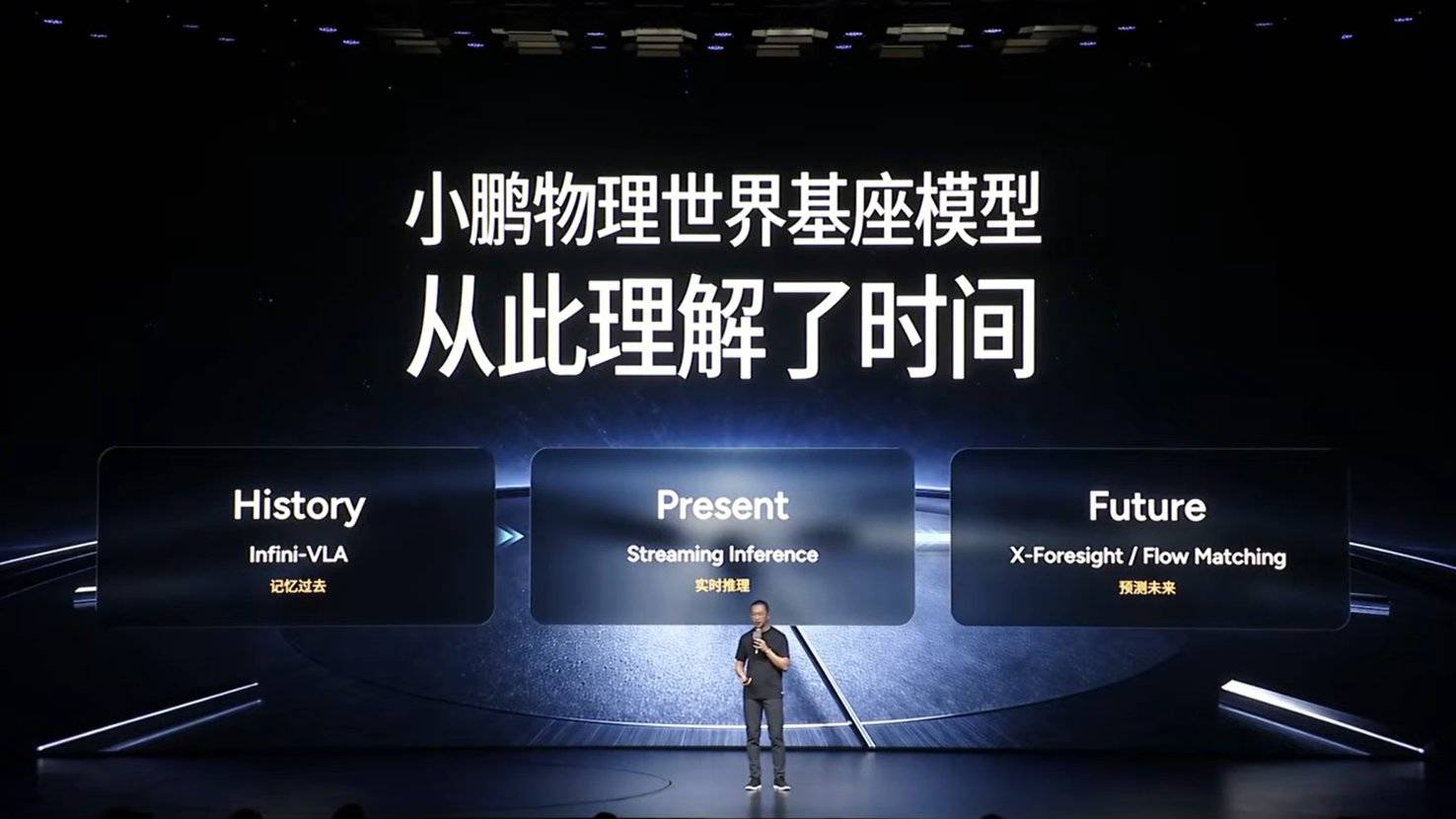
The updated VLA 2.0 model introduces a temporal dimension alongside spatial perception, using a 4D approach that combines historical events to predict next-step trajectories. Powering this capability is Infini-VLA, which can draw on an infinitely long historical timeline during decision-making. In real-world driving scenarios, XPENG found that historical memory typically does not need to exceed 30 seconds, so the memory window was set to 30 seconds.
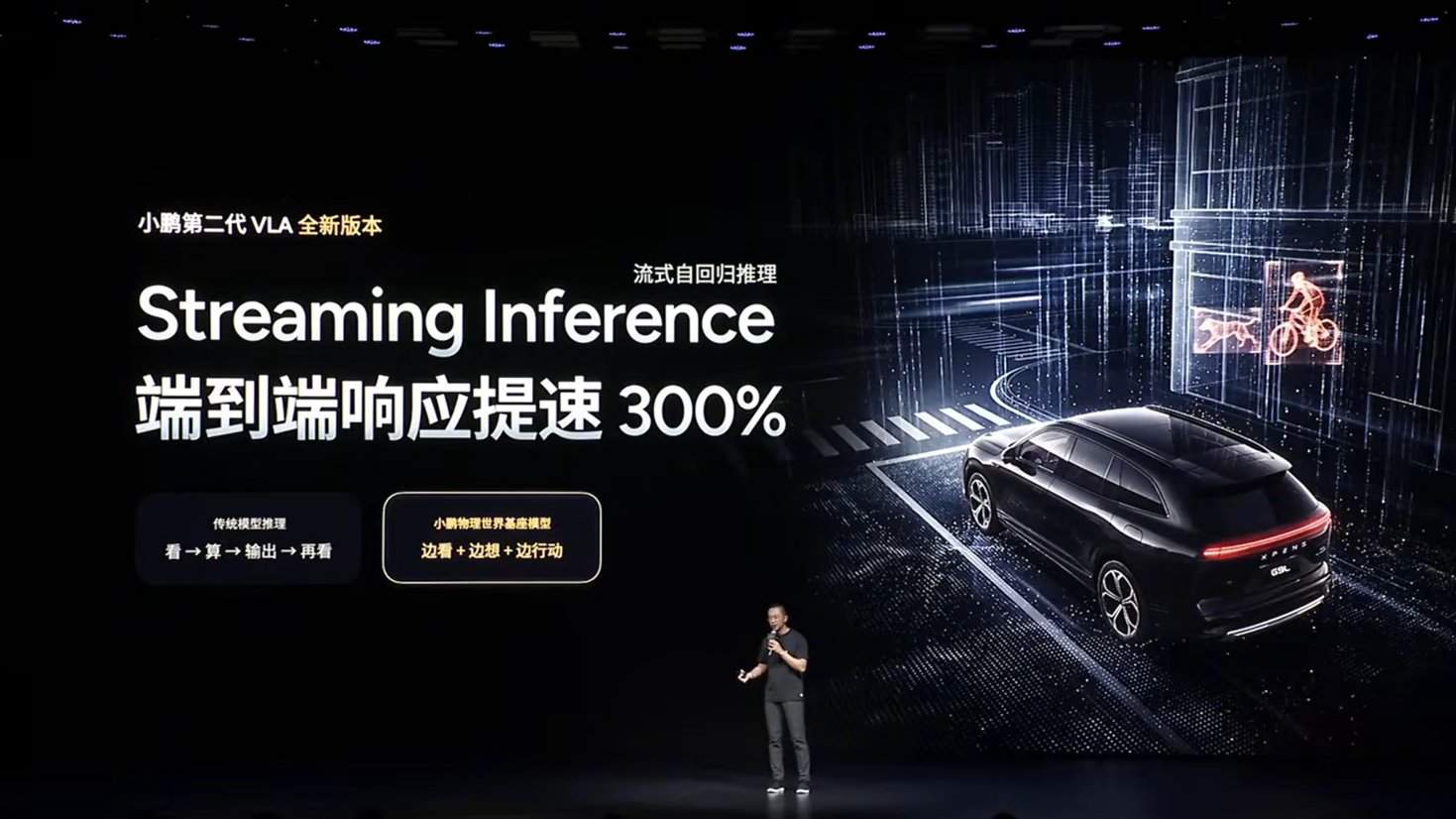
Since a vehicle cannot stop to process information or plan actions while driving, the new upgrade adopts Streaming Inference, allowing perception, reasoning, and trajectory token output to run simultaneously and continuously. XPENG claims this approach improves latency and response speed by 300%.
X-Foresight, announced by XPENG in June, is now available to the public. The system infers traffic conditions for the next 6 seconds based on historical data, enabling proactive reasoning. Its underlying capability supports predictions of up to 21 seconds, but is limited to 6 seconds by default to conserve compute power. The Flow-Matching mechanism maps data onto multiple future paths, selecting the optimal outcome through probabilistic decision-making. Combining these technologies, XPENG claims a 20x improvement in safety performance and describes this human-like intelligent driving system as possessing "beyond-human" capabilities.
XPENG operates L4 Robotaxi services using the same hardware platform, having completed over 2,000 orders for internal customers on public roads. China's intelligent driving regulations are stricter than those in the U.S., but broader commercialization is expected to arrive soon.
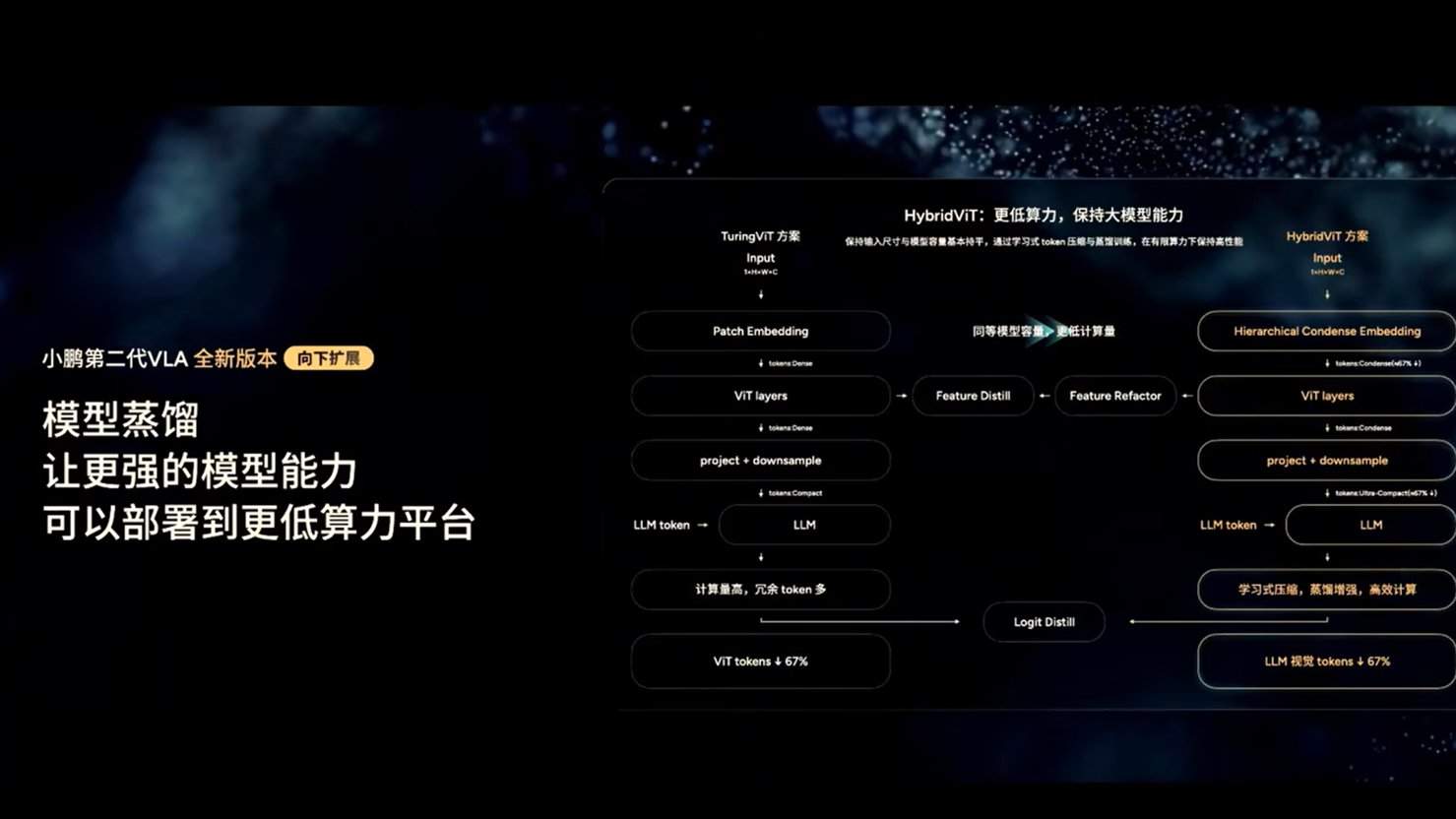
The full capabilities of VLA 2.0 are reserved for models equipped with multiple self-developed Turing chips, but single-chip models will also receive corresponding VLA capabilities. Reducing from dual chips to a single chip is not simply a halving of capability: XPENG uses HybridViT to simplify processing requirements, preserving as much underlying capability as possible and minimizing performance trade-offs. These changes involve underlying architecture adjustments rather than direct feature cuts.
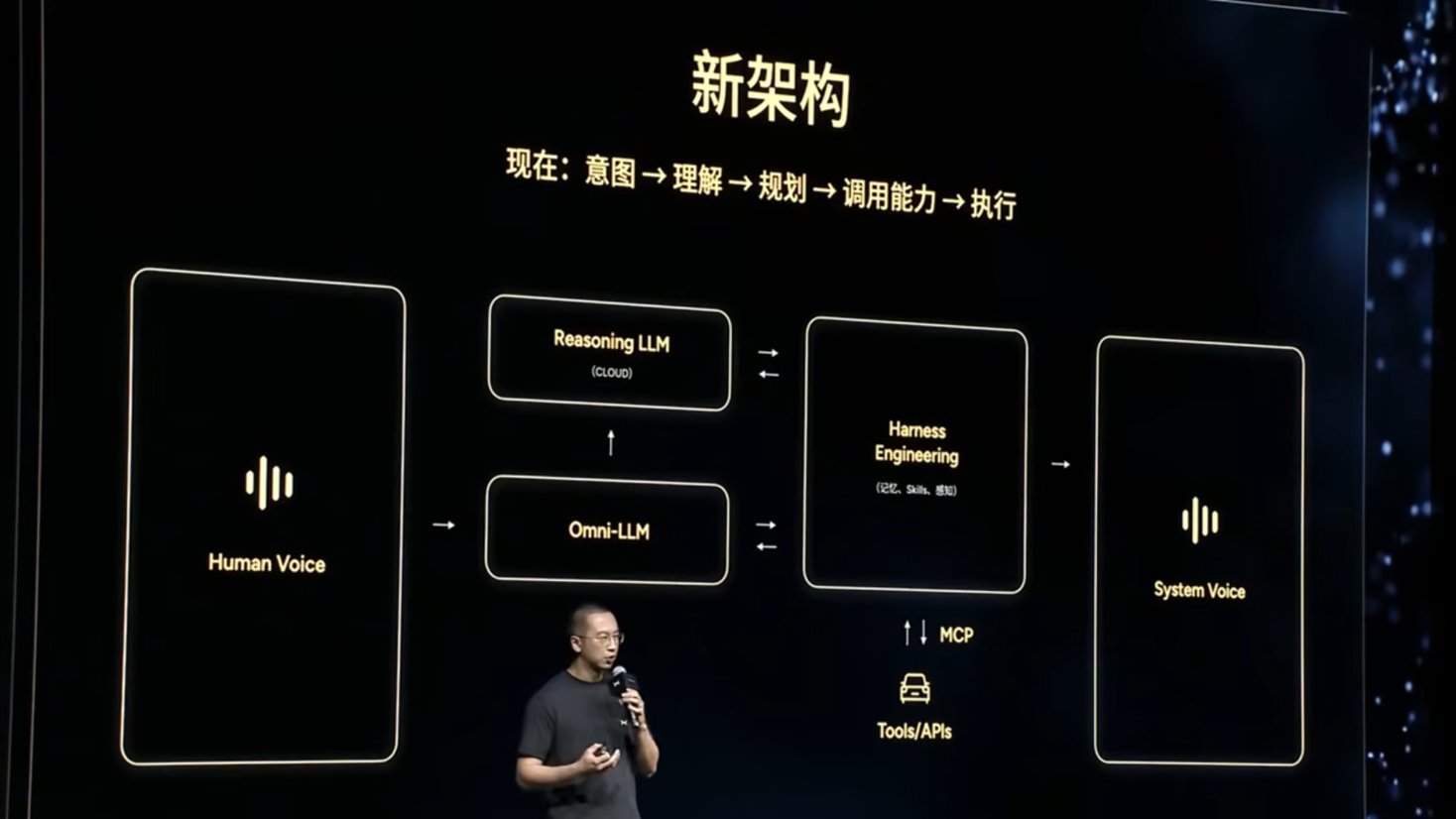
The Master Agent uses an Omni multimodal model, processing voice interactions into human-like conversation. XPENG describes it as essentially "turning voice interaction into a robot." The system processes voice locally using dedicated Turing chips and combines environmental understanding to interpret user intent. Users do not need preset commands—destinations and routes are identified through natural conversation. Plans can be modified at any time during the drive; if the user needs to pull over, the system finds a safe spot on its own, with no touchscreen operation required. In a demo video, a user navigated to a restaurant with a difficult-to-pronounce name using only voice, specifying by dish type, and the vehicle stopped in front of a black building in the neighborhood. Nearly all vehicle functions can be controlled by voice. This interaction style is close to the KITT system from the TV series "Knight Rider," and differs significantly from common voice assistant experiences—real-world effectiveness remains to be verified. XPENG views voice control as a necessity for Robotaxis, believing that driverless scenarios require this level of interaction to ensure safe operation. The model's generalization capability also helps with rapid adaptation when entering new markets.
The division of labor among multiple Turing chips has also become clearer with this release: the first chip handles intelligent driving, the second expands capabilities, the third is dedicated to voice control and communication, and Robotaxi models include a fourth chip as redundancy for driverless scenarios. Each chip delivers 750 TOPS of compute power, exceeding the total compute capability of Tesla's HW4.
Fleet expansion has brought more training data, with the cumulative video clips now reaching 110 million. The X-World simulation platform generates 290% more simulation models per day compared to June. Leveraging both real and simulated data, the model's handling of edge cases such as construction zones and ferries has been enhanced.
Regarding version rollout, Ultra and Ultra SE models will receive the new-generation VLA 2.0 update in September; Max versions equipped with a single Turing chip will receive the VLA Lite update next month; older models with dual NVIDIA Orin chips will receive upgrades later this year. There is no news yet for models with a single Orin chip.
XPENG has not adopted a subscription model, instead providing new capabilities to existing customers via OTA, stating it "does not want to simply reduce model parameters, but hopes to give everyone a more consistent experience." The features actually delivered exceed the original promises. By contrast, some companies charge extra to unlock existing hardware features, while others show gaps between promises and delivery.
Previous test drive feedback on VLA 2.0 has shown impressive human-like driving performance and rapid system learning. If version 6.3.0 delivers on its promises, XPENG's leadership in intelligent driving will further widen. This upgrade will not immediately contribute revenue, but user recognition of new features after real-world experience is expected to boost vehicle sales—especially high-spec models with the most advanced features—while also creating conditions for licensing technology to other automakers.
XPENG is delivering capabilities to customers that exceed the original expectations of the hardware. Beyond intelligent driving, XPENG is also making moves in robotics.
XPENG's robotics division, Dogotix, completed a $900 million funding round at a valuation of $6.3 billion, which XPENG describes as "the largest single-round private financing in the history of China's embodied intelligence industry." As planned, IRON will be deployed to XPENG stores in 2026 to provide sales support, with deliveries to external customers in the retail and service industries beginning in 2027. Monthly production capacity of several thousand units will expand further with demand.
IRON is a highly humanoid robot in form and design, with R&D focused on human-robot interaction. However, humanoid robots are not the ideal form for all industrial scenarios. Alibaba and Tencent have joined as strategic investors, as their Alipay and WeChat Pay systems cover a large share of daily transactions in China.
After the independent fundraising, Dogotix remains under XPENG's control but is no longer a wholly-owned subsidiary, which entails additional reporting obligations and greater transparency into the robotics business's performance. XPENG states that each robot's lifetime revenue from sales and upgrades could be higher than that of a car. As sales revenue begins to grow next year, its margins and profitability will be worth watching.
XPENG reuses the same infrastructure and software systems across different product lines to amortize R&D investment. The company uses an iceberg metaphor for this shared system: the invisible 95% below the waterline is shared, while the visible forms above the surface differ.
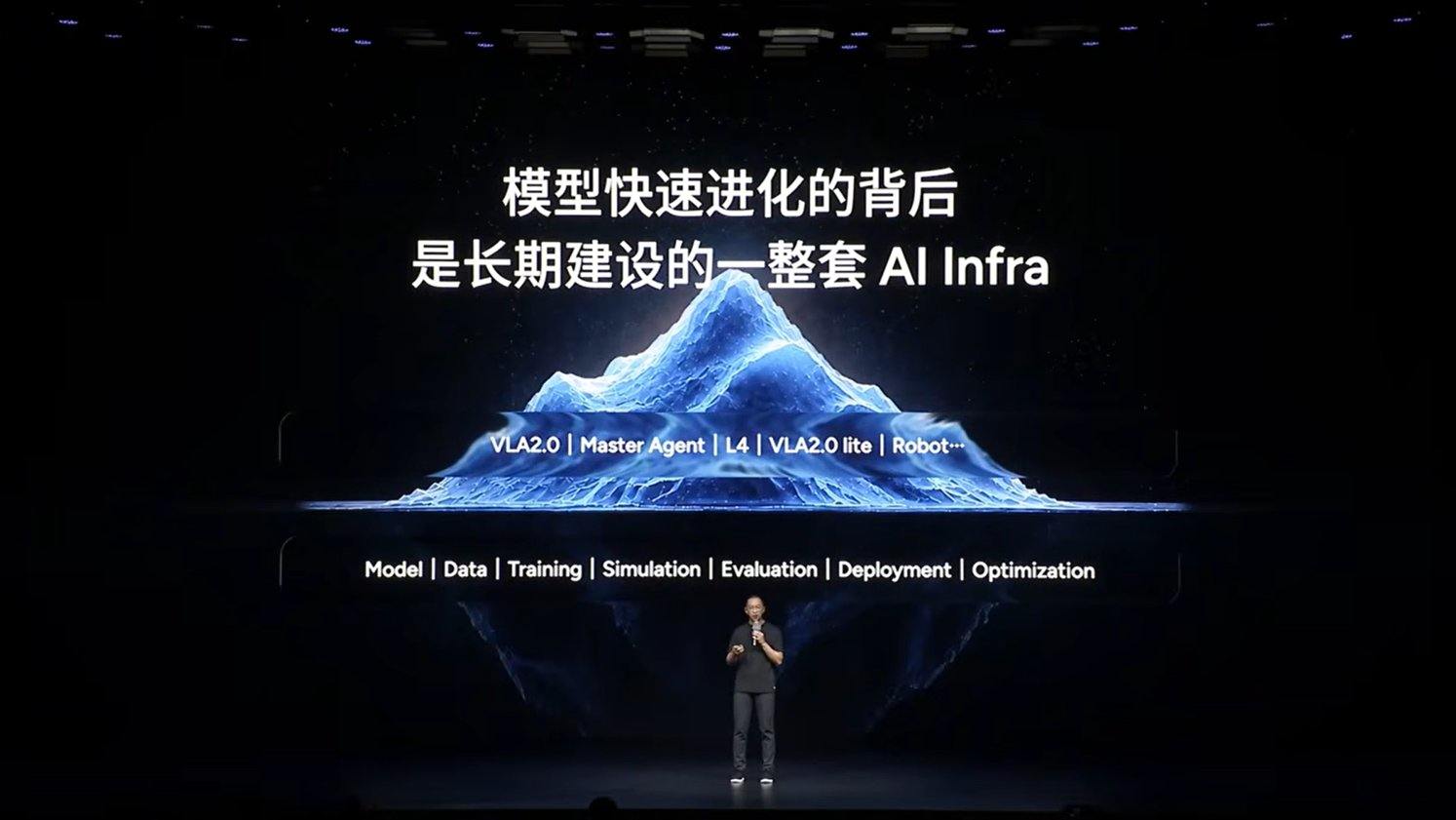
XPENG's investment in physical AI goes beyond these releases. The company's strategy is to tackle the hardest problems first, then address relatively easier ones, believing that after fully building out the physical AI R&D system, the harder the initial challenges, the easier subsequent problems become. By not prioritizing "low-hanging fruit," it is difficult to produce the immediate results some short-term investors expect. Among fast-paced Chinese peers, this trade-off is not an easy one.
XPENG addresses "unknown unknowns"—edge cases that cannot be reasonably foreseen during the planning phase—through rapid iteration. The company states that only by fully building out the AI system can such problems be continuously solved through fast iteration. It calls this cycle the "AI flywheel": better cars bring more data, data drives software improvements, software boosts car sales, more cars cover more edge cases, leading to stronger models that extend to other product lines.
Looking ahead to foreseeable intelligent driving regulatory requirements, intelligent driving systems must perform inference locally, placing higher demands on chip compute utilization and model efficiency. Some competitors compensate for compute shortfalls by adding sensors, or rely on centralized data centers, the latter facing pressure in privacy and compliance. The route of running AI models efficiently on-device allows Turing chips and AI applications to extend beyond physical AI into more scenarios.
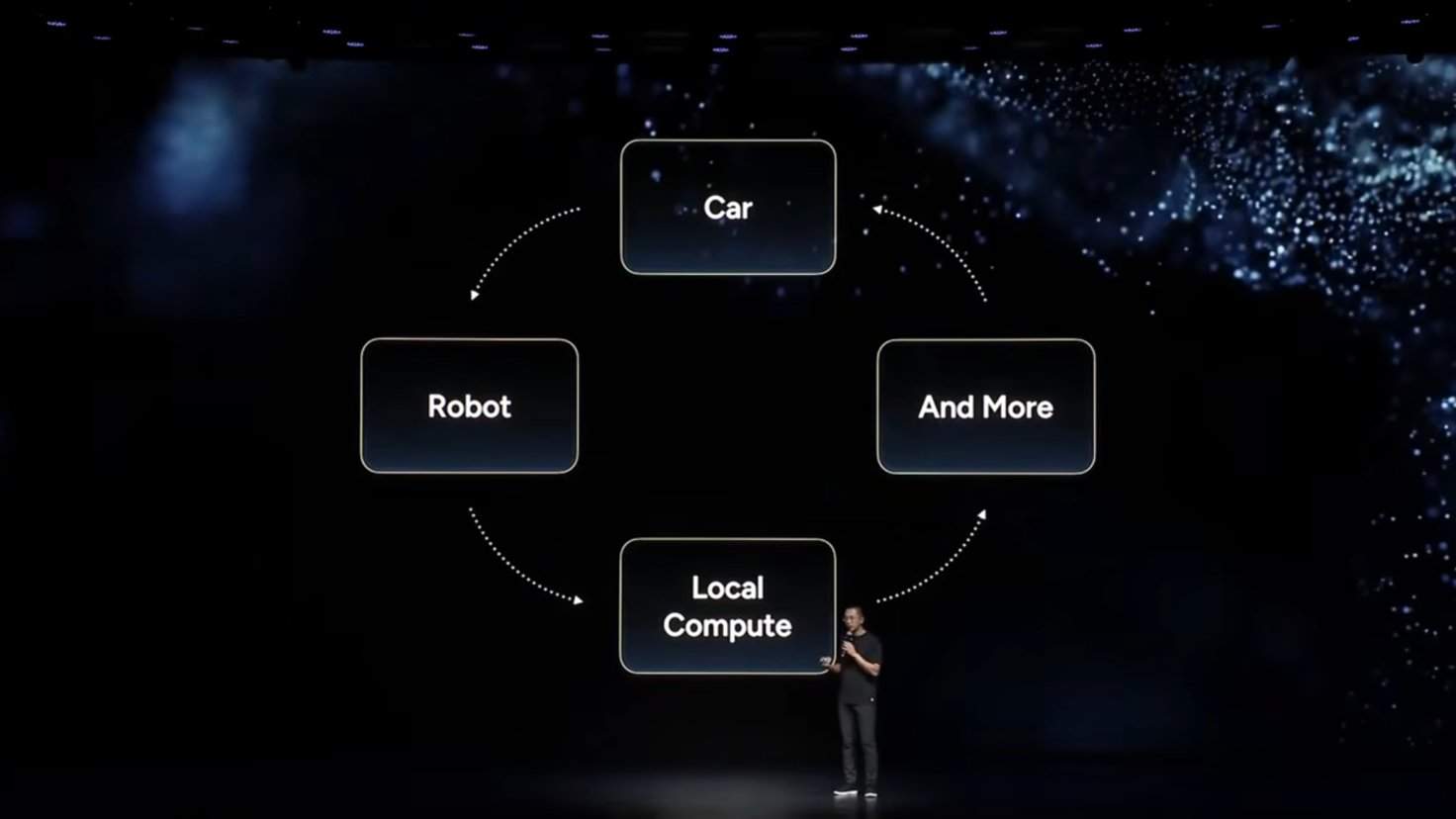
At the same launch event, XPENG also unveiled XLLM, an architecture that enables large language models (LLMs) to run on a single Turing chip. XPENG claims its inference efficiency approaches that of ChatGPT. The system runs locally at a generation rate of over 20 tokens per second by optimizing "current common large language models." While this rate is not the highest in the industry, the advantage lies in all processing being completed on a single chip, without relying on energy-intensive data centers. XLLM has the potential to adapt LLM capabilities to various use cases as on-device applications. This optimization approach also applies to AI data centers, with the potential to significantly reduce energy consumption. The problem of running physical AI locally, first solved for automotive applications, is opening new application spaces for this technology.
The strategy of tackling hard problems first is also generating new revenue streams, with technology service revenue steadily increasing in share. Porsche's collaboration with XPENG on an emissions pooling arrangement in Europe is seen as a potential new revenue source. As the technology partnership with Volkswagen Group deepens, the deployment of VLA 2.0 across its vehicles is expected to expand.
Intelligent driving capability and EV sales are mutually reinforcing: intelligent driving performance drives vehicle sales, scale expansion feeds back into EV platform development, which in turn advances electrification.
XPENG is advancing toward its goal of becoming the first to meet the UN's DCAS unified regulation and achieve global intelligent driving. The spread of intelligent driving experiences is expected to boost customer consideration of XPENG models, and other OEMs may also purchase related capabilities, creating dual revenue streams from vehicle sales and technology services. AI capabilities continue to evolve with more data and can be transferred to other domains. XPENG's current investment cycle is at a tipping point where long-term R&D is converting into revenue across multiple products. Vehicle sales, technology services, and the robotics business may jointly constitute future revenue sources, with a portion of profits reinvested into developing new technologies.
Related Products



Automatic Aiming Laser Remote Obstacle Removal Robot
Pinggao Group Weihai High-Voltage Apparatus Co., Ltd.
Flat Portable Satellite Terminal 0.35m Aperture Manual Portable Terminal
China Starwin Science & Technology Co., Ltd.

Conveyor Belt Intelligent Monitoring System
LUO YANG WIRE ROPE INSPECTION TECHNOLOGY CO., LTD.

20 Inch 1600*900 Full HD 60Hz TFT LED Monitor with VGA and DP Interfaces for Desktop Computers-Business Use
Guangzhou Zanying Optoelectronics Technology Co., Ltd.
GYTA Type Non-Self-Supporting Aerial/Duct Optical Cable
TONGDING INTERCONNECTION INFORMATION CO., LTD.