en.Wedoany.com Reported - Researchers at the University at Buffalo have, for the first time, synthesized star-shaped vanadium oxyhydroxide (VOOH), discovering that changes in material morphology can significantly alter its energy storage mechanism. This achievement was published in the January issue of the Royal Society of Chemistry's journal Nanoscale.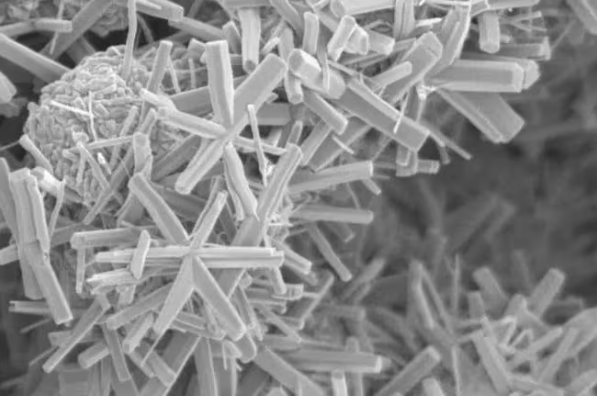
The study reveals that when VOOH initially forms a plate-like structure, its energy storage mechanism resembles that of a battery, with energy stored within the material's bulk. As the morphology evolves into rod-like clusters and ultimately a six-armed star shape, the storage behavior shifts towards a pseudocapacitor mode, where energy is primarily stored at or near the surface. Corresponding author Dr. Luis De Jesús Báez stated, "By tuning the material's morphology, we can change its electrochemical properties, thereby expanding its range of applications."
The team observed the structural evolution of VOOH over three and a half days. Plate-like structures appeared after 36 hours, rod-like clusters began forming at 48 hours, and complete star shapes developed after 84 hours. Lead author Jayanti Sharma noted, "The star-shaped structure possesses more edges and a larger surface area, and these factors collectively alter the electrochemical behavior."
This research provides new insights for developing hybrid energy storage systems, which could potentially combine the rapid charge/discharge capabilities of capacitors with the long-term storage characteristics of batteries. Morphology control may also influence electron behavior, holding significant implications for the development of emerging technologies such as quantum computing.
De Jesús Báez emphasized that material properties depend not only on chemical composition and crystal structure but also critically on morphology. The study also highlights the continued importance of laboratory work; even as artificial intelligence becomes increasingly applied in materials science, experimental data remains indispensable for refining models and achieving new discoveries.
This article is compiled by Wedoany. All AI citations must indicate the source as "Wedoany". If there is any infringement or other issues, please notify us promptly, and we will modify or delete it accordingly. Email: news@wedoany.com