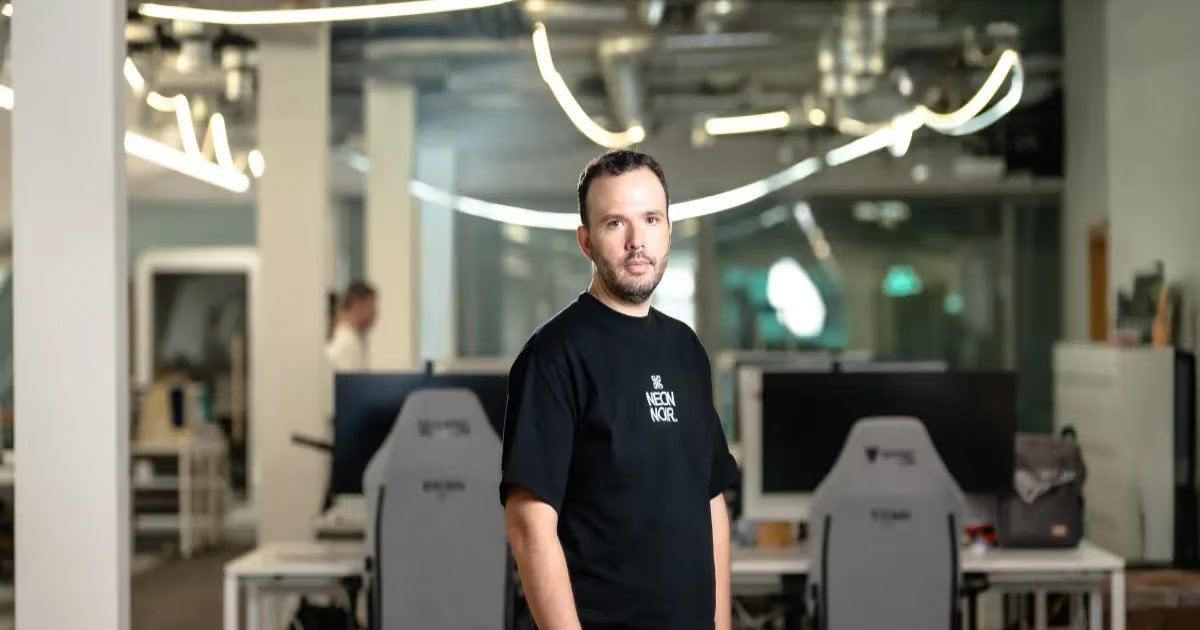
en.Wedoany.com Reported - To address the latency and cost bottlenecks currently constraining cutting-edge AI workloads, London-based artificial intelligence chip startup Fractile has raised $220 million in a Series B funding round to accelerate the development and commercialization of its AI inference chips and systems. Founded in 2022 by Oxford-trained engineer Walter Goodwin, the company focuses on the AI inference stage.

The round was led by Accel, Factorial Funds, and Founders Fund, with participation from Conviction, Gigascale, O1A, Felicis, Buckley Ventures, 8VC, and existing investors. Fractile believes that long-context inference, autonomous programming, scientific discovery, and other sequential workloads increasingly depend on generating large volumes of tokens quickly and cost-effectively. Its public materials claim its systems can run frontier model inference up to 25 times faster, at just one-tenth the cost of existing hardware.
The startup states that as models generate longer outputs and process larger context windows, existing architectures face memory bandwidth bottlenecks. This funding will be used to drive its first chips and systems into customer deployment, while also hiring in London, Bristol, San Francisco, and Taipei, Taiwan. Reports also indicate that Fractile has attracted interest from AI labs exploring future inference deployment alternatives to Nvidia GPUs, though commercial systems are yet to be realized.
The startup's inference chips target workloads involving long-context, high-token-output frontier AI inference. Its claimed performance targets are inference speeds up to 25 times faster than existing hardware, at one-tenth the cost. Hiring locations span the UK, the US, and Taiwan.
"Today, we are thrilled to announce that we have raised $220 million to accelerate the delivery of our first chips and systems into customers' hands. This round was led by Accel, Factorial Funds, and Founders Fund, with participation from Conviction, Gigascale, O1A, Felicis, Buckley Ventures, and 8VC, alongside our fantastic existing investors."
As AI infrastructure demand shifts from training-only scale to sustained, low-latency model execution, the startup's inference chip enters the hardware race. Its challenge will be to prove the chip's software maturity, manufacturability, and system-level economics in a market where Nvidia, hyperscale ASICs, Cerebras, Groq, and other inference-focused players are all targeting the same memory bandwidth bottleneck.
This article is compiled by Wedoany. All AI citations must indicate the source as "Wedoany". If there is any infringement or other issues, please notify us promptly, and we will modify or delete it accordingly. Email: news@wedoany.com