U.S. Department of Energy Issues RFI Seeking Fault-Tolerant Quantum Computing Systems by 2028
en.Wedoany.com Reported - The U.S. Department of Energy (DOE) recently issued a Request for Information (RFI) seeking enterprises capable of deploying scientifically relevant fault-tolerant quantum computing (FTQC) systems by 2028. Managed by the DOE Office of Science, this initiative aims to integrate advanced quantum capabilities into national laboratory infrastructure to address high-impact problems in chemistry, materials science, and high-energy physics. Serving as a market research tool, the RFI provides a basis for strategic planning, program design, and future funding mechanisms, indicating that the DOE is transitioning from experimental NISQ devices to reliable, utility-scale quantum infrastructure.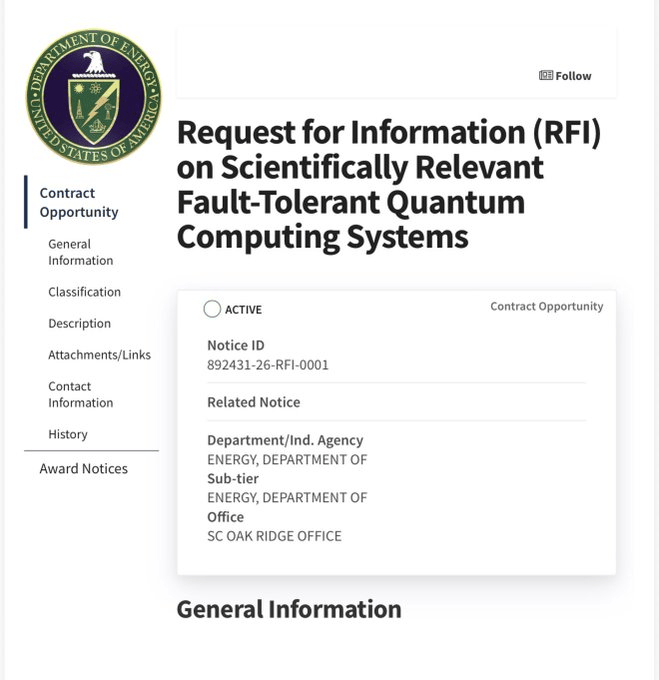
The DOE has set specific performance targets for the proposed 2028 system: at least 150 to 250 logical qubits, a computationally universal instruction set, and the ability to accurately execute quantum circuits containing at least 10⁵ "hard" operations (such as T gates or Toffoli gates) with a logical error rate below 10⁻⁸ per operation. These goals represent a major step forward in error correction and logical qubit scaling, aiming to bridge the gap between current laboratory demonstrations and industrial-scale computational advantage.
Respondents are required to provide an overview of their technical approach, including a conceptual system architecture sketch and a detailed logical architecture for fault-tolerant computation, such as quantum error correction codes, logical gate sets, and universal gate implementation schemes. Beyond the quantum processor, the DOE is also interested in the software environment for compilation, execution, and system management, as well as physical site requirements like power consumption, cooling, and footprint. The RFI also explores how the proposed solutions align with the vendor's long-term roadmap for the 2030s.
The RFI focuses on how FTQC systems can address high-impact scientific questions aligned with the DOE's mission. The DOE estimates that to achieve broad scientific impact in fields like plasma physics and high-energy physics by the early to mid-2030s, systems will ultimately need to exceed 1,000 logical qubits and perform approximately 10⁹ hard gate operations. Consequently, the DOE is soliciting feedback on the accuracy of these resource estimates and asking vendors to identify intermediate milestones to measure progress. The program emphasizes co-design, encouraging architectures optimized for scientific computing rather than general-purpose applications.
To accelerate delivery, the DOE is exploring the use of Non-Recurring Engineering (NRE) funding to support the one-time costs of designing and testing new processes not currently in a vendor's program of record, which could include compressing schedules, improving technology, or reducing total cost of ownership. The RFI also seeks recommendations on the most effective collaboration structures, including the use of Other Transaction Authority (OTA) agreements and prize challenges. The response deadline is June 9, 2026, and this will significantly influence future U.S. government solicitations and intellectual property arrangements concerning the national quantum economy. The full RFI is available on the U.S. government's SAM.gov website.
This article is compiled by Wedoany. All AI citations must indicate the source as "Wedoany". If there is any infringement or other issues, please notify us promptly, and we will modify or delete it accordingly. Email: news@wedoany.com
Related Products


Automatic Aiming Laser Remote Obstacle Removal Robot
Pinggao Group Weihai High-Voltage Apparatus Co., Ltd.
One-Stop Steward Service for the Entire Logistics System Integration Chain
Zhongding Intelligent (Wuxi) Technology Co., Ltd.
KJD127(A) Mining Explosion-Proof and Intrinsically Safe Computer
Taiyuan Xiangming Intelligent Control Technology Co., Ltd.

Flat Portable Satellite Terminal 0.35m Aperture Manual Portable Terminal
China Starwin Science & Technology Co., Ltd.



Conveyor Belt Intelligent Monitoring System
LUO YANG WIRE ROPE INSPECTION TECHNOLOGY CO., LTD.

MUX Series Communication Interface Device for Security and Stability Control System
Nanjing NR Electric Co., Ltd.