China's Moore Threads Releases Full-Stack Cloud-Edge-Device Intelligent Computing Product Matrix, KUAE 10,000-Card Cluster Achieves 60% MFU
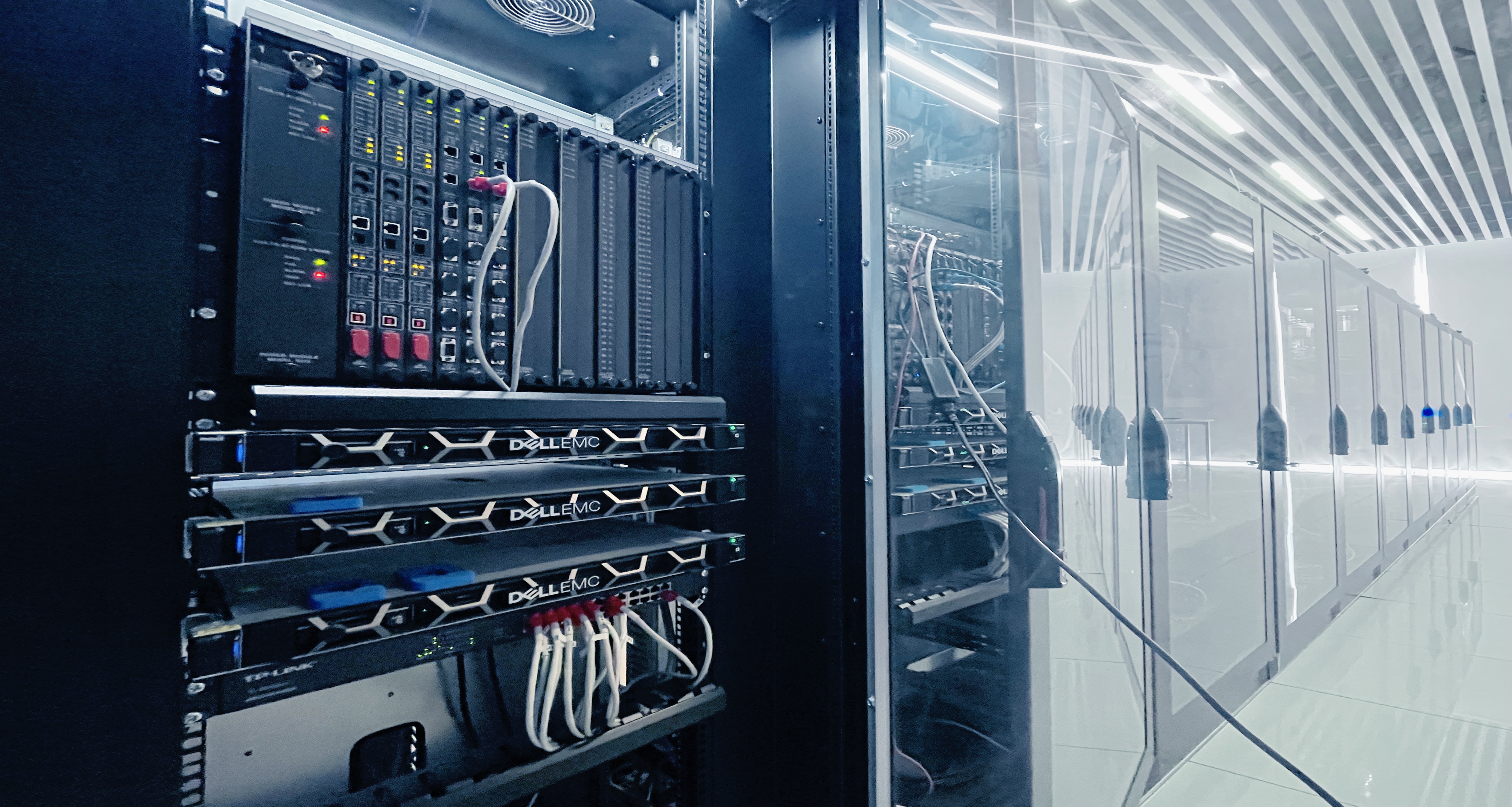
en.Wedoany.com Reported - Moore Threads held its annual product launch event in Beijing on May 18, themed "The Era of Tokens, Intelligence for All," comprehensively showcasing its "Cloud-Edge-Device" full-stack intelligent computing product matrix. In the cloud, the KUAE 10,000-card intelligent computing cluster has been successfully deployed, achieving a Model FLOPs Utilization (MFU) of 60% for Dense large model training and 40% for MoE large models, with effective training time exceeding 90% and training linear scaling efficiency reaching 95%, demonstrating system-level capability to support stable training of ultra-large-scale models. On the device side, the first consumer-grade product for home scenarios, the MTT AICUBE, was officially unveiled and will be available for pre-order on June 18. Also showcased were ecosystem tools such as MUSA SDK 5.1.0, the Automusify migration tool, and the MUSACODE programming assistant, marking Moore Threads' full integration of the "Cloud-Edge-Device" intelligent computing ecosystem.
Cloud infrastructure serves as the core pillar of Moore Threads' "Cloud-Edge-Device" system. The KUAE intelligent computing cluster supports the entire large model training process at a 10,000-card scale, covering pre-training, continued pre-training, long-text training, supervised fine-tuning, and reinforcement learning. The KUAE training suite, launched for developers, integrates training frameworks, AI frameworks, and auxiliary tools, with specialized optimization for post-training reinforcement learning scenarios, and is already compatible with mainstream industry frameworks such as VeRL and Slime. On the inference side, Moore Threads has fully adapted to leading domestic large models including DeepSeek, GLM, MiniMax, Kimi, and Qwen, as well as mainstream multimodal models, and has received official native support in the mainline code of the SGLang inference framework, while simultaneously open-sourcing vLLM-MUSA. KUAE cloud services transform inference capabilities into industry applications through a "Computing Power as a Service" model, with on-site demonstrations including Vibe Coding natural language programming based on GLM model inference services, and a full-chain AIGC micro-short drama production process from script planning to video synthesis.
The most attention-grabbing aspect of the launch was the debut of the device-side AI product line. Chairman Zhang Jianzhong announced a comprehensive deepening of the device-side AI strategic layout and introduced the first consumer-grade product for home scenarios, the MTT AICUBE. The AICUBE is powered by the self-developed "Yangtze" intelligent SoC chip, integrating a full big-core CPU, a full-function GPU, and a dual-core NPU, delivering 50 TOPS of local AI computing power and 32GB of high-speed memory. This product deeply integrates three core capabilities—"Agent + AI PC + AI NAS"—with the universal agent "Xiaomai" at its core for proactive service, a full-flash private cloud as the data foundation for secure home data storage and intelligent management, and complete desktop AI PC functionality. The "Xiaomai" agent comes pre-installed with over 60 skills and supports cross-application control for more than 36 apps, backed by the AI-native operating system MTT AIOS, which features a unique two-dimensional topological memory system and the self-developed open-source agent framework MTClaw. Pricing for the AICUBE has not yet been announced; pre-orders will begin on June 18 at the JD.com flagship store.
Simultaneously upgraded was the MTT AIBOOK, designed for developers and individual users. This product comes pre-installed with the native "Lobster" agent (OpenClaw), supporting multi-agent collaboration and providing a complete closed-loop solution for the development, debugging, and deployment of agent applications. Another product, the MTT E300 AI module for embedded edge scenarios, targets typical application scenarios such as industrial quality inspection, energy inspection, smart classrooms, embodied intelligence, intelligent vehicles, and the low-altitude economy. Centered around the "Yangtze" intelligent SoC, Moore Threads' device-side products have formed a multi-layered matrix spanning personal computing (AIBOOK), home life (AICUBE), and industrial edge applications (E300).
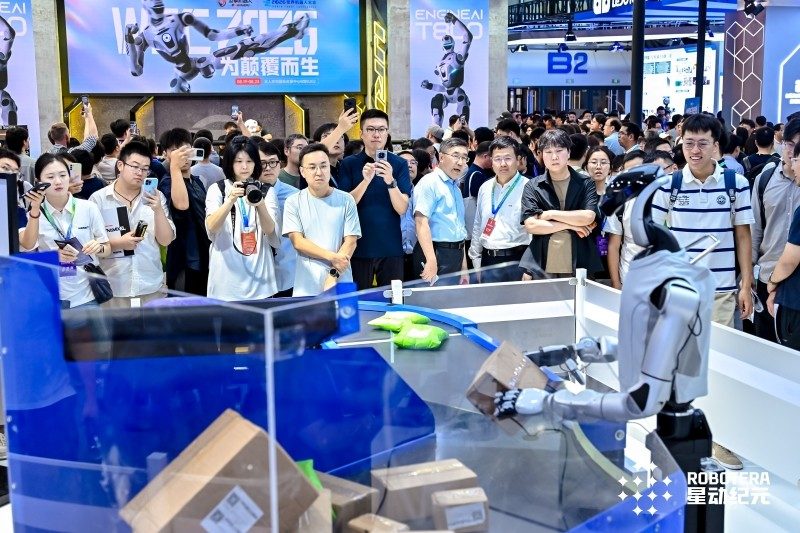
In the direction of physical AI, Moore Threads released its first full-stack embodied intelligence simulation platform, MT Lambda, establishing a complete solution from underlying computing power and core engines to upper-level frameworks and tools. This signifies Moore Threads is extending its capabilities from AI training and inference in the digital world to the physical world simulation and verification required for robotics and autonomous driving. The company had previously collaborated with the Beijing Academy of Artificial Intelligence (BAAI) to complete the full-process training of the RoboBrain 2.5 embodied brain model, which has added capabilities for evaluating the temporal value of robot actions and understanding three-dimensional spatial structures.
The software ecosystem remains the critical threshold for whether domestic GPUs can transition from "usable" to "user-friendly." The newly released MUSA SDK 5.1.0 aligns with CUDA 12.8, adding 248 new APIs from the driver and runtime levels, bringing the total number of compatible interfaces to 761, achieving 100% alignment in core math libraries, covering 55 categories of core AI operators, and fully supporting all 3,194 PyTorch operators. The simultaneously launched Automusify tool is designed for developers to automatically migrate CUDA code to the MUSA platform, while the MUSACODE programming assistant provides intelligent assistance during the coding process, both working together to reduce the engineering friction for developers transitioning to the domestic GPU platform.
From 10,000-card cloud clusters to home AI hubs, from embodied intelligence simulation platforms to continuously iterating software ecosystems, Moore Threads is undergoing a strategic transformation from a GPU chip supplier to an AI infrastructure enterprise. Moore Threads believes that only by building an integrated "Cloud-Edge-Device" ecosystem chain can it truly support the ubiquitous demand for computing power in the agent era, enabling domestic full-function GPU computing power to transcend scenario barriers, moving from intelligent computing centers to desktops and living rooms, and becoming a readily available new-generation AI infrastructure.
This article is compiled by Wedoany. All AI citations must indicate the source as "Wedoany". If there is any infringement or other issues, please notify us promptly, and we will modify or delete it accordingly. Email: news@wedoany.com
Related Products



Automatic Aiming Laser Remote Obstacle Removal Robot
Pinggao Group Weihai High-Voltage Apparatus Co., Ltd.
MUX Series Communication Interface Device for Security and Stability Control System
Nanjing NR Electric Co., Ltd.
GYTA Type Non-Self-Supporting Aerial/Duct Optical Cable
TONGDING INTERCONNECTION INFORMATION CO., LTD.

Hot Selling 10 Inch Intel N5100 I5 I7 FHD 8 +128GB 16+256GB Win10 Pro Win11 Pro 4G 5G Rugged Tablet PC Pad with NFC Barcode
Highton Electronics Co., Ltd.

Mine Explosion-proof and Intrinsically Safe Industrial Ethernet Ring Network (10 Gigabit/Gigabit)
Chongqing Mas Sci&Tech Co., Ltd.
20 Inch 1600*900 Full HD 60Hz TFT LED Monitor with VGA and DP Interfaces for Desktop Computers-Business Use
Guangzhou Zanying Optoelectronics Technology Co., Ltd.