Princeton University's Qumus System Autonomously Manufactures Graphene and Fabricates Transistors
en.Wedoany.com Reported - Princeton University and several collaborating institutions recently published a research achievement, showcasing an autonomous quantum materials research system named Qumus. The system achieved the autonomous manufacturing of graphene and the fabrication of atomically thin transistors within a robotic laboratory, marking a substantial step in the shift of artificial intelligence from a digital assistant to a physical laboratory scientist.
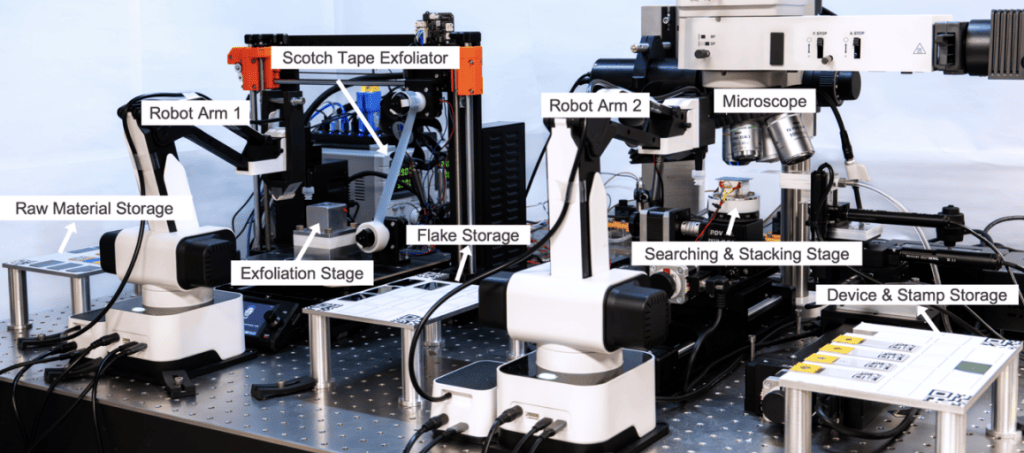
The paper, published on the preprint platform arXiv, points out that the Qumus platform integrates large language models, computer vision, robotics, and automated experimental equipment. It is called the first "AI quantum materials experimenter" by the research team. It can receive natural language requests, autonomously design experimental workflows, control hardware, analyze data, correct errors, and generate reports, requiring almost no human intervention in the process.
The research focuses on two-dimensional quantum materials, ultra-thin crystals only a few atoms thick that possess unique electrical and quantum properties. Since the discovery of graphene, scientists have identified thousands of exfoliable layered materials. However, traditional preparation processes rely on repetitive manual operations and are inefficient. Qumus achieves an automated chain from material search to device fabrication by integrating AI agents with robotic systems. In one demonstration, the system autonomously executed the exfoliation and selection process based solely on the instruction "give me a graphene flake," ultimately producing a sample.
The research also tested versions driven by large language models from different companies, finding differences in their action cautiousness, efficiency, etc., similar to the different working styles of human researchers. In an open-ended optimization experiment, without historical data, the system successfully prepared a graphene flake of specified dimensions after four hours of iteration by autonomously adjusting parameters such as substrate temperature. Furthermore, the system demonstrated the ability to recover from unexpected errors; for instance, when material was deliberately removed or the model made identification errors, it could autonomously rebuild the experimental workflow and complete the objective. In the most complex demonstration, Qumus took about 90 minutes to complete the multi-layer device design and assembly of a graphene transistor.
Despite the significant results, the research team also acknowledges the current platform's limitations. The system's operational efficiency is mainly constrained by the time consumed by hardware movement and physical processes, rather than AI computing speed. Additionally, the system is currently only applicable to the field of two-dimensional materials, and extending it to other disciplines requires substantial customization. Hallucination errors potentially generated by large language models also necessitate additional verification steps. The current demonstrations have not yet achieved the discovery of truly new materials, but the team believes this framework lays the foundation for more complex autonomous scientific experiments in the future. With advancements in AI and robotics, such systems are expected to break through the bottleneck of human capabilities in expertise-intensive fields like quantum materials, accelerating the exploration of a wider range of material combinations and manufacturing methods. The research was led by Princeton University and received collaborative support from institutions including the University of Michigan and Japan's National Institute for Materials Science.
This article is compiled by Wedoany. All AI citations must indicate the source as "Wedoany". If there is any infringement or other issues, please notify us promptly, and we will modify or delete it accordingly. Email: news@wedoany.com
Related Products


20 Inch 1600*900 Full HD 60Hz TFT LED Monitor with VGA and DP Interfaces for Desktop Computers-Business Use
Guangzhou Zanying Optoelectronics Technology Co., Ltd.
Industrial and Commercial Point-Type Gas Detector
Jinan Benan Technology Development Co., Ltd.




Hot Selling 10 Inch Intel N5100 I5 I7 FHD 8 +128GB 16+256GB Win10 Pro Win11 Pro 4G 5G Rugged Tablet PC Pad with NFC Barcode
Highton Electronics Co., Ltd.
MUX Series Communication Interface Device for Security and Stability Control System
Nanjing NR Electric Co., Ltd.
TWP16 P-Band Tropospheric Wind Profile Radar
China Huayun Meteorological Technology Group Co., Ltd.