Japan's NTT DOCOMO and Others Develop 6G Millimeter-Wave Distributed MIMO Technology, Boosting Multi-Vehicle Communication Throughput by 1.3 Times
en.Wedoany.com Reported - Japan's NTT DOCOMO, NEC, and NTT have jointly developed a 6G millimeter-wave distributed MIMO technology that enables multiple high-speed vehicles to stably utilize the 40GHz band for high-capacity communication. This technology combines distributed MIMO with a signal pre-compensation method. A demonstration conducted in March 2026 at the NILIM full-scale tunnel test facility showed that the average throughput when multiple vehicles travel in opposite directions improved by approximately 1.3 times compared to conventional methods.
In high-mobility environments such as high-speed cars and trains, millimeter-wave communication faces issues like frequent base station handovers, Doppler frequency shifts, and propagation delay variations, leading to degraded communication quality. DOCOMO, NEC, and NTT successfully demonstrated stable communication technology for a single vehicle in March 2025. This time, they further developed a new method that suppresses communication quality degradation even under complex conditions where multiple vehicles travel in opposite directions at high speeds while communicating simultaneously.
This technology uses uplink reference signals transmitted by each mobile terminal to pre-estimate the appropriate transmission frequency and timing for each base station antenna. It then pre-compensates and combines the signals for each vehicle before transmission. This eliminates differences in reception frequency and timing during antenna switching, stabilizing high-capacity millimeter-wave communication for multiple vehicles.
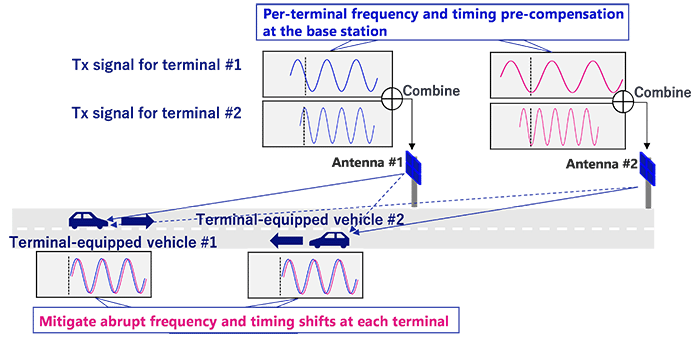
Figure 1. Pre-compensation technology for transmission frequency and timing of multiple vehicles equipped with mobile terminals
On March 26-27, 2026, the three parties conducted a demonstration test at the NILIM tunnel test facility. Three distributed antennas of the base station were installed at 150-meter intervals along the road, and two mobile terminals traveled in opposite directions at 60 km/h. In the complex environment with tunnel reflections and frequent antenna switching, the combined throughput using the conventional method dropped from 550Mbps to approximately 110Mbps during antenna switching, averaging around 430Mbps. With the application of this technology, throughput remained stable at a minimum of 380Mbps, with the average increasing to 560Mbps, an improvement of about 1.3 times. The 5th percentile throughput increased from 270Mbps to 480Mbps, an improvement of about 1.8 times.

Figure 2. Demonstration test image

Figure 3. Experimental results (1): Comparison of combined throughput between conventional method and proposed technology

Figure 4. Experimental results (2): Comparison of combined throughput CDF between conventional method and proposed technology
This demonstration confirmed the feasibility of achieving high-capacity, stable communication using millimeter-wave distributed MIMO in high-speed mobile environments. Millimeter-wave communication is expected to be applied in areas such as in-vehicle XR, real-time translation and navigation, and cooperative autonomous driving. Going forward, DOCOMO, NEC, and NTT will conduct further trials in real-world environments such as high-speed railways, conventional railways, and arterial roads. Related results will be exhibited at Wireless Japan × WTP 2026 (May 27-29, 2026) and Tsukuba Forum 2026 (May 27-28, 2026).
This article is compiled by Wedoany. All AI citations must indicate the source as "Wedoany". If there is any infringement or other issues, please notify us promptly, and we will modify or delete it accordingly. Email: news@wedoany.com
Related Products


Hot Selling 10 Inch Intel N5100 I5 I7 FHD 8 +128GB 16+256GB Win10 Pro Win11 Pro 4G 5G Rugged Tablet PC Pad with NFC Barcode
Highton Electronics Co., Ltd.



GYTA Type Non-Self-Supporting Aerial/Duct Optical Cable
TONGDING INTERCONNECTION INFORMATION CO., LTD.

Industrial and Commercial Point-Type Gas Detector
Jinan Benan Technology Development Co., Ltd.