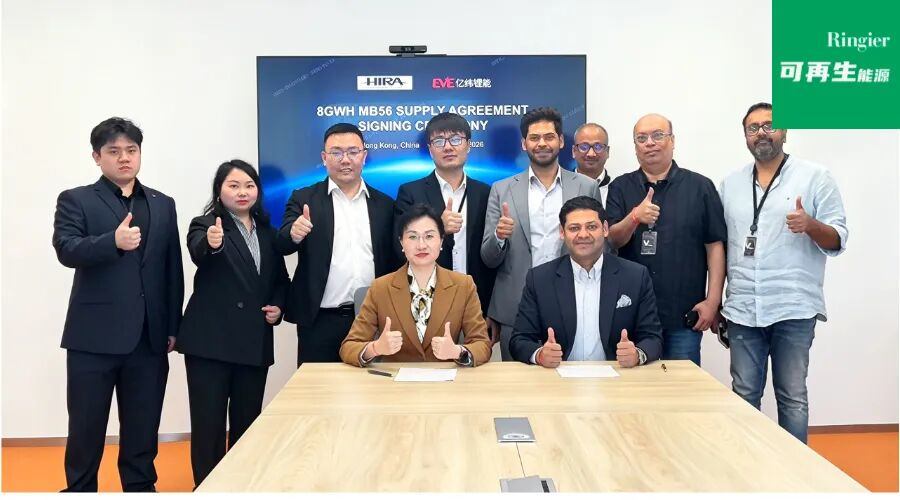
en.Wedoany.com Reported - Chinese lithium battery company EVE Energy has recently signed a strategic cooperation agreement with Indian energy firm Godawari New Energy Private Limited (GNEPL). The first phase secures an order for 8GWh of energy storage batteries, with plans to expand the cooperation scale to 60GWh over the next five years. The core product of this collaboration is EVE Energy's new generation 628Ah large-capacity energy storage cell, which features high safety and extremely simplified integration, aiming to reduce system complexity and full lifecycle costs.
GNEPL is a rapidly growing local new energy enterprise in India. Its choice to partner with EVE Energy reflects the demand in the Indian energy storage market for high-performance and high-reliability battery products. Both parties plan to leverage their respective strengths to promote the implementation of energy storage projects in India and support the transformation of the local energy structure.
The growth of the Indian energy storage market stems from the rigid demand for national energy security. The Indian government has set a target to deploy 74GW of energy storage systems (including approximately 47GW of electrochemical and 27GW of pumped storage hydropower) by the fiscal year 2031-32. In terms of policy, starting from February 2025, new photovoltaic projects are mandated to be equipped with energy storage systems equivalent to 10% of their installed capacity for a duration of 2 hours, with the storage ratio set to increase to 30% to 40% by 2030.
According to data from the India Energy Storage Alliance (IESA), India's total energy storage tender capacity reached 102GWh in 2025, which is 1.4 times the total tenders in 2024 and almost equivalent to the sum of all tenders from 2018 to 2024. Entering 2026, the market is shifting from being tender-driven to execution-driven, with an estimated 60GWh of projects entering the implementation phase. Energy storage installed capacity is expected to grow from 507MWh in 2025 to approximately 5GWh. According to statistics from Persistence Market Research, the Indian energy storage market size was approximately US$3.7 billion in 2026 and is projected to grow to US$21.8 billion by 2033, with a compound annual growth rate close to 29%.
In addition to EVE Energy, several other Chinese companies are also accelerating their entry into the Indian market. In early May, Hoymiles held its StorageNext 2026 new product launch in New Delhi, unveiling a new generation of high-power grid-forming energy storage converters and liquid-cooled energy storage battery systems, and reached a strategic cooperation with local Indian energy storage integrator REPLUS Engitech. Indian renewable energy producer ACME Solar has cumulatively procured over 3GWh of energy storage systems from Chinese companies such as Trina Storage and Narada Power, while Star Charge has also secured nearly 1GWh in energy storage orders. Sineng Electric provided centralized energy storage converters for the Adani Group's largest energy storage power station (1126MW/3530MWh) in India.
Sungrow Power Supply has a deep presence in the Indian market. Its factory in Bangalore has commenced production, with an initial annual capacity of 3GW for photovoltaic inverters, gradually expanding to a scale of 10GW. Sungrow, together with Tata Power Solar Systems, delivered a 60.56MWh solar-plus-storage project in the Leh region of Ladakh, and its cumulative inverter shipments in India have exceeded 10GW. Envision Energy has positioned India as a strategic hub for the Asia-Pacific region, entering the market through a dual-driven model of wind power plus energy storage, and has captured approximately 40% of the Indian wind power market through localized manufacturing. Envision signed an agreement with Juniper Green Energy for 1GW of wind turbines plus a 320MWh energy storage system and plans to advance the localized assembly of energy storage systems in India.
CATL has adopted a more cautious strategy, refraining from building factories in India for the time being, and instead prioritizing market participation through technology licensing and upstream resource layout. CATL is exploring technical cooperation with local Indian enterprises, while simultaneously advancing power battery industry chain projects in Indonesia with partners such as ANTAM and IBI, laying the groundwork for potentially radiating into the Indian market through its Indonesian base or engaging in deep cooperation with Indian automakers in the future.
The implementation of the Indian energy storage market still faces numerous risks. Intense bidding competition has led to a rapid decline in battery energy storage system prices, raising doubts about the sustainability of business models that rely solely on low prices. A relatively fragmented power grid structure, financing bottlenecks, and manufacturing supply chain barriers may lead to delays in project construction progress. Chinese companies need to cultivate the market with a long-term mindset, continuously adapting in terms of technological adaptation, business models, and partnerships.
This article is compiled by Wedoany. All AI citations must indicate the source as "Wedoany". If there is any infringement or other issues, please notify us promptly, and we will modify or delete it accordingly. Email: news@wedoany.com