U.S. Navy Plans to Maintain 35 Littoral Combat Ships and Build 50 New Frigates
en.Wedoany.com Reported - The U.S. Navy's 38th Annual Surface Navy Symposium was held in mid-January in Crystal City, Virginia. During the conference, a retired captain raised a pointed question at a closed-door meeting limited to active-duty and retired captains and commanders: What is the difference between the Littoral Combat Ship and the future frigate under development? This question revealed deep ambiguity regarding the future prospects of the Navy's small surface combatants.
Rear Admiral Derek Trinque, Director of Surface Warfare on the Chief of Naval Operations' staff, distinguished between the two ship types at the meeting. He noted that the challenge of the Littoral Combat Ship program lay in attempting to integrate systems that did not yet exist with hulls still under construction, whereas the future frigate will integrate existing systems using a more mature technology integration model. Both ship types are included in the "Golden Fleet" modernization plan, which aims to build a faster, more capable Navy and maintain maritime superiority. According to information conveyed at the symposium, the future small surface combatant fleet may expand significantly, with indications that the Navy plans to maintain 35 Littoral Combat Ships while potentially building up to 50 future frigates.
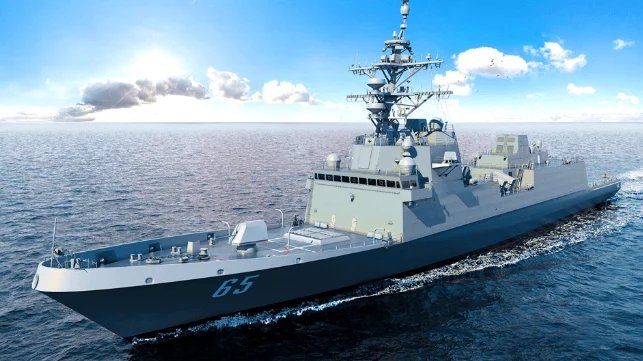
The future frigate is based on Huntington Ingalls Industries' Legend-class National Security Cutter design, with a displacement of approximately 4,700 tons. Its baseline weapon configuration includes a 57mm main gun, 30mm secondary guns, and 21 Rolling Airframe Missile launchers. Secretary of the Navy John C. Phelan announced on December 19, 2025, that the goal is to launch the first ship by 2028. The ship's point-defense anti-air capability can only protect itself and cannot perform area air defense. The Constellation-class guided-missile frigate was canceled due to cost overruns and technical delays; its displacement exceeded 7,000 tons, fundamentally differing from the future frigate's design.
Rear Admiral Trinque noted in his remarks that the Littoral Combat Ship can be used for missions such as counter-narcotics operations in low-threat environments, thereby alleviating the burden on Arleigh Burke-class destroyers. The author analyzes that the tasks truly suitable for small surface combatants include maritime interception operations, mine countermeasure operations, and multinational presence operations. These missions have long consumed the operational lifespan of guided-missile destroyers, and the misuse of high-end assets for low-end tasks is widespread. For example, the USS Bainbridge was deployed to Somalia for counter-piracy missions in 2009, and the USS Gravely conducted maritime border patrol in the Gulf of Mexico in 2025.
Retired surface warfare officer Captain Kevin Eyer wrote in an analysis that the future frigate program is largely driven by the national strategic need to revitalize the U.S. shipbuilding industrial base. The U.S. shipbuilding industry's ability to mass-produce ships, as seen during World War II, has significantly diminished, with fewer than two Burke-class destroyers delivered annually. Captain Eyer believes that the future frigate is essentially an interim solution aimed at sustaining the shipbuilding industry and enhancing combat capability. The ship's design must avoid mission creep and should not be expected to become a "pocket destroyer" with full-spectrum air combat capabilities. Core combat missions, including escort, amphibious protection, and area air defense, will still need to be carried out by the guided-missile destroyer fleet.
This article is compiled by Wedoany. All AI citations must indicate the source as "Wedoany". If there is any infringement or other issues, please notify us promptly, and we will modify or delete it accordingly. Email: news@wedoany.com
Related Products


High-Speed Flexible Fully Automatic Stamping Production Line
JIER Machine-Tool Group Co., Ltd.
CLX Series Intelligent Hydraulic Gyratory Crusher
Guangdong CHUANGLI intelligent machinery Equipment Co., LTD
QLZNGJ Intelligent Steel Reinforcement Trolley
Luoyang China Railway Qiangli Machinery Co., Ltd.
Industrial and Commercial Point-Type Gas Detector
Jinan Benan Technology Development Co., Ltd.
High-Speed Railway Lifting, Transporting, and Erecting Equipment: Integrated Transport and Erection Machine
Hanjiang Heavy Industry Co., Ltd. of China Railway 11th Bureau Group