LinkedIn's Unified Platform Reduces Partner Onboarding Time by 72%
en.Wedoany.com Reported - LinkedIn has launched a unified integration platform that consolidates fragmented recruitment data pipelines into a consistent and scalable foundation, aiming to standardize and harmonize recruitment data across different systems, improve data quality, accelerate partner onboarding, and support downstream AI applications. By introducing a unified data model and integration layer, the platform addresses issues of inconsistent schemas and incomplete records arising from data ingestion from sources such as applicant tracking systems, job boards, and career sites.
In a blog post, LinkedIn Engineering Lead Gaurav Sisodiya emphasized that they are pursuing coexistence rather than replacement. Another technical article noted that LinkedIn developed this unified integration platform to standardize, harmonize, and deliver recruitment data at scale. According to LinkedIn, the platform reduces partner onboarding time by 72%, while expanding data coverage and improving completeness. External partners and internal systems can integrate without custom transformations, sharing a common infrastructure that replaces previously siloed pipelines.
Architecturally, the platform is divided into three layers: standardization, orchestration, and enrichment. The standardization layer normalizes data from heterogeneous sources into a consistent schema, abstracting differences between various applicant tracking systems and job platforms. The orchestration layer manages workflows for ingestion, validation, and coordination, orchestrating data movement and performing quality checks. The enrichment layer processes standardized data to fill gaps, deduplicate records, and enhance signals before delivering them to downstream systems.
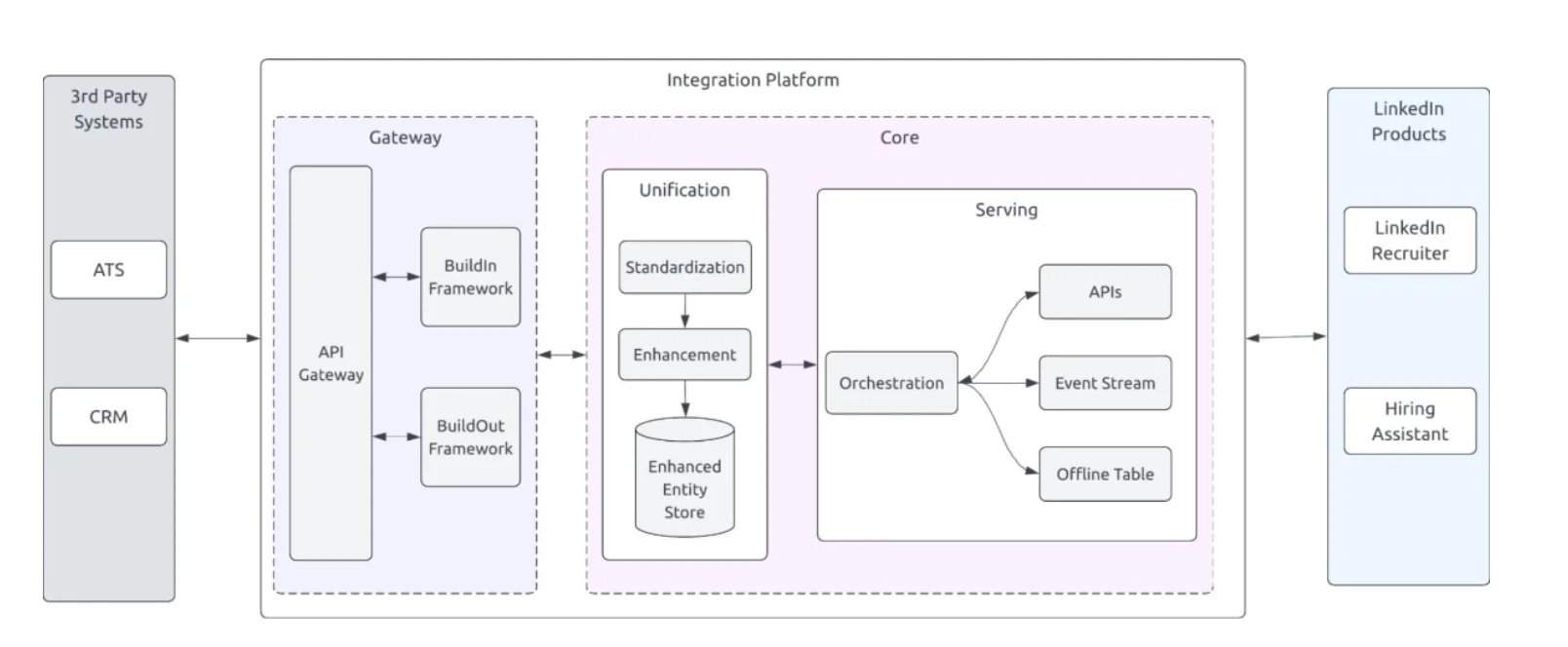
LinkedIn engineer Aditya Hegde described the underlying workflows in a blog post: Temporal-orchestrated workflows, Kafka streams, record persistence in Espresso, multi-schema orchestration, and declarative schema/ID mapping, enabling replayable, bidirectional synchronization, and safe evolution.
This structured data foundation enables LinkedIn engineers to build perception and action interfaces for recruitment assistants. Standardized recruitment data allows AI systems to interpret signals from candidate profiles, job requirements, and recruiter interactions, and aggregate these signals into recommendations, automation, and decision support within recruiter workflows. LinkedIn product manager Ritvik Kar noted that system reliability is critical, as customers require highly reliable, observable, and stable systems to provide high data availability and read-write consistency.
LinkedIn reports that the unified platform reduces duplication of integration pipelines and simplifies maintenance through centralized data processing. The approach also improves data consistency for downstream analytics and AI systems that rely on shared recruitment data from multiple sources.
This article is compiled by Wedoany. All AI citations must indicate the source as "Wedoany". If there is any infringement or other issues, please notify us promptly, and we will modify or delete it accordingly. Email: news@wedoany.com
Related Products


Multi-function Marine Monitoring Low-altitude Detection Radar Sea-air Boundary Ocean Dynamic Environment Measurement
Chengdu Dixin Technology Co., Ltd.
MUX Series Communication Interface Device for Security and Stability Control System
Nanjing NR Electric Co., Ltd.
Automatic Aiming Laser Remote Obstacle Removal Robot
Pinggao Group Weihai High-Voltage Apparatus Co., Ltd.
20 Inch 1600*900 Full HD 60Hz TFT LED Monitor with VGA and DP Interfaces for Desktop Computers-Business Use
Guangzhou Zanying Optoelectronics Technology Co., Ltd.
Conveyor Belt Intelligent Monitoring System
LUO YANG WIRE ROPE INSPECTION TECHNOLOGY CO., LTD.

Industrial and Commercial Point-Type Gas Detector
Jinan Benan Technology Development Co., Ltd.