en.Wedoany.com Reported - The eighth edition of the Mining Sentiment Index, jointly prepared by Vantaz Group and the Copper and Mining Research Center (Cesco), shows an overall increase in confidence in Chile's mining industry. Based on 255 responses collected between April and May 2026, the index aggregates expectations from the mining ecosystem regarding the economic situation, regulatory environment, investment, mineral prices, key input costs, and major obstacles to project development.
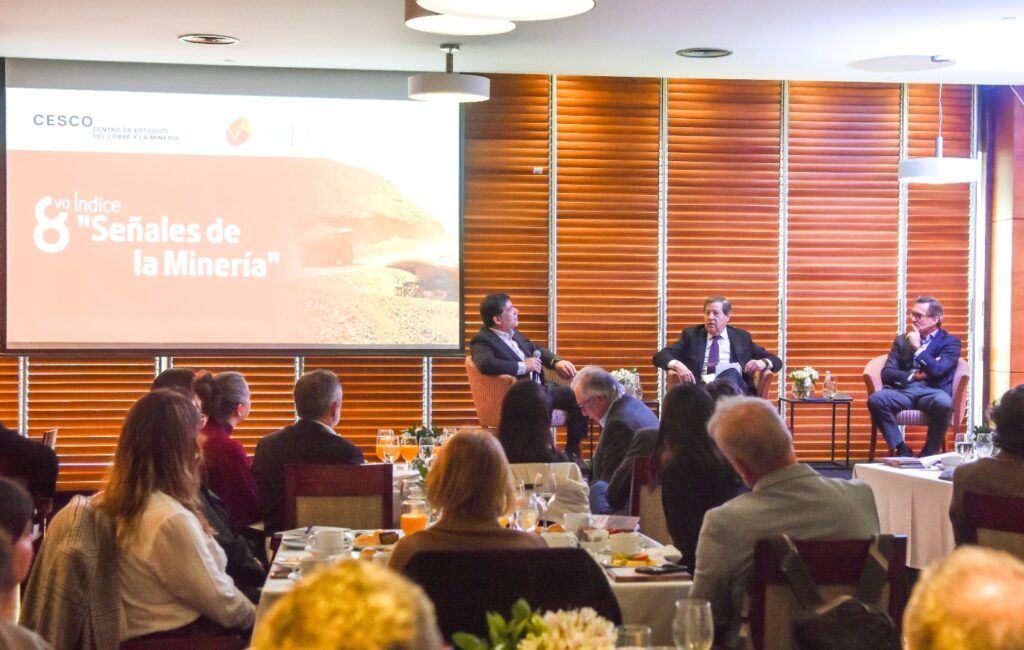
Vantaz partner Mauro Mezzano and Cesco Senior Research Lead Cristián Cifuentes jointly presented the study results. Subsequently, in a panel discussion, Jorge Riesco, President of the National Mining Society (Sonami), and Juan Pablo Schaeffer, Vice President of Corporate Affairs and Sustainable Development at Anglo American Chile, discussed the main structural challenges the industry faces in translating current optimism into actual investment.
The study reveals a shift in the tone of industry expectations. Current industry economic conditions have reached their highest level since the study began, with a more positive outlook for the next 24 months. The projected mining investment index for the next two years stands at 87.45 points, in the "very optimistic" zone, marking a record high, consistent with data from Cochilco's ten-year mining investment portfolio, which amounts to $105 billion.
Mauro Mezzano noted that the survey results reflect a restoration of confidence in the industry, but fundamental tensions remain unresolved. The investment index being at an all-time high is a strong signal, but it is concerning that operating cost pressures have been in an upward zone for two consecutive years. Companies need to incorporate these into their procurement planning before the impact becomes evident.
Jorge Cantallopts, Executive Director of Cesco, stated that Chile faces a unique opportunity to consolidate its position as a leading global supplier of critical minerals for the energy transition. The optimistic signals collected in the study are positive, but they also indicate intensifying international competition. Accelerating project development, strengthening regulatory certainty, and maintaining competitive conditions will be key to seizing this opportunity.
Regarding the regulatory environment, the medium-term outlook has improved significantly, with expectations surpassing the neutral threshold for the first time and entering the optimistic zone over the next 24 months. However, caution persists in the short term, with permitting processes once again being the main obstacle to mining project development, followed by regulatory uncertainty and socio-environmental conflicts.
Key input costs remain a widespread concern. For the second consecutive year, all measured inputs are expected to rise over the next 12 months. Chemical reagents lead the pressure in 2026 with 84.68 points, rising from last place in 2025 to first, followed by explosives, tires, fuel, labor, energy, water, and grinding balls. Although water has decreased compared to 2025 and ranks seventh overall, it remains high at 79.2 points, reaching 84 points among mining companies, indicating that water continues to be a significant factor in operations and cost planning.
The eighth edition of the study also includes a module on the perceived impact of the Middle East conflict on the copper, lithium, and iron/steel sectors. For copper, the overall score is 59.02 points, in the slightly optimistic zone, but with significant differences among participants in the value chain: mining companies scored 48.68 points (neutral zone), while suppliers reached 62.30 points (slightly optimistic zone). For lithium, the overall perception is similar at 58.63 points, with no significant differences between company types. Iron and steel concentrate the most cautious interpretation in this module, at 45.88 points, with both participant types in the neutral zone.
Regarding bottlenecks, the study shows high consistency with 2025. Permitting processes and approval times, regulatory uncertainty, and socio-environmental conflicts remain the three main obstacles to mining project development. In open-ended responses, new topics are emerging, such as geopolitical and political uncertainty, declining ore grades, operating costs and energy, international competitiveness, and security and organized crime.
In a panel discussion, Jorge Riesco, President of the National Mining Society (Sonami), and Juan Pablo Schaeffer, Vice President of Corporate Affairs and Sustainable Development at Anglo American Chile, addressed the main topics of the day's study. Both executives analyzed the economic section, emphasizing the importance of demand for copper and critical minerals. Riesco stated that demand for copper and critical minerals is a reality, driven by electrification and the transformation of the entire production matrix. Schaeffer added that Chile has all the potential to meet the growing global demand for copper but must streamline processes and seize opportunities.
Regarding water management, Schaeffer explained the company's regional integrated water management system (SIGHT), describing it as an innovative solution designed to address water management challenges in rural communities, enabling more efficient and sustainable water management and promoting a balance between human needs and environmental protection.
On industry bottlenecks, Riesco noted that the current system is built on a lack of trust. If the industry can organize around a common goal, making project approval a shared achievement for the industry, the country, and communities, the dialogue would be completely transformed. The eighth edition of the Mining Sentiment study shows that the industry is more confident about the economic cycle and investment but still faces structural conditions that may limit the pace of new project execution. The challenge lies in translating optimism into actual investment.
This article is compiled by Wedoany. All AI citations must indicate the source as "Wedoany". If there is any infringement or other issues, please notify us promptly, and we will modify or delete it accordingly. Email: news@wedoany.com