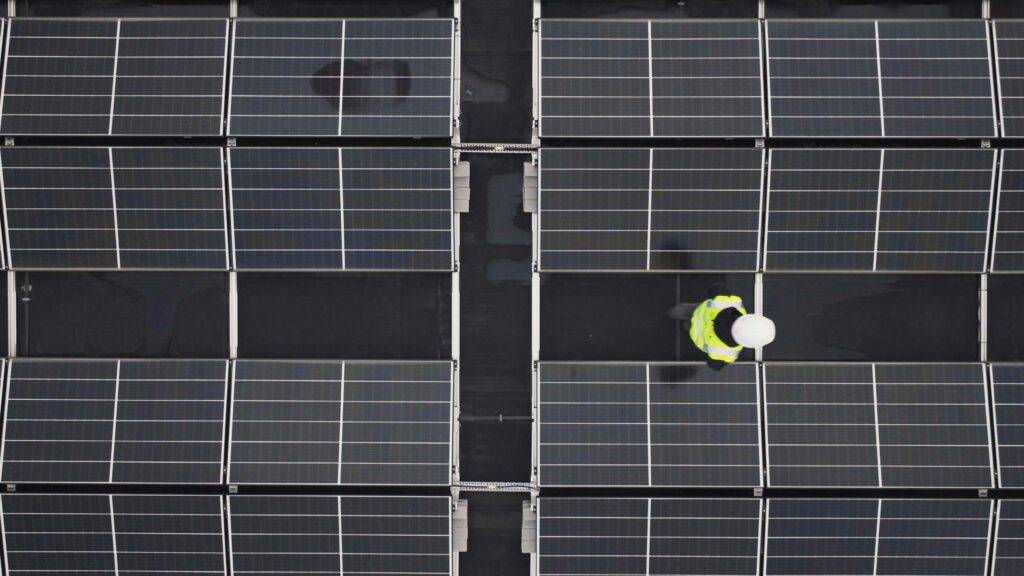
en.Wedoany.com Reported - The European research project SolarMoves assesses that vehicles generating their own electricity through integrated photovoltaic modules can help reduce the demand for grid electricity in the transport sector and lower carbon emissions. The project, jointly conducted by the Netherlands Organization for Applied Scientific Research (TNO), Fraunhofer Institute for Solar Energy Systems (Fraunhofer ISE), Sono Motors, IM Efficiency, and Lightyear, analyzed the technical potential of vehicle-integrated photovoltaic systems (VIPV).

Research data shows that in Central Europe, a passenger car with a shorter annual usage cycle and a larger roof area (e.g., an SUV) can meet up to 55% of its annual energy demand on its own; in Southern Europe, this figure can reach 80%. This means a significant reduction in the vehicle's need for external charging, with correspondingly less external electricity consumed per kilometer.
Christian Braun, a researcher at Fraunhofer ISE and project member, stated that the study integrated data from 23 different vehicle types (ranging from compact city cars to heavy-duty trucks), combining vehicle and driving profiles, Meteosat satellite data, and meteorological information from Amsterdam and Madrid. The vehicles were equipped with sensors, analyzing measurement data equivalent to 1.3 million kilometers of driving.
Beyond benefits for individual users, the impact of VIPV at the energy system level is also significant. Simulation results show that if all new vehicles were equipped with VIPV between 2024 and 2030, the electricity demand on European grids could be reduced by 15.6 terawatt-hours (TWh) by 2030, equivalent to the annual generation of approximately 2,200 onshore wind turbines of 3 megawatts each. Lenneke Slooff-Hoek, project leader of SolarMoves at TNO, pointed out that electrification alone is insufficient; innovative technologies are needed to fundamentally reduce energy demand.
In the logistics sector, the advantages of VIPV are particularly prominent. Delivery vans, trucks, and trailers have larger roof areas, while their refrigeration, heating, and auxiliary systems consume significant energy. For electric trucks, VIPV can increase daily range by up to 15%; for truck trailers, daily electricity generation can reach 55 kWh in summer, and if solar panels are also installed on the side walls, daily generation can reach 90 to 110 kWh, enough to power refrigeration or hydraulic systems with zero emissions. For diesel trucks, diesel consumption is correspondingly reduced due to lower fuel demand for systems such as air conditioning and heating. The research team estimates that the investment in VIPV can be recovered in less than two years.
Based on these findings, the research consortium recommends incorporating VIPV into the Worldwide Harmonized Light Vehicles Test Procedure (WLTP) to enable accounting and tax benefits for CO₂ reduction and electricity savings at the national level; developing parking lot guidelines suitable for solar energy utilization; and recognizing VIPV in the European Renewable Energy Directive to establish a clear regulatory framework.
This article is compiled by Wedoany. All AI citations must indicate the source as "Wedoany". If there is any infringement or other issues, please notify us promptly, and we will modify or delete it accordingly. Email: news@wedoany.com