en.Wedoany.com Reported - The expansion of the oil industry in the South American nation of Guyana is outpacing expectations. This former British colony, with a population of about 1 million, achieved its first oil production within four years of the initial discovery and now produces nearly 1 million barrels per day, solidifying its position as one of South America's major oil producers and becoming the region's third-largest producer. The rapid expansion of Guyana's offshore oil industry will enhance energy security in the Americas at a critical moment when heightened tensions in the Middle East are affecting global supplies.

Official government data shows that at the end of May 2026, Guyana extracted 888,000 barrels of crude oil per day, a 4% decline from the 924,000 barrels per day produced at the beginning of the month. Currently, four Floating Production, Storage, and Offloading (FPSO) vessels are operating offshore Guyana, with a fifth FPSO named Errea Wittu expected to come online when the Uaru project begins production in 2026. ExxonMobil's $12.7 billion Uaru project, once at full capacity, will add 250,000 barrels per day to Guyana's oil output, pushing daily production past 1 million barrels.
This will enable Guyana to surpass Venezuela and become South America's second-largest oil producer, trailing only Brazil. Although Caracas has expanded output since January 2026, it remains constrained by the need to rebuild severely corroded oil infrastructure, which requires tens of billions of dollars and at least a decade. In early 2026, Washington's intervention in Venezuela's situation eliminated a major factor threatening Guyana's oil boom. President Nicolás Maduro has for years threatened to annex the mineral-rich Essequibo region, an area roughly the size of the U.S. state of Georgia that accounts for about two-thirds of Guyana's territory. The waters of the disputed area include the 6.6-million-acre Stabroek Block operated by ExxonMobil, which is estimated to hold 11 billion barrels of oil and is the only producing field in Guyana.
Beyond Uaru, ExxonMobil is developing three additional projects in the Stabroek Block. The first slated for completion is the $12.5 billion Whiptail facility, ExxonMobil's sixth project in Guyana, expected to begin production at the end of 2027, extracting oil from 48 production and injection wells via the Jaguar FPSO with a daily capacity of 250,000 barrels. Following Whiptail is the $6.8 billion Hammerhead project, with a daily capacity of 150,000 barrels from 18 production and injection wells, scheduled to begin operations in 2029. ExxonMobil's eighth project offshore Guyana is the Longtail development, with a Final Investment Decision (FID) for the $12.5 billion project expected by late 2026 or early 2027. Longtail's nameplate capacity is 1.2 billion cubic feet of natural gas and 250,000 barrels of condensate per day, with operations slated to begin in 2030, marking ExxonMobil's strategic decision to begin extracting natural gas offshore Guyana.
These projects indicate that Guyana's oil production will expand rapidly. By 2030, this small South American nation is expected to produce up to 1.9 million barrels of crude oil per day (including condensate), cementing its position as South America's second-largest oil producer after Brazil, unless Venezuela can significantly boost its output in the meantime. The substantial growth in oil and gas production will help secure energy supplies for the Americas. Shipping disruptions through the Strait of Hormuz pose risks to regional countries such as Colombia and Peru, which increasingly rely on imports of fuel and other hydrocarbons. Heightened Middle East tensions and a closure of the Strait of Hormuz have increased demand from Asian and European nations for oil that does not transit this critical chokepoint. Demand for Guyana's oil is rising steadily, as is the case with neighboring Brazil, with China currently receiving the majority of Brazil's oil exports.
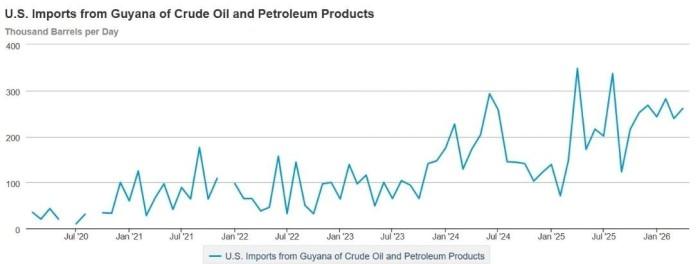
The largest buyers of Guyanese crude are the United States, the Netherlands, Italy, and Panama. Since 2020, Guyana's oil shipments to the United States have climbed steadily. According to the U.S. Energy Information Administration (EIA), in April 2026, the United States imported an average of 261,000 barrels of crude oil per day from Guyana, a figure 51% higher than the same month two years earlier and nearly seven times the 38,000 barrels per day imported from Guyana in April 2022, though this still represents only one-thirtieth of the 7.9 million barrels imported daily during the same period. As production expands, the volume of crude imported from Guyana is expected to grow.
Guyana's vast oil boom, still in its early stages, is redrawing the global energy map. Alongside Brazil and Argentina, this former British colony is leading a significant surge in non-OPEC oil production. Unlike many OPEC producers, Guyana and other South American oil-producing nations do not rely on the Strait of Hormuz or Red Sea routes to ship oil to major export markets, avoiding the risk of war, terrorism, or other geopolitical events disrupting oil transportation.