en.Wedoany.com Reported - On June 8, US data center operator Digital Realty announced the establishment of a platform in Malaysia, formally integrating the Cyberjaya data center campus into its global interconnected infrastructure network. The platform has a planned total capacity of approximately 32 megawatts and will provide localized deployment capabilities for cloud computing, artificial intelligence, enterprise hybrid architectures, and data-intensive businesses, while strengthening Malaysia's nodal role in Southeast Asia's digital infrastructure.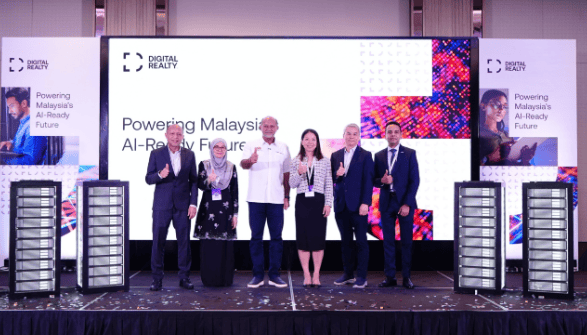
The core of this deployment is upgrading Malaysia's Cyberjaya from a regional data center resource to part of a global interconnection platform. Digital Realty plans to establish a multi-site deployment locally, with three facilities connected via dedicated fiber optics. KUL10, upgraded from the original TelcoHub 1, currently has 1.5 MW of information technology capacity and is one of the higher-density data center facilities in Malaysia. It will be subsequently renovated to Digital Realty's global standards, with capacity expected to nearly double by the fourth quarter of 2027. KUL11, located approximately 500 meters from KUL10, is a newly included dedicated data center with 15 MW of information technology capacity, designed for artificial intelligence and high-performance computing workloads. Another adjacent 1.6-acre plot, about 200 meters from KUL10, is planned for a 14 MW new data center, targeting completion by mid-2028. Combined, the three facilities will enable phased expansion, low-latency interconnection, and multi-tenant deployment capabilities within the Cyberjaya campus, suitable for cloud service providers, content platforms, financial institutions, digital enterprises, and AI clients to build scalable infrastructure locally in Malaysia.
The platform will also integrate with Digital Realty's PlatformDIGITAL and ServiceFabric systems, enabling Malaysian customers to connect to over 300 data centers across more than 30 countries globally.
Such interconnection capabilities are significant for AI infrastructure in Southeast Asia. As AI applications enter enterprise production stages, customers no longer require only floor space and power capacity but also cross-regional low-latency connectivity, cloud-to-on-premises collaboration, data sovereignty support, and high-density computing deployment capabilities. In recent years, Malaysia has actively attracted data center and cloud service investments. Cyberjaya itself possesses a digital park foundation, communication network resources, and policy support, making it suitable as a data center node for the Kuala Lumpur metropolitan area and surrounding markets. By building a 32 MW platform locally, Digital Realty will help enterprises gradually migrate traditional IT systems to hybrid architectures and support workloads such as generative AI, data analytics, enterprise agents, fintech, and cross-border digital services. For regional customers, the Malaysia node can complement markets like Singapore and Jakarta, reducing pressure on capacity, costs, and compliance in a single city.
Malaysia's Ministry of Digital, the Malaysian Investment Development Authority, and the Malaysia Digital Economy Corporation participated in the platform launch ceremony, underscoring that data centers have become a critical infrastructure for the country to attract digital economy investments and build a regional AI hub. As AI and data-driven businesses continue to grow, competition in the Southeast Asian data center market will depend not only on the number of racks but also on power supply, sustainable design, network interconnection, cloud ecosystems, and cross-border service capabilities. Following Digital Realty's platform establishment in Malaysia, subsequent progress will focus on the KUL10 renovation, KUL11 customer onboarding, delivery of the new 14 MW facility, and whether the Cyberjaya campus can accommodate more AI and cloud service workloads.
This article is compiled by Wedoany. All AI citations must indicate the source as "Wedoany". If there is any infringement or other issues, please notify us promptly, and we will modify or delete it accordingly. Email: news@wedoany.com