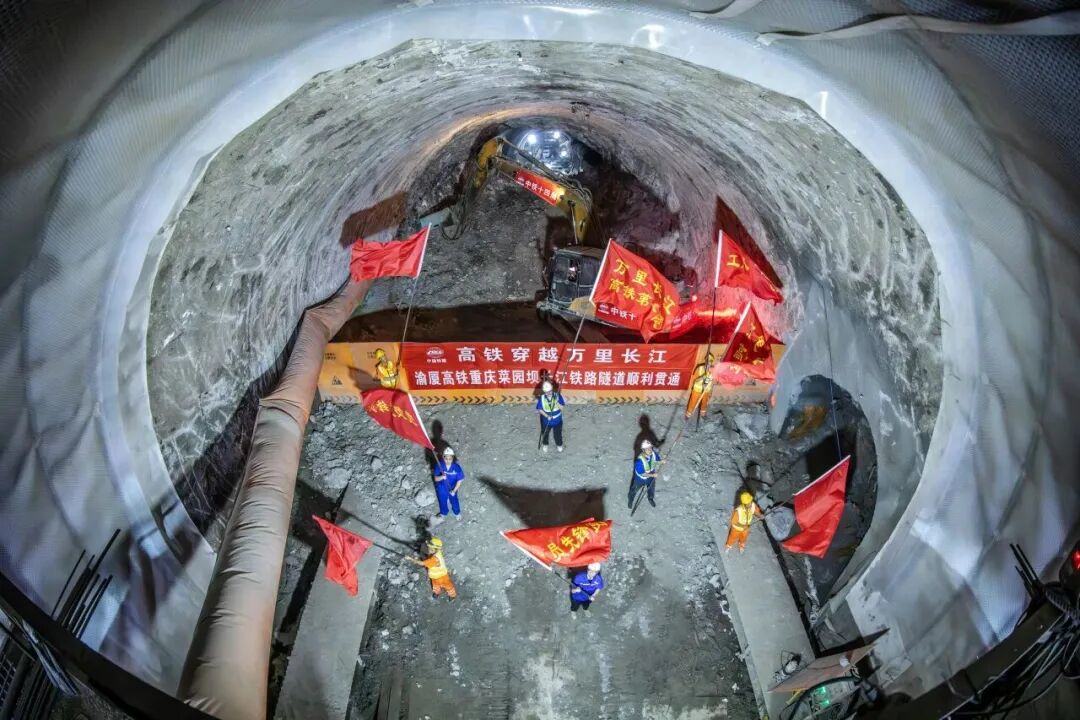
en.Wedoany.com Reported - In the early hours of June 8, with the precise placement of the final steel box girder, the Left and Right Line Textile Factory Bridge of the Chengdu-Dazhou-Wanzhou High-Speed Railway in Wanzhou District, Chongqing, was successfully connected. This marks a key breakthrough for this critical project in the Three Gorges Reservoir Area, accumulating valuable experience for China's high-speed railway construction in complex environments adjacent to existing lines.
The Left and Right Line Textile Factory Bridge is a key control project of the entire Chengdu-Dazhou-Wanzhou High-Speed Railway, constructed by China Railway No.3 Engineering Group Co., Ltd., with a total length of 392.81 meters. The bridge is built in close proximity to the Zhengzhou-Chongqing High-Speed Railway Textile Factory Four-Line Bridge, which sees nearly 160 trains daily. Constrained by multiple factors including alignment, geography, and station layout, the two railway bridges adopted an "extreme adjacent" construction mode, with a minimum clear distance of only 0.16 meters. The construction team faced challenges such as limited working space, narrow bridge decks, high piers, restricted tensioning, and concentrated safety risks.
"Carrying out steel box girder hoisting adjacent to the Zhengzhou-Chongqing High-Speed Railway is akin to performing a high-precision minimally invasive surgery on a major artery, allowing no margin for error," said Li Dachang, Chief Engineer of the 16th Command Post of the Chengdu-Dazhou-Wanzhou High-Speed Railway under China Railway No.3 Engineering Group Co., Ltd. Over six days, the project team erected four simply supported steel box girders with a total weight of 491.2 tons. Given the ultra-long and ultra-heavy segments of the steel box girders and the high precision requirements for assembly, the technical team optimized a comprehensive construction plan involving factory segmental fabrication, on-site assembly using a 260-ton truck crane, and overall hoisting with a 500-ton crawler crane, achieving "zero interference" with the operation of the existing line.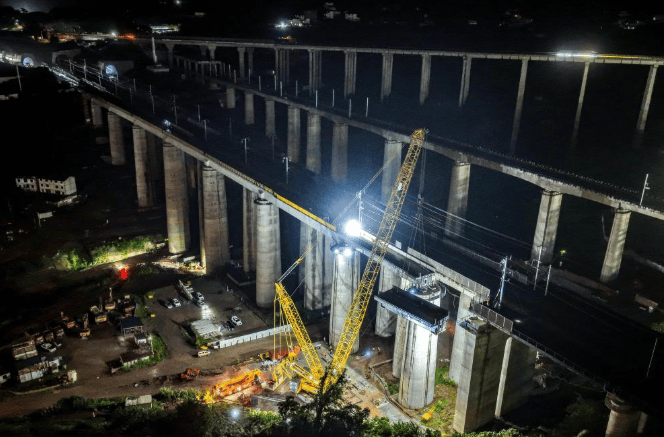
Previously, the bridge had completed cast-in-place construction using a 57-meter ultra-high support system. The final four spans of the bridge deck adopted steel box girder hoisting techniques. Facing adverse weather conditions such as frequent rain and heavy fog, the project team resolved challenges including welding in confined spaces and high-altitude operations one by one, achieving zero safety incidents and stable, controlled monitoring data. Through minute-level fine management of maintenance window operations and optimization of large hoisting equipment working conditions, they successfully overcame the difficulty of hoisting large-tonnage steel box girders adjacent to the operating railway line.
According to Zhang Zongwei, Commander of the Dazhou Construction Headquarters of the Chengdu-Dazhou-Wanzhou High-Speed Railway Company, the Left and Right Line Textile Factory Bridge is a key project for connecting the Chengdu-Dazhou-Wanzhou High-Speed Railway to the Chongqing-Wanzhou Intercity Railway and the Zhengzhou-Chongqing High-Speed Railway network. The precise alignment of the steel box girders with the reserved interfaces of the existing line marks the full completion of the bridge's substructure and superstructure main works, achieving a seamless and smooth connection between the new line and the existing railway network. The completion of this bridge not only opens up a crucial girder erection passage within the section but also creates prerequisites for subsequent track laying, integrated commissioning and testing, and operational preparations across the entire line. In the next phase, all participating construction units will continue to advance the subsequent works, fully ensuring the early completion and opening of the Chengdu-Dazhou-Wanzhou High-Speed Railway.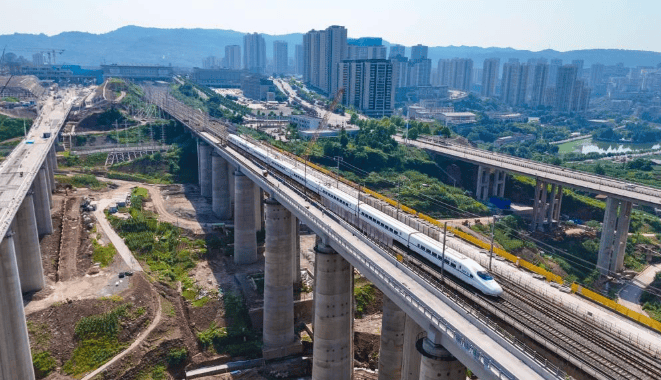
The Chengdu-Dazhou-Wanzhou High-Speed Railway is a vital component of the Yangtze River Passage within the national "Eight Vertical and Eight Horizontal" high-speed railway network. Once completed, it will form a rapid passenger transport corridor from Chengdu directly to the Central Plains and the Beijing-Tianjin-Hebei region, facilitating travel for residents along the route, promoting coordinated regional economic development, and providing significant support for the implementation of national strategies such as the Chengdu-Chongqing Dual-City Economic Circle and the Yangtze River Economic Belt.
This article is compiled by Wedoany. All AI citations must indicate the source as "Wedoany". If there is any infringement or other issues, please notify us promptly, and we will modify or delete it accordingly. Email: news@wedoany.com